The Space Feed | Latest Space News
  • Home
  • News
    • Launches
    • Space Technology
    • Human Spaceflight
    • Space Exploration
    • Astronomy
  • Launch Schedule
    • Upcoming Launches
    • Completed Launches
  • Knowledge Base
    • All Missions
    • All Rockets
No Result
View All Result
  • Home
  • News
    • Launches
    • Space Technology
    • Human Spaceflight
    • Space Exploration
    • Astronomy
  • Launch Schedule
    • Upcoming Launches
    • Completed Launches
  • Knowledge Base
    • All Missions
    • All Rockets
No Result
View All Result
The Space Feed | Latest Space News

JWST Spots Silane in Ancient Brown Dwarf, Solving a Giant-Planet Silicon Mystery

September 9, 2025
in Astronomy

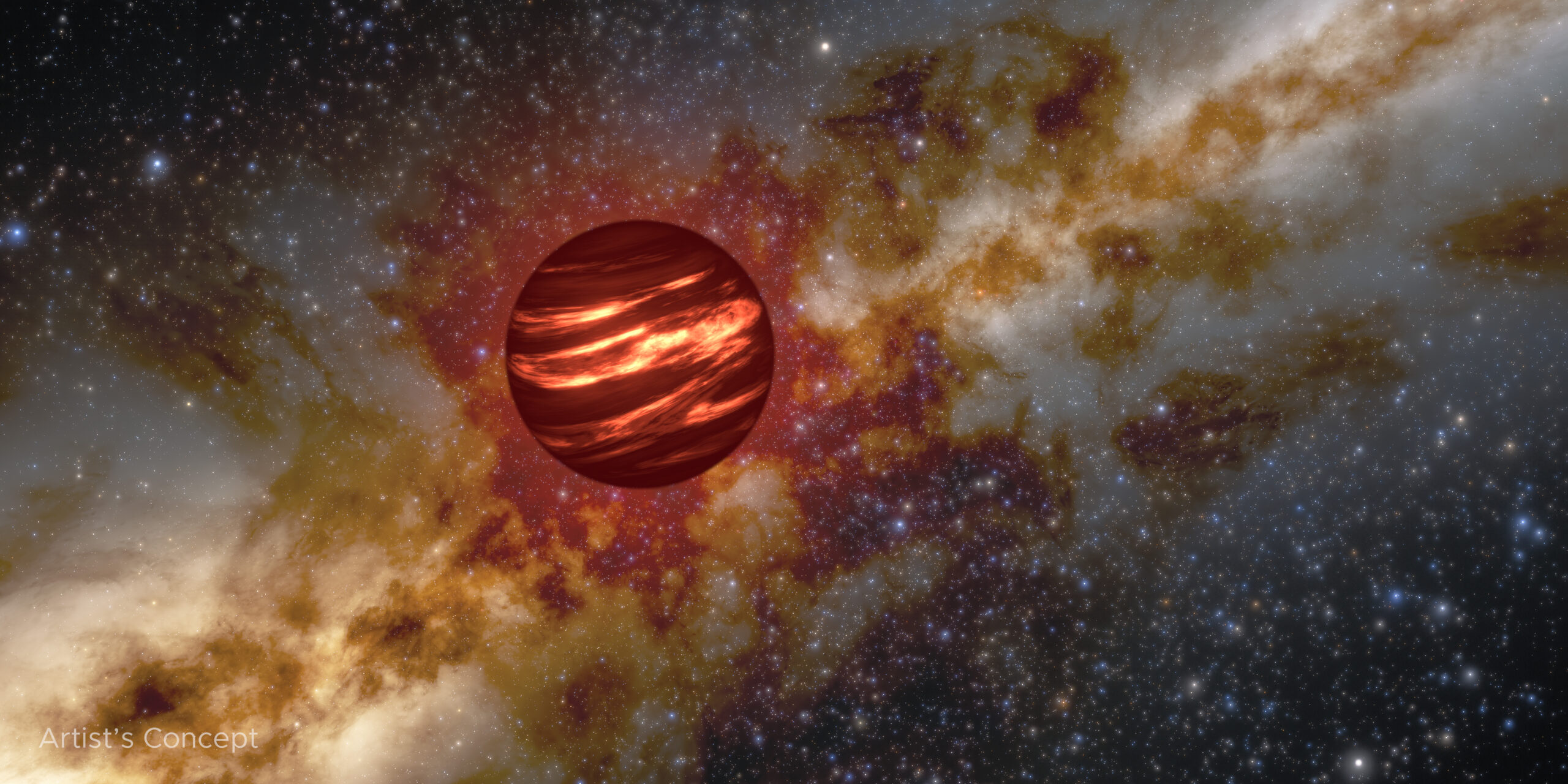
NASA’s James Webb Space Telescope has identified spectral fingerprints of silane (SiH4) in the atmosphere of an ancient brown dwarf known as “The Accident”, offering a new explanation for why silicon-bearing molecules remain elusive in the visible layers of Jupiter, Saturn, and many giant exoplanets. The findings, published Sept. 4, 2025, in Nature, suggest that oxygen availability is a key control on silicon chemistry in giant-planet atmospheres. Source: NASA.

What Webb saw

The brown dwarf informally dubbed The Accident was discovered in 2020 by a citizen-science effort using data from WISE/NEOWISE. Located roughly 50 light-years away and likely 10–12 billion years old, it is unusually faint and chemically peculiar. Webb’s infrared spectroscopy revealed features consistent with silane, marking the first clear identification of this molecule in a brown dwarf. Brown dwarfs sit between planets and stars in mass, cool over time, and provide clean laboratories for atmospheric chemistry without the glare of a host star.

Why silicon hides in giant planets

Silicon is abundant in the cosmos, yet silicon-bearing gases are rarely detected in the upper atmospheres of Jupiter- and Saturn-class worlds. At moderate to high oxygen levels, silicon tends to bond with oxygen to form silicates and oxides. On hot giants, these compounds can condense into mineral clouds; on cooler giants, they sink to deeper layers beneath water and ammonia clouds, pushing silicon chemistry below observable altitudes.

The Accident appears to be different because it formed when the universe contained less oxygen-rich material. In an oxygen-poor atmosphere, silicon more readily bonds with hydrogen, allowing silane to persist higher in the atmosphere where telescopes can see it. Webb’s detection supports this oxygen-limited pathway and provides a benchmark for interpreting non-detections of silicon molecules in other giant atmospheres.

Key implications

  • Chemical pathways: Oxygen scarcity can favor silane over silicates, altering expected gas abundances.
  • Retrieval models: Atmospheric models for brown dwarfs and exoplanets may need updated priors for silicon chemistry and cloud formation as a function of metallicity and C/O ratio.
  • Solar system context: The result is consistent with silicon being sequestered at depth in Jupiter and Saturn, beyond current observational reach.
  • Brown dwarfs as analogs: Solo brown dwarfs offer clearer spectra than star-lit exoplanets, enabling tests of chemistry relevant to many giant worlds.

Instruments and missions behind the result

Webb’s broad infrared coverage and sensitivity enabled a decisive look at The Accident’s faint spectrum. The object was initially flagged in all-sky data from the Wide-field Infrared Survey Explorer (WISE), later extended as NEOWISE. Together, these missions provided discovery and follow-up pathways linking archival surveys and state-of-the-art spectroscopy.

What’s next

Targeted surveys can now search for silane across older, metal-poor brown dwarfs and giant exoplanets to map where oxygen-limited chemistry emerges. Improved laboratory measurements of silane and silicate opacities, combined with multi-wavelength observations, will refine constraints on temperature, composition, and cloud structure. Comparative studies with Jupiter and Saturn will help determine how deep sequestration and vertical mixing shape observable silicon species.

For full study details and mission context, see NASA’s summary: NASA: JWST study of ‘The Accident’.

Previous Post

ISS Sets Back-to-Back Resupply Ops: Progress 93 Docking, NG-23 Cygnus on Deck

Next Post

NASA–KX AI Predicts Satellite-Disrupting Solar Storms a Day in Advance

Related Posts

Astronomy

LOFAR and XMM-Newton confirm coronal mass ejection from a red dwarf, threatening exoplanet atmospheres

November 12, 2025
Astronomy

PLATO Assembly Complete; Final Tests Ahead of 2026 Ariane 6 Launch

October 10, 2025
Astronomy

Protoplanet WISPIT 2b Imaged Inside Disk Gap, Marking a Planet-Formation First

October 1, 2025
Astronomy

Gaia maps a massive stellar ripple sweeping the Milky Way’s outer disk

September 30, 2025
Astronomy

Webb Spots Carbon-Rich Circumplanetary Disk Around CT Cha b, Illuminating Moon Formation

September 29, 2025
Astronomy

JWST maps carbon chemistry in circumplanetary disk around CT Cha b, a likely moon nursery

September 29, 2025
Next Post

NASA–KX AI Predicts Satellite-Disrupting Solar Storms a Day in Advance

Leave a Reply Cancel reply

Your email address will not be published. Required fields are marked *

  • Trending
  • Comments
  • Latest

NASA and SpaceX Conduct Crew-11 Dry Run Ahead of Launch

July 29, 2025

SpaceX Dragon Missions: Crew Prepares for Departure and Arrival at ISS

July 30, 2025

NASA Advances Supersonic Parachute Technology for Mars Missions

July 30, 2025

Upcoming Suborbital Rocket Launches from NASA Wallops: July 28-August 8, 2025

July 28, 2025

Dragonfly Mission Hits Major Test Milestones, Targets 2028 Falcon Heavy Launch

1

ESA Initiates Construction of LISA Mission to Detect Gravitational Waves

0

UK-France MicroCarb Satellite Launches to Enhance Global CO₂ Monitoring

0

NASA’s SpaceX Crew-11 Arrives at Kennedy Space Center for Upcoming Launch

0

ESCAPADE Reset to Nov. 13 After G4 Storm; Blue Origin VADR Launch Preserves Mars Trajectory

November 13, 2025

Brazil, INPE and ESA plan uptake of Biomass P-band radar data for Amazon carbon monitoring

November 13, 2025

LOFAR and XMM-Newton confirm coronal mass ejection from a red dwarf, threatening exoplanet atmospheres

November 12, 2025

DLR’s MAPHEUS-16 Sets Microgravity Payload Record with Twin Red Kite Motors

November 12, 2025

Popular Stories

  • NASA and SpaceX Conduct Crew-11 Dry Run Ahead of Launch

    0 shares
    Share 0 Tweet 0
  • SpaceX Dragon Missions: Crew Prepares for Departure and Arrival at ISS

    0 shares
    Share 0 Tweet 0
  • NASA Advances Supersonic Parachute Technology for Mars Missions

    0 shares
    Share 0 Tweet 0
  • Upcoming Suborbital Rocket Launches from NASA Wallops: July 28-August 8, 2025

    0 shares
    Share 0 Tweet 0
  • SpaceX Crew-11 Prepares for Launch: Final Steps Before Hatch Closure

    0 shares
    Share 0 Tweet 0
  • About
  • Advertise
  • Privacy & Policy
  • Contact
The Space Feed

© 2025 Stride Interactive Group

No Result
View All Result
  • Home
  • News
    • Launches
    • Space Technology
    • Human Spaceflight
    • Space Exploration
    • Astronomy
  • Launch Schedule
    • Upcoming Launches
    • Completed Launches

© 2025 Stride Interactive Group