The International Space Station advanced a slate of human health and space biology experiments as Expedition 73 prepared for a rare back-to-back pair of cargo arrivals. With Roscosmos’ Progress 93 and Northrop Grumman’s Cygnus XL queued for launch on opposite sides of the globe, the orbital laboratory balanced daily science with upcoming logistics and robotics operations.
Two resupply missions on the clock
The station is set for consecutive deliveries spanning three days, adding food, fuel, hardware, and new research payloads to support long-duration missions.
- Progress 93 launch: Thursday, 11:54 a.m. EDT from Baikonur Cosmodrome, Kazakhstan; docking to the Zvezda service module on Saturday at 1:27 p.m. EDT. The freighter carries about 2.8 tons of cargo and is planned to remain docked for roughly six months.
- Cygnus XL launch: Sunday, Sept. 14, 6:11 p.m. EDT on a SpaceX Falcon 9 from Cape Canaveral Space Force Station, Florida. The spacecraft will deliver more than 11,000 pounds of experiments and station hardware.
- Robotic capture and berthing: Wednesday, Sept. 17, 6:35 a.m. EDT capture by Canadarm2 from the Cupola workstation, followed by ground-controlled installation to the Unity module’s Earth-facing port about 90 minutes later for a planned six-month stay.
Health and life science at the forefront
Researchers continued investigations designed to protect astronaut health on deep-space missions while advancing medical knowledge on Earth. Cardiovascular, skeletal, nutritional, and plant biology studies highlighted the day’s agenda.
- CIPHER Vascular Echo: Ultrasound and sensor data documented changes in arterial stiffness and cardiac function in microgravity, informing countermeasures for long-duration flight.
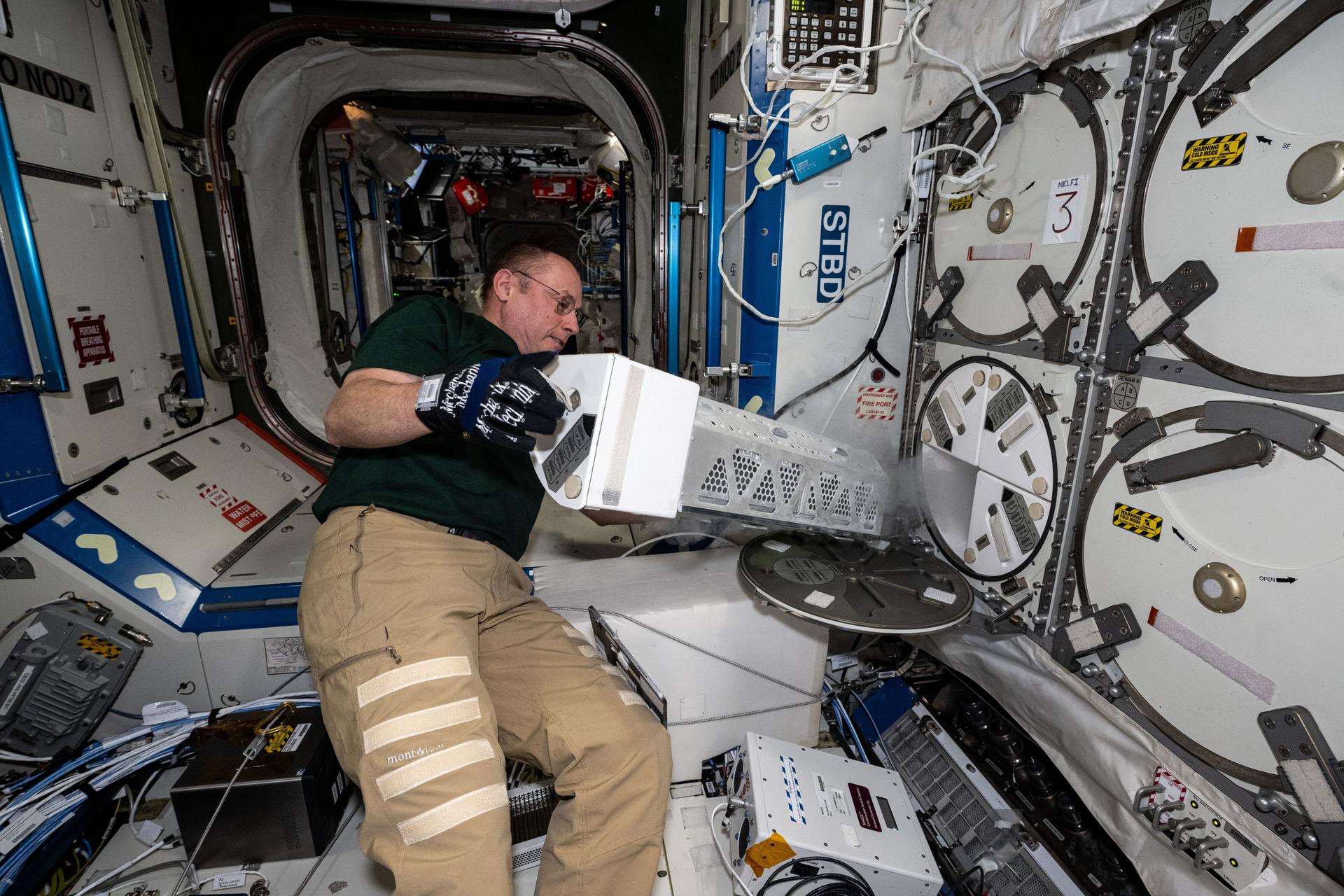
- Bone stem cell adaptation: Samples were processed in the Microgravity Science Glovebox and preserved in the Minus Eighty-Degree Laboratory Freezer for ISS (MELFI), supporting future therapies for bone loss in space and on Earth.
- BioNutrients-3: Crewmembers treated yeast, yogurt, and fermented milk samples in an incubator to evaluate on-demand biomanufacturing of vitamins and nutrients during missions far from resupply.
- Space botany and cell division: Algae cell samples were conditioned for later imaging in JAXA’s COSMIC fluorescent microscope to assess how microgravity alters plant cell division and microstructures, informing future in-space crop production.
Systems, physics, and Earth observation
Cosmonauts configured physics research hardware in the Nauka module to support propulsion and plasma technology studies, while maintenance in the Zarya module kept the station’s power systems in peak condition. An afternoon Earth observation session targeted glaciers in South America and mountain ranges in Africa, contributing to long-running datasets on environmental change.
Why this cadence matters
Consecutive Progress and Cygnus arrivals sustain a robust research tempo and operational resilience aboard the ISS. The cargo sequence refreshes life support consumables, delivers critical spares, and introduces fresh investigations that probe cardiovascular adaptation, bone health, nutrition, and plant growth. These findings help refine countermeasures for crews headed to the Moon and Mars while yielding potential benefits for patients and agriculture on Earth.
For additional mission details and timelines, see the NASA source: Biology, Botany Research Advancing Health as Two Resupply Missions Near Launch.