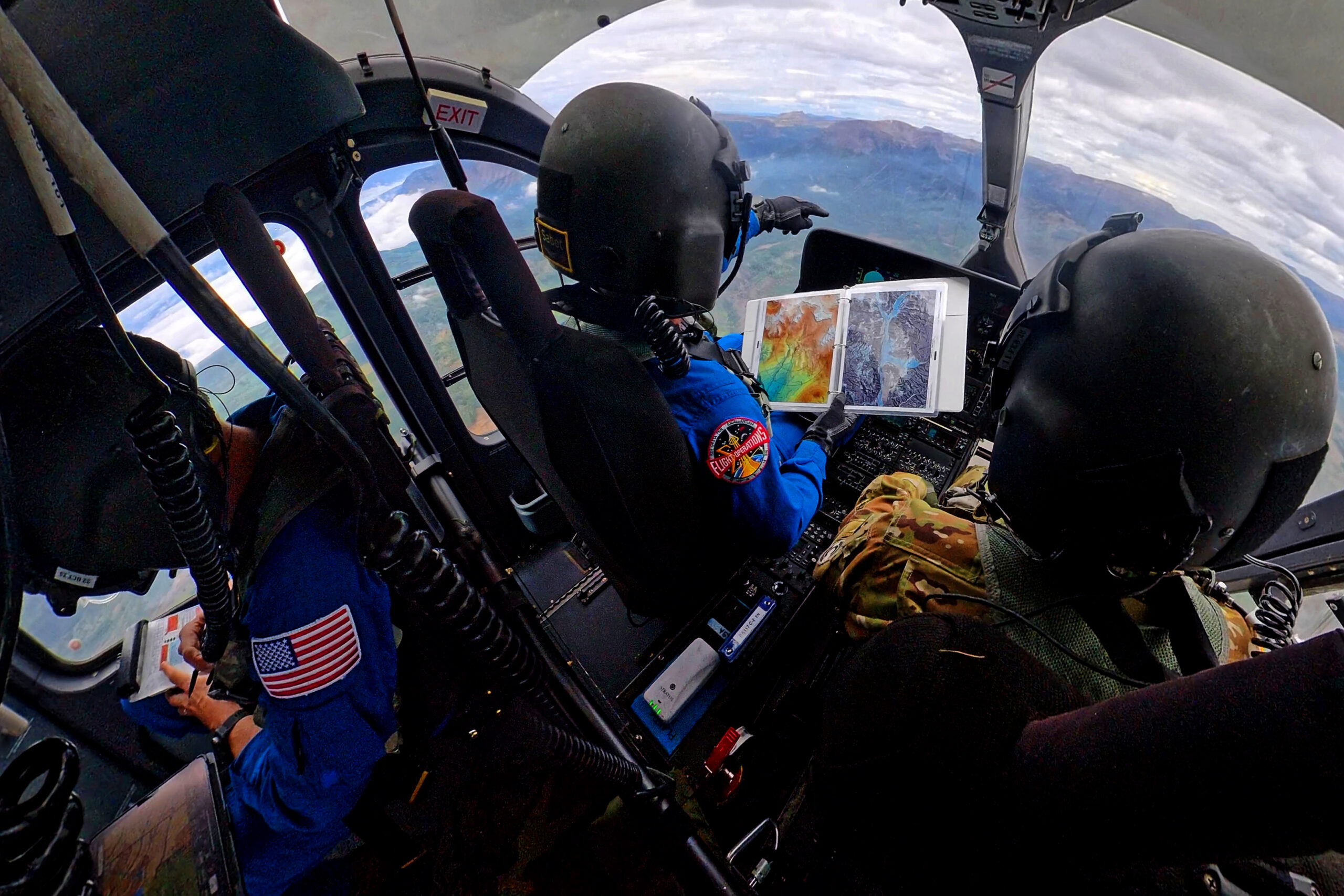
NASA has certified a helicopter-based lunar lander training course in Colorado, establishing a new field standard to prepare Artemis crews for approach and landing operations. The curriculum, developed with the Colorado Army National Guard at the High-Altitude Army National Guard Aviation Training Site (HAATS) near Gypsum, underwent a two-week certification run in late August and is now cleared to support upcoming Artemis missions. Source: NASA.
Why Colorado’s Mountains
Northern Colorado’s steep ridgelines, deep valleys, and rapidly changing weather create visual and handling challenges that mirror lunar approach conditions. Snow and dust routinely produce degraded visual environments (DVE), offering a practical analog to lunar dust that can obscure terrain and force pilots to transition to instruments near touchdown.
What the Certification Involved
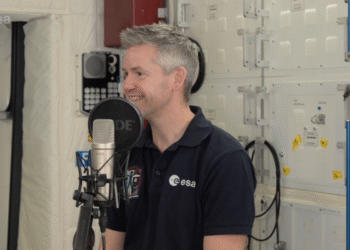
NASA astronauts Mark Vande Hei and Matthew Dominick alternated pilot and navigator roles to validate procedures, crew coordination, and mission-relevant decision-making. Flight crew trainers, mission control leads, and Human Landing System (HLS) operational experts from NASA Johnson accompanied sorties to assess instruction quality, training realism, and applicability to crewed lunar landings.
- Aircraft employed: LUH-72 Lakota, CH-47 Chinook, UH-60 Black Hawk.
- Training profiles: mountaintop and valley landing zones, sloped terrain operations, DVE approaches, and instrument transitions when external cues degrade.
- Competencies assessed: hazard identification, risk evaluation, crew communications, workload management, and precision landing.
How It Trains for Lunar Landings
The course emphasizes high-fidelity crew coordination and rapid risk trades during final descent—conditions expected during Artemis landings where dust plumes and low-angle lighting can mask obstacles. Progressive difficulty across landing zones builds proficiency in handling ambiguous cues, steep approaches, and partial loss of visibility—key elements for controlling a lander in an unfamiliar terrain with limited margins.
Artemis III Mission Context
Training aligns with the Artemis III architecture, which is designed to return humans to the lunar surface and expand operations near the south pole.
- Orion launches on the Space Launch System to the Moon.
- Orion rendezvous and docks with SpaceX’s Starship Human Landing System in lunar orbit.
- Two astronauts transfer to the lander for descent.
- Surface operations occur at high-priority science sites.
- The lander ascends to lunar orbit for docking with Orion.
- Orion returns the crew to Earth.
Program Status and Next Steps
In development since 2021, the course has now trained and evaluated more than two dozen NASA astronauts, including the latest participants Vande Hei and Dominick, and one ESA astronaut. The certification enables year-round training, leveraging seasonal snow and dust to stress-test procedures. NASA plans continued refinement based on operational feedback to further reduce landing risk and strengthen crew safety margins for the Human Landing System campaign.