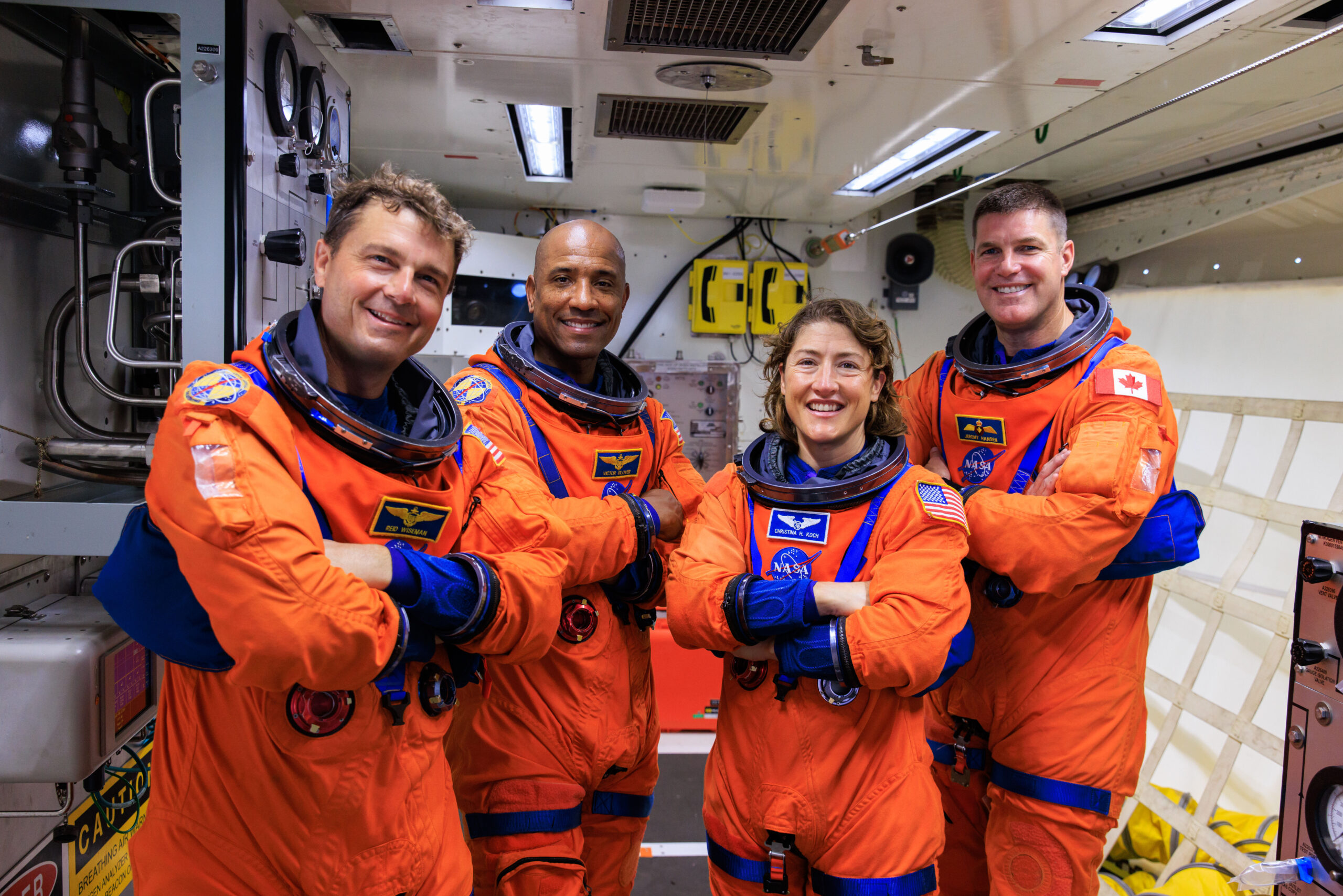
NASA is preparing the Artemis II test flight to function as both a crewed lunar flyby and a deep-space science campaign. The four-person crew — NASA astronauts Reid Wiseman, Victor Glover, Christina Koch, and Canadian Space Agency astronaut Jeremy Hansen — will operate and participate in research designed to refine human health countermeasures, quantify radiation risks inside Orion, evaluate real-time lunar science operations, and deploy international CubeSats. Insights from the mission are intended to derisk future Artemis surface sorties and inform planning for eventual Mars expeditions.
Human Health Investigations
Artemis II will extend biomedical research beyond low Earth orbit with an integrated portfolio focused on performance, immunity, and individualized risk assessment:
- ARCHeR (Artemis Research for Crew Health and Readiness): Wearable devices and pre-/post-flight assessments will characterize sleep, stress, cognition, behavior, and teamwork in a deep-space environment, where factors differ from the International Space Station.
- Immune Biomarkers: Dry and liquid saliva sampling, supplemented by blood draws pre- and post-flight, will track immune changes and potential reactivation of latent viruses under heightened radiation and isolation stressors.
- AVATAR (A Virtual Astronaut Tissue Analog Response): Organ-on-a-chip devices made from crew-derived bone marrow cells will probe individual responses to microgravity and radiation beyond the Van Allen belts, supporting validation of personalized medical approaches.
- Spaceflight Standard Measures: A common dataset spanning nutrition, cardiovascular function, vestibular and balance tests, muscle performance, ocular and brain health, microbiome, and motion sickness will enable cross-mission comparisons via NASA’s Life Sciences Data Archive.
Radiation Monitoring Inside Orion
Building on Artemis I, Orion will carry six Hybrid Electronic Radiation Assessors at distributed cabin locations, while each astronaut wears a personal dosimeter. The system will provide real-time awareness of solar-driven space weather. In collaboration with DLR, four upgraded M-42 EXT instruments will add higher-resolution spectral discrimination, including heavy ions, to refine exposure models and guide protective procedures, such as ad hoc shielding if needed.
Lunar Observations and Real-Time Science Ops
During the lunar flyby, the crew will photograph and document surface features, leveraging human sensitivity to color and texture to complement orbital datasets. Observation opportunities depend on launch timing and lighting conditions, with potential views of the far side. Artemis II will also pioneer integrated science flight control support, with a mission control science officer coordinating experts in cratering, volcanism, tectonism, and volatiles to prioritize targets and capture standardized datasets for future surface missions.
International CubeSats on SLS
Four secondary payloads will deploy from the SLS upper stage into high Earth orbit before maneuvering to operational altitudes. Each targets environmental factors critical to human exploration and lunar systems engineering:
- ATENEA (Argentina/CONAE): Characterizes radiation doses under varied shielding, maps spectrum near Earth, collects GPS data for trajectory optimization, and validates long-range communications.
- K-Rad Cube (Korea/KASA): Uses tissue-equivalent dosimetry to evaluate biological radiation effects across altitudes including the Van Allen belts.
- Space Weather CubeSat (Saudi Space Agency): Monitors radiation, solar X-rays, energetic particles, and magnetic fields over a range of distances.
- TACHELES (Germany/DLR): Measures space environment impacts on electronic components to harden future lunar vehicle designs.
Program Context and Schedule
Artemis II is the first crewed flight of Orion and the Space Launch System, targeting no later than April 2026. The mission is structured to validate life-support operations while returning high-value datasets on human performance and radiation in cislunar space, plus lessons for human-in-the-loop science. Combined results are expected to sharpen medical protocols, onboard sensing strategies, and surface science playbooks for Artemis III and beyond.
Source: NASA mission overview