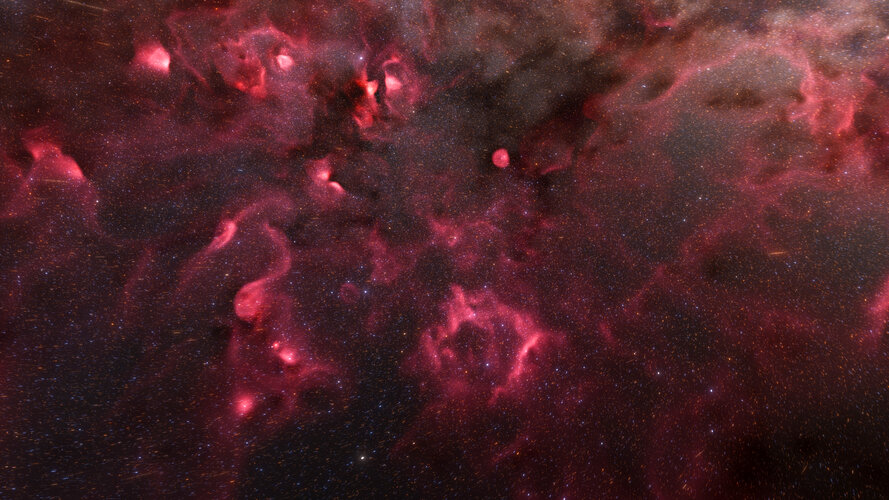
Europe’s Gaia mission has enabled the most detailed 3D atlas to date of nearby stellar nurseries and ionised gas in the Milky Way, charting the structure of dust and hot, young star environments out to roughly 4000 light-years from the Sun. Built from Gaia’s precision measurements of stellar positions, distances and light extinction, the atlas reconstructs where interstellar dust resides and infers where ionised hydrogen is present—key tracers of ongoing star formation.
What Gaia mapped
The new model synthesises Gaia observations of 44 million ordinary stars with a curated set of 87 O-type stars, whose intense ultraviolet radiation carves and illuminates surrounding gas. By combining these datasets, researchers produced a coherent picture of local star-forming regions and ionisation bubbles around massive stars.
- 3D distribution of interstellar dust and associated ionised gas across the solar neighbourhood, centred on the Sun.
- Coverage extends to approximately 4 kly, providing a contiguous, top-down view of local Galactic structure.
- Identification and context for well-known complexes, including the Gum Nebula, North America Nebula, California Nebula and the Orion–Eridanus superbubble.
- Evidence that some clouds have opened, with streams of gas and dust venting into a large, low-density cavity.
How the 3D atlas was built
Gaia does not image cold clouds directly. Instead, it measures the dimming of starlight by dust (extinction) and the precise distances to those stars. Inverting these data yields a volumetric dust map. The locations and luminosities of nearby O-type stars are then used to estimate regions where hydrogen is likely ionised (H II), consistent with characteristic emission at the H-alpha spectral line (656.3 nm). This fusion of dust distribution and ionising radiation sources produces a physically grounded view of where star formation feedback is shaping the interstellar medium.
Why it matters
The atlas provides a quantitative framework for studying how massive stars sculpt their natal environments: how far their radiation penetrates, where cavities and superbubbles link, and how ionisation fronts interact with cold molecular clouds. It improves constraints on feedback-driven turbulence, cloud dispersal and triggered star formation, and offers a more realistic local context for simulations of the Milky Way’s disk. The 3D perspective also aligns disparate 2D observations across optical, infrared and radio wavelengths, enabling more robust cross-survey comparisons.
What comes next
High-resolution reconstruction demanded substantial computation and was limited to about 4 kly for this release. The methodology is designed to scale with forthcoming Gaia data, and future expansions are expected as the mission delivers improved astrometry and photometry. The work builds on prior 3D dust mapping and incorporates a new census of nearby hot stars to visualise ionised regions with greater fidelity.
Data and resources
Agency overview and media, including interactive visualisations and fly-throughs, are available via the European Space Agency: ESA source. Technical details and validation are presented in peer-reviewed publications in Monthly Notices of the Royal Astronomical Society: MNRAS Letters and MNRAS.