The Space Feed | Latest Space News
  • Home
  • News
    • Launches
    • Space Technology
    • Human Spaceflight
    • Space Exploration
    • Astronomy
  • Launch Schedule
    • Upcoming Launches
    • Completed Launches
  • Knowledge Base
    • All Missions
    • All Rockets
No Result
View All Result
  • Home
  • News
    • Launches
    • Space Technology
    • Human Spaceflight
    • Space Exploration
    • Astronomy
  • Launch Schedule
    • Upcoming Launches
    • Completed Launches
  • Knowledge Base
    • All Missions
    • All Rockets
No Result
View All Result
The Space Feed | Latest Space News

ESA’s P-band Biomass Mission Sets Out to Map Global Forest Carbon and Structure

September 18, 2025
in Space Technology

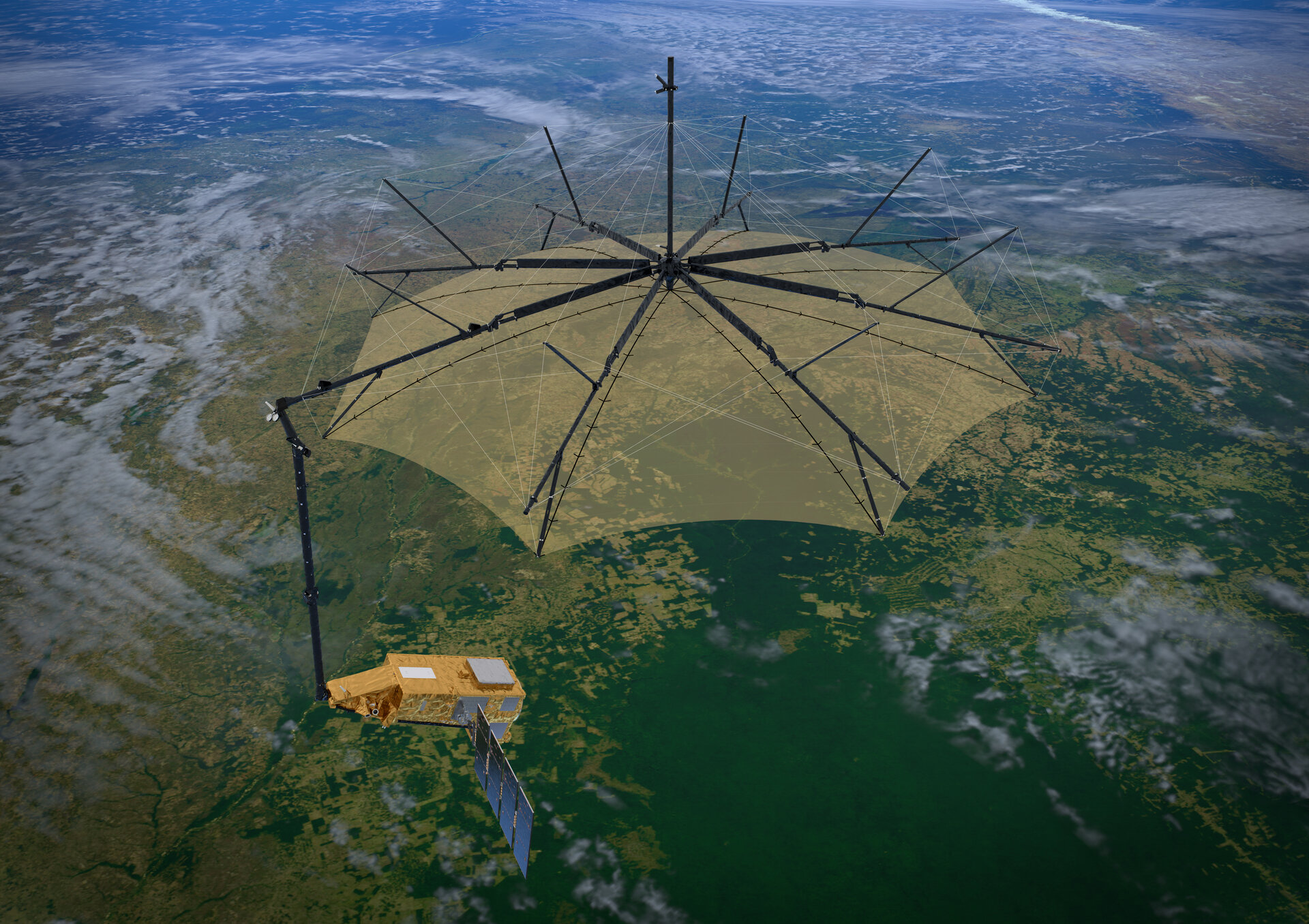
Europe’s Biomass satellite has begun a global effort to quantify the carbon stored in the world’s forests, following its launch on 29 April aboard a Vega-C rocket from the Guiana Space Centre. Developed by the European Space Agency with strong support from CNES and a broad research community, the mission is the first to fly a spaceborne P-band radar, designed to retrieve key biophysical variables that define forest structure and carbon stocks.

How P-band sees through the canopy

Biomass operates at approximately 435 MHz with a wavelength near 70 cm, allowing radar signals to penetrate foliage and interact with branches and trunks, reaching depths of up to roughly 40 meters in dense forests. Instead of producing conventional images, the mission focuses on retrieving quantitative parameters from the radar signal. Dedicated processing chains are designed to correct for ionospheric and environmental effects and to convert radar returns into geophysical measurements relevant to the carbon cycle and climate modeling.

Core data products

The mission will generate four primary products intended for wide scientific and policy use:

  • Above-Ground Biomass (AGB) expressed in tonnes of carbon per hectare.
  • Forest height, enabling three-dimensional assessments of structure.
  • Forest disturbances detected through repeat coverage, including deforestation and fire impacts.
  • Digital Terrain Model (DTM) beneath dense vegetation, revealing underlying topography.

To minimize signal disturbances linked to plant water dynamics, the satellite overflies target regions near 6:00 a.m. local time. Repeated observations will enable time-series analyses to track changes and refine biomass estimates, and will be complementary to other missions such as NISAR.

Built by and for science

Biomass was conceived to answer specific scientific questions about forest carbon and structure. Years of preparatory work anchored the mission’s approach, including airborne campaigns like TropiSAR and surveys in Central and West Africa that demonstrated the feasibility of mapping forest structure in three dimensions with P-band radar. These efforts informed instrument design, observation strategy and the development of inversion algorithms that translate radar measurements into AGB and height across diverse forest types.

Ground truth and a global inventory

Extensive field measurements underpin the mission’s calibration and validation. Through the GEO-TREES initiative, research teams are assembling standardized datasets—such as tree height, trunk diameter and species composition—across global plots. This harmonized corpus enables cross-comparison and consistent validation of satellite products, strengthening the reliability of biomass maps intended for climate assessments and national reporting.

Beyond forests

While designed for forest science, the long-wavelength radar may also reveal features hidden beneath ice or dry sand, such as buried channels or subglacial structures, opening ancillary avenues for geoscience. These secondary targets will not detract from the mission’s central objective of quantifying forest carbon and structure with unprecedented coverage.

What to watch next

Following launch, Biomass is proceeding through commissioning, calibration and validation before routine data release. Its datasets are expected to support carbon accounting, inform land-use policy, and refine climate models by providing consistent global measurements of forest biomass, height and change. The mission’s results will be closely watched by both the scientific community and stakeholders in conservation and sustainable resource management.

Source: CNES
Previous Post

ISS Canadarm2 Grapples Cygnus XL for Berthing to Unity Nadir Port

Next Post

Historic Diamant Pad Reborn as Multi-Launcher Hub for European Micro-Launchers

Related Posts

Space Technology

DLR’s MAPHEUS-16 Sets Microgravity Payload Record with Twin Red Kite Motors

November 12, 2025
Space Technology

ESA flags X5.1 flare and fast CMEs driving severe G4 storm with satellite and GNSS risk

November 12, 2025
Space Technology

Sentinel-1D Lifts Off on Ariane 62; DLR to Calibrate SAR for Copernicus Continuity

November 5, 2025
Space Technology

ESA’s AI quake-mapping models move toward operational use under CNES-led Charter

October 29, 2025
Space Technology

ESA’s Henon CubeSat clears CDR to demo deep-space comms, ion propulsion, and solar-storm early warning

October 29, 2025
Space Technology

ISS study maps fin-film condensation to advance spacecraft cooling systems

October 23, 2025
Next Post

Historic Diamant Pad Reborn as Multi-Launcher Hub for European Micro-Launchers

Leave a Reply Cancel reply

Your email address will not be published. Required fields are marked *

  • Trending
  • Comments
  • Latest

NASA and SpaceX Conduct Crew-11 Dry Run Ahead of Launch

July 29, 2025

SpaceX Dragon Missions: Crew Prepares for Departure and Arrival at ISS

July 30, 2025

NASA Advances Supersonic Parachute Technology for Mars Missions

July 30, 2025

Upcoming Suborbital Rocket Launches from NASA Wallops: July 28-August 8, 2025

July 28, 2025

Dragonfly Mission Hits Major Test Milestones, Targets 2028 Falcon Heavy Launch

1

ESA Initiates Construction of LISA Mission to Detect Gravitational Waves

0

UK-France MicroCarb Satellite Launches to Enhance Global CO₂ Monitoring

0

NASA’s SpaceX Crew-11 Arrives at Kennedy Space Center for Upcoming Launch

0

ESCAPADE Reset to Nov. 13 After G4 Storm; Blue Origin VADR Launch Preserves Mars Trajectory

November 13, 2025

Brazil, INPE and ESA plan uptake of Biomass P-band radar data for Amazon carbon monitoring

November 13, 2025

LOFAR and XMM-Newton confirm coronal mass ejection from a red dwarf, threatening exoplanet atmospheres

November 12, 2025

DLR’s MAPHEUS-16 Sets Microgravity Payload Record with Twin Red Kite Motors

November 12, 2025

Popular Stories

  • NASA and SpaceX Conduct Crew-11 Dry Run Ahead of Launch

    0 shares
    Share 0 Tweet 0
  • SpaceX Dragon Missions: Crew Prepares for Departure and Arrival at ISS

    0 shares
    Share 0 Tweet 0
  • NASA Advances Supersonic Parachute Technology for Mars Missions

    0 shares
    Share 0 Tweet 0
  • Upcoming Suborbital Rocket Launches from NASA Wallops: July 28-August 8, 2025

    0 shares
    Share 0 Tweet 0
  • SpaceX Crew-11 Prepares for Launch: Final Steps Before Hatch Closure

    0 shares
    Share 0 Tweet 0
  • About
  • Advertise
  • Privacy & Policy
  • Contact
The Space Feed

© 2025 Stride Interactive Group

No Result
View All Result
  • Home
  • News
    • Launches
    • Space Technology
    • Human Spaceflight
    • Space Exploration
    • Astronomy
  • Launch Schedule
    • Upcoming Launches
    • Completed Launches

© 2025 Stride Interactive Group