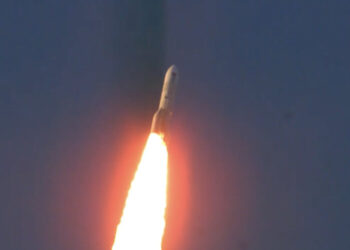
Fueling operations are underway at Launch Complex 39A, where a SpaceX Falcon 9 is preparing to lift off with NASA’s IMAP observatory, the Carruthers Geocorona Observatory (Carruthers GEO), and NOAA’s SWFO‑L1 satellite. According to a NASA fueling update, teams gave the go to begin first‑stage loading less than 40 minutes before the targeted 7:30 a.m. EDT liftoff from Kennedy Space Center, Florida. RP‑1 (rocket‑grade kerosene) is flowing into the first stage, liquid oxygen loading is in progress, and second‑stage propellant loading will begin shortly.
What’s riding to space
- IMAP (Interstellar Mapping and Acceleration Probe): A heliophysics mission designed to chart the boundary where the solar wind meets the local interstellar medium and to investigate how particles are accelerated across the heliosphere. The spacecraft is set to head toward a trajectory near the Sun–Earth L1 region after separation.
- Carruthers Geocorona Observatory (Carruthers GEO): A NASA smallsat focused on ultraviolet observations of Earth’s extended hydrogen envelope, the geocorona, to improve understanding of the interface between our atmosphere and space.
- NOAA SWFO‑L1: The Space Weather Follow On mission destined for the Sun–Earth L1 point to deliver continuous solar wind measurements and solar imagery that support operational space‑weather forecasting.
Countdown status and next milestones
With first‑stage fueling underway, the countdown is proceeding through standard Falcon 9 prelaunch steps. Key events typically include:
- Completion of RP‑1 and liquid oxygen loading on both stages.
- Engine chilldown to thermally condition the nine Merlin engines.
- Strongback retraction ahead of terminal count.
- Falcon 9 startup in the final minute and ignition at T0, pending final range and vehicle checks.
Launch timing and trajectory
Liftoff is targeted for 7:30 a.m. EDT from LC‑39A. After ascent and stage separation, Falcon 9 will deploy the payloads to their respective transfer trajectories. IMAP and SWFO‑L1 are planned for operations near the Sun–Earth L1 point, while Carruthers GEO will proceed to its mission orbit to study Earth’s geocorona.
Why this flight matters
Together, these missions advance heliophysics and space‑weather readiness. IMAP’s maps of the heliosphere will help reveal how our star interacts with interstellar space. SWFO‑L1’s continuous monitoring is designed to enhance forecasting of solar storms that can impact satellites, power grids, and communications. Carruthers GEO will deliver new data on the outermost reach of Earth’s atmosphere, informing models that connect our planet to the broader space environment.
NASA’s live updates on fueling and countdown progress are available via the agency’s blog: NASA fueling update.