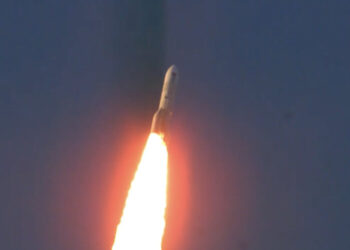
SpaceX’s Falcon 9 has cleared a key early-flight milestone for NASA’s IMAP mission, passing Max Q before completing main engine cutoff, first-stage separation, and fairing deployment. The second stage is continuing its ascent to deliver the Interstellar Mapping and Acceleration Probe and two rideshare payloads to their target orbit following liftoff from Launch Complex 39A at NASA’s Kennedy Space Center in Florida.
Launch status at a glance
- Vehicle passed peak dynamic pressure (Max Q) early in ascent.
- Main engine cutoff occurred as planned, followed by successful first-stage separation.
- Payload fairing jettison confirmed, exposing IMAP and two rideshares for orbital insertion.
- Second stage remains in powered flight to place the payload stack on the intended trajectory.
- The first stage is attempting a controlled landing on a SpaceX drone ship for potential reuse.
What IMAP will do
IMAP, the Interstellar Mapping and Acceleration Probe, is designed to build a global picture of how particles are accelerated and how the solar wind interacts with the interstellar medium. From the Sun–Earth L1 point, the spacecraft will map energetic neutral atoms and sample the solar wind to refine models of the heliosphere’s boundary. The mission’s data set is expected to help characterize particle acceleration processes that affect space weather throughout the inner solar system.
Next steps in ascent and deployment
Following completion of the second-stage burn sequence, IMAP is expected to separate and begin its transfer toward the L1 region, where it will enter commissioning and instrument checkout before full science operations. The two rideshare payloads are slated for deployment on their respective trajectories after primary mission separation. If booster recovery is successful, the landed first stage will undergo standard post-flight assessment to evaluate performance and potential for future missions.
Why this matters for space operations
IMAP’s measurements are intended to improve understanding of the heliosphere’s structure and the mechanisms that energize particles, both of which underpin more accurate space weather models. Better knowledge of these processes supports the reliability of satellite operations, crewed missions, and critical infrastructure that can be affected by solar storms.
For official updates and additional context, see NASA’s mission blog: NASA IMAP launch updates.