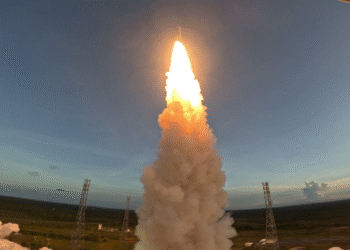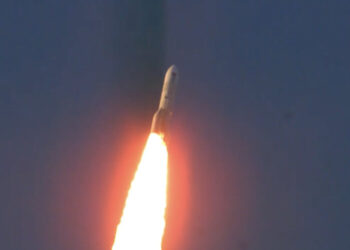
SpaceX’s Falcon 9 first stage landed on the Atlantic drone ship Just Read the Instructions following the launch of NASA’s IMAP (Interstellar Mapping and Acceleration Probe). The mission is proceeding through a planned coast after second-stage engine cutoff, setting up the observatory’s separation and transfer toward the Sun–Earth L1 Lagrange Point, about one million miles from Earth.
Launch and landing status
According to a NASA mission update, the booster completed a successful drone-ship touchdown off Florida as the upper stage entered a coast segment to align IMAP’s trajectory. Spacecraft separation is scheduled shortly before 9 a.m., pending completion of the coast phase and standard health checks. Source: NASA IMAP mission update.
Trajectory to L1
L1 is a gravitational balance point between Earth and the Sun that enables nearly continuous solar viewing and in-situ sampling of the solar wind. Reaching this orbit typically involves a sequence of burns and a long-duration coast to target a halo or Lissajous orbit. For IMAP, this geometry provides a stable vantage for measuring particles and fields that shape the heliosphere and its boundary with interstellar space.
What happens next
- Spacecraft separation from the Falcon 9 second stage after the coast phase.
- Initial deployments and power-up, including solar arrays, followed by early health and safety checks.
- Cruise to L1 with potential trajectory correction maneuvers and a commissioning period to verify instruments and subsystems.
- Transition to routine science operations once calibration and checkout are complete.
About IMAP
IMAP is designed to map the distribution and acceleration of energetic particles that originate at the boundary of the heliosphere. By sampling interstellar particles and the solar wind, the mission will refine models of how the Sun interacts with the local interstellar medium and improve the scientific basis for space weather research. Findings are expected to inform understanding of particle acceleration processes that affect spacecraft operations and radiation environments throughout the inner solar system.
Why it matters
The booster’s return to the drone ship underscores the operational cadence of reusable launch systems, a factor that can lower mission costs and shorten timelines for deep-space science. IMAP’s observations from L1 will complement ongoing heliophysics efforts and support improved space weather forecasting, benefiting satellite operators, navigation services, and infrastructure planners reliant on resilient space-based systems.
For continuing updates, see the official NASA blog: IMAP mission status.