The Space Feed | Latest Space News
  • Home
  • News
    • Launches
    • Space Technology
    • Human Spaceflight
    • Space Exploration
    • Astronomy
  • Launch Schedule
    • Upcoming Launches
    • Completed Launches
  • Knowledge Base
    • All Missions
    • All Rockets
No Result
View All Result
  • Home
  • News
    • Launches
    • Space Technology
    • Human Spaceflight
    • Space Exploration
    • Astronomy
  • Launch Schedule
    • Upcoming Launches
    • Completed Launches
  • Knowledge Base
    • All Missions
    • All Rockets
No Result
View All Result
The Space Feed | Latest Space News

NASA’s IMAP Checks In, Begins Cruise to L1 for Space Weather Science

September 25, 2025
in Space Exploration

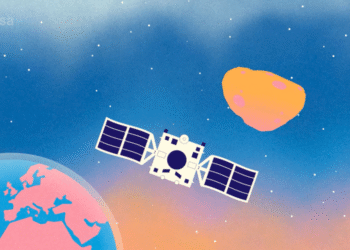
NASA’s Interstellar Mapping and Acceleration Probe (IMAP) has checked in with mission control, with full acquisition of signal confirming healthy communications as the spacecraft begins its cruise to the Sun–Earth L1 point. From this vantage, about one million miles sunward of Earth, IMAP will investigate how charged particles gain energy and map the boundary of the heliosphere, the vast magnetic bubble that helps shield our solar system from galactic radiation.

What IMAP Will Study

The heliosphere forms where the Sun’s continual outflow of energetic particles — the solar wind — meets the surrounding interstellar medium. IMAP’s 10 science instruments are designed to help clarify the physics at this boundary and across the inner heliosphere, advancing heliophysics research and improving understanding of the solar system’s radiation environment.

Cruise and L1 Operations

IMAP is slated to arrive at L1 in January 2026. The location provides an unobstructed view of solar activity and interplanetary conditions. The observatory spins once every 15 seconds, enabling its instrument suite to scan the full sky and build comprehensive maps and time-resolved measurements related to particle acceleration and solar wind dynamics.

Space Weather Value

Beyond basic science, IMAP is built to support real-time monitoring of the solar wind and energetic particles that can drive space weather. According to NASA, the mission can provide a roughly 30-minute warning of incoming radiation bursts that pose risks to astronauts and spacecraft. That capability is timely as the agency prepares for the Artemis II lunar mission in early 2026 and plans future human expeditions to Mars.

Key Mission Facts

  • Status: Full acquisition of signal from the spacecraft achieved
  • Destination: Sun–Earth Lagrange Point 1 (L1), ~1 million miles from Earth toward the Sun
  • Arrival: January 2026
  • Spin rate: One revolution every 15 seconds
  • Payload: 10 science instruments
  • Operations: Real-time observations to improve space weather awareness and hazard response

Why It Matters

By characterizing the heliosphere’s boundary and the mechanisms that energize particles, IMAP aims to refine models of the space environment that affects satellites, crewed missions, and technology on Earth. Insights from the mission will also inform how the heliosphere contributes to a protective environment that supports life in the solar system.
Source: NASA: Signal Acquired for NASA’s IMAP

Previous Post

IMAP Separates Cleanly from Falcon 9, Begins Spin-Stabilized Cruise to L1

Next Post

NOAA’s SWFO-L1 Heads to Sun–Earth L1 to Strengthen Space Weather Alerts

Related Posts

Space Exploration

ESA’s RAMSES Aims to Shadow Apophis During 2029 Earth Flyby

October 13, 2025
Space Exploration

ESA Maps 1,039 Martian Dust Devils, Uncovering Faster Winds for Mission Planning

October 8, 2025
Space Exploration

ESA’s Hera completes year one: Mars flyby achieved, autonomous navigation proven, Didymos arrival in 2026

October 7, 2025
Space Exploration

Fresh Enceladus Plume Chemistry Uncovered, Energizing ESA Orbiter-Lander Plans

October 1, 2025
Space Exploration

Carruthers Geocorona Observatory Deploys, Begins L1 Cruise to Probe Earth’s Exosphere

September 25, 2025
Space Exploration

CNES CASPEX cameras to ride UAE’s Rashid-2 rover on Firefly’s Blue Ghost in 2026

September 25, 2025
Next Post

NOAA’s SWFO-L1 Heads to Sun–Earth L1 to Strengthen Space Weather Alerts

Leave a Reply Cancel reply

Your email address will not be published. Required fields are marked *

  • Trending
  • Comments
  • Latest

NASA and SpaceX Conduct Crew-11 Dry Run Ahead of Launch

July 29, 2025

SpaceX Dragon Missions: Crew Prepares for Departure and Arrival at ISS

July 30, 2025

NASA Advances Supersonic Parachute Technology for Mars Missions

July 30, 2025

Upcoming Suborbital Rocket Launches from NASA Wallops: July 28-August 8, 2025

July 28, 2025

Dragonfly Mission Hits Major Test Milestones, Targets 2028 Falcon Heavy Launch

1

ESA Initiates Construction of LISA Mission to Detect Gravitational Waves

0

UK-France MicroCarb Satellite Launches to Enhance Global CO₂ Monitoring

0

NASA’s SpaceX Crew-11 Arrives at Kennedy Space Center for Upcoming Launch

0

ESCAPADE Reset to Nov. 13 After G4 Storm; Blue Origin VADR Launch Preserves Mars Trajectory

November 13, 2025

Brazil, INPE and ESA plan uptake of Biomass P-band radar data for Amazon carbon monitoring

November 13, 2025

LOFAR and XMM-Newton confirm coronal mass ejection from a red dwarf, threatening exoplanet atmospheres

November 12, 2025

DLR’s MAPHEUS-16 Sets Microgravity Payload Record with Twin Red Kite Motors

November 12, 2025

Popular Stories

  • NASA and SpaceX Conduct Crew-11 Dry Run Ahead of Launch

    0 shares
    Share 0 Tweet 0
  • SpaceX Dragon Missions: Crew Prepares for Departure and Arrival at ISS

    0 shares
    Share 0 Tweet 0
  • NASA Advances Supersonic Parachute Technology for Mars Missions

    0 shares
    Share 0 Tweet 0
  • Upcoming Suborbital Rocket Launches from NASA Wallops: July 28-August 8, 2025

    0 shares
    Share 0 Tweet 0
  • SpaceX Crew-11 Prepares for Launch: Final Steps Before Hatch Closure

    0 shares
    Share 0 Tweet 0
  • About
  • Advertise
  • Privacy & Policy
  • Contact
The Space Feed

© 2025 Stride Interactive Group

No Result
View All Result
  • Home
  • News
    • Launches
    • Space Technology
    • Human Spaceflight
    • Space Exploration
    • Astronomy
  • Launch Schedule
    • Upcoming Launches
    • Completed Launches

© 2025 Stride Interactive Group