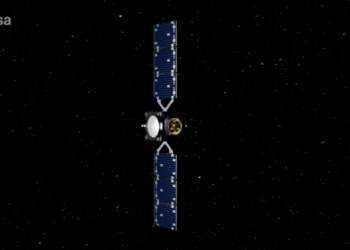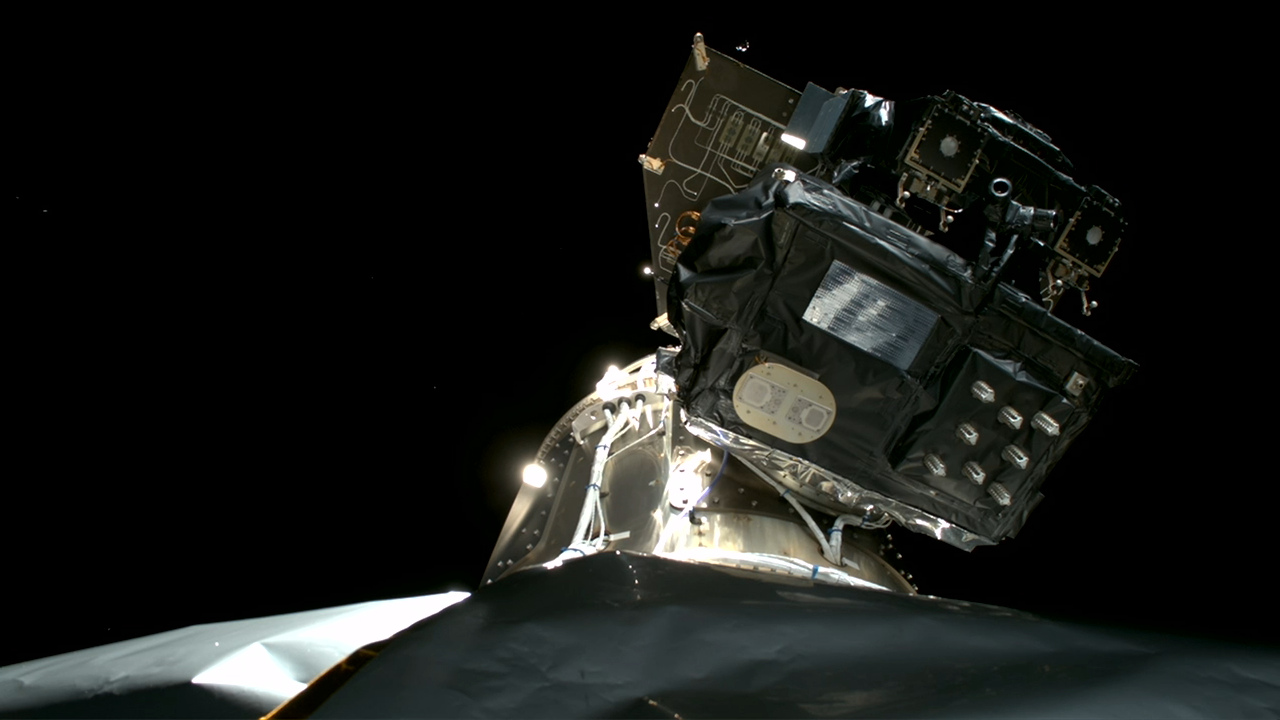
NASA’s Carruthers Geocorona Observatory (also known as GLIDE) has separated from a SpaceX second stage and begun its cruise to Lagrange Point 1 (L1), initiating a mission to investigate Earth’s outermost atmosphere, the exosphere. The deployment took place Sept. 24, 2025, as the third and final Sun and space-weather observatory to leave the upper stage on this flight. NASA’s update is available here.
Mission focus
The Carruthers mission will concentrate on the geocorona—the extremely tenuous hydrogen envelope enveloping Earth—to understand how the exosphere’s shape, size, and density vary and what drives those changes. It is the first mission dedicated to tracking changes in this expansive region, which is challenging to observe from the surface.
- Characterize global morphology of the exosphere and geocorona.
- Quantify variability over time and identify drivers linked to solar activity and Earth’s space environment.
- Improve models that connect the outer atmosphere to space-weather conditions.
Why it matters
The exosphere serves as a transitional zone between Earth’s environment and interplanetary space. Its behavior influences how the planet responds to space weather. Disturbances driven primarily by the Sun can affect satellites, communication and navigation signals in the upper atmosphere, and even power grids on the ground. By refining the physics of this boundary region, Carruthers is expected to strengthen forecasting of space-weather impacts.
Trajectory and operations
The observatory is heading toward L1, a Sun–Earth gravitational balance point commonly used for heliophysics observations. Mission operations at the Space Sciences Laboratory, University of California, Berkeley, plan to attempt first signal acquisition around 9:30 a.m. EDT, with additional updates anticipated as cruise and commissioning proceed.
Key points
- Spacecraft: Carruthers Geocorona Observatory (GLIDE)
- Deployment: Sept. 24, 2025, from a SpaceX second stage
- Destination: Sun–Earth L1 trajectory
- Primary focus: Earth’s exosphere and its response to solar activity
- Objective: Advance understanding and prediction of space-weather impacts
- Source: NASA blog