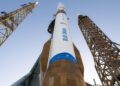
SWFO-L1, the National Oceanic and Atmospheric Administration’s new space weather sentinel, has checked in following launch, with mission controllers confirming acquisition of signal. The spacecraft now begins its cruise to the Sun–Earth L1 point to provide continuous, operational monitoring of solar activity that can disrupt satellites, communications, navigation, and power grids.
What the mission will observe
The Space Weather Follow-On Lagrange 1 (SWFO-L1) observatory is NOAA’s first satellite designed specifically for continuous, operational space weather observations. From its upstream vantage point between Earth and the Sun, it will:
- Track the Sun’s outer atmosphere for large eruptions known as coronal mass ejections (CMEs).
- Measure the solar wind and embedded magnetic fields before they reach Earth.
- Feed near-real-time data into forecasting models to strengthen early warnings of geomagnetic storms.
This upstream data is critical for safeguarding space-based assets and technology-dependent industries on the ground.
Timeline to operations
- Cruise and insertion: Arrival at the Sun–Earth L1 point, nearly one million miles (about 1.6 million kilometers) from Earth, is expected in January 2026.
- Commissioning: On-orbit checkout and calibration are planned through mid-2026.
- Operations: Transition to operational service will follow commissioning.
Program roles and launch architecture
NOAA manages the program, defines mission requirements, funds development, and oversees operations and data distribution. NASA and commercial partners developed, built, and tested the spacecraft and instruments to NOAA specifications.
SWFO-L1 launched as a rideshare with NASA’s IMAP mission. As part of the rideshare, NOAA did not procure a dedicated launch vehicle. NASA’s Heliophysics Division funded the launch vehicle for IMAP and supported the integration effort, while NASA’s Launch Services Program at Kennedy Space Center managed the launch service.
Why it matters for the space industry
- Satellite operators: Improved situational awareness for spacecraft charging, radiation exposure, and anomaly risk.
- Navigation and timing: Support for GNSS reliability and precision timing users during solar disturbances.
- Aviation: Enhanced forecasting for high-latitude communications and radiation environment planning.
- Power grids: Better advance notice of geomagnetic disturbances that can induce currents in transmission infrastructure.
As SWFO-L1 progresses to L1 and through commissioning, its data pipeline is expected to bolster operational forecasting and resilience planning across these sectors.