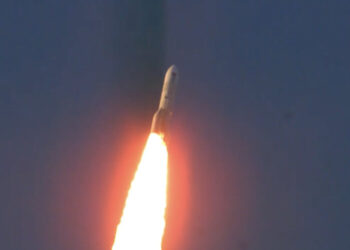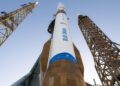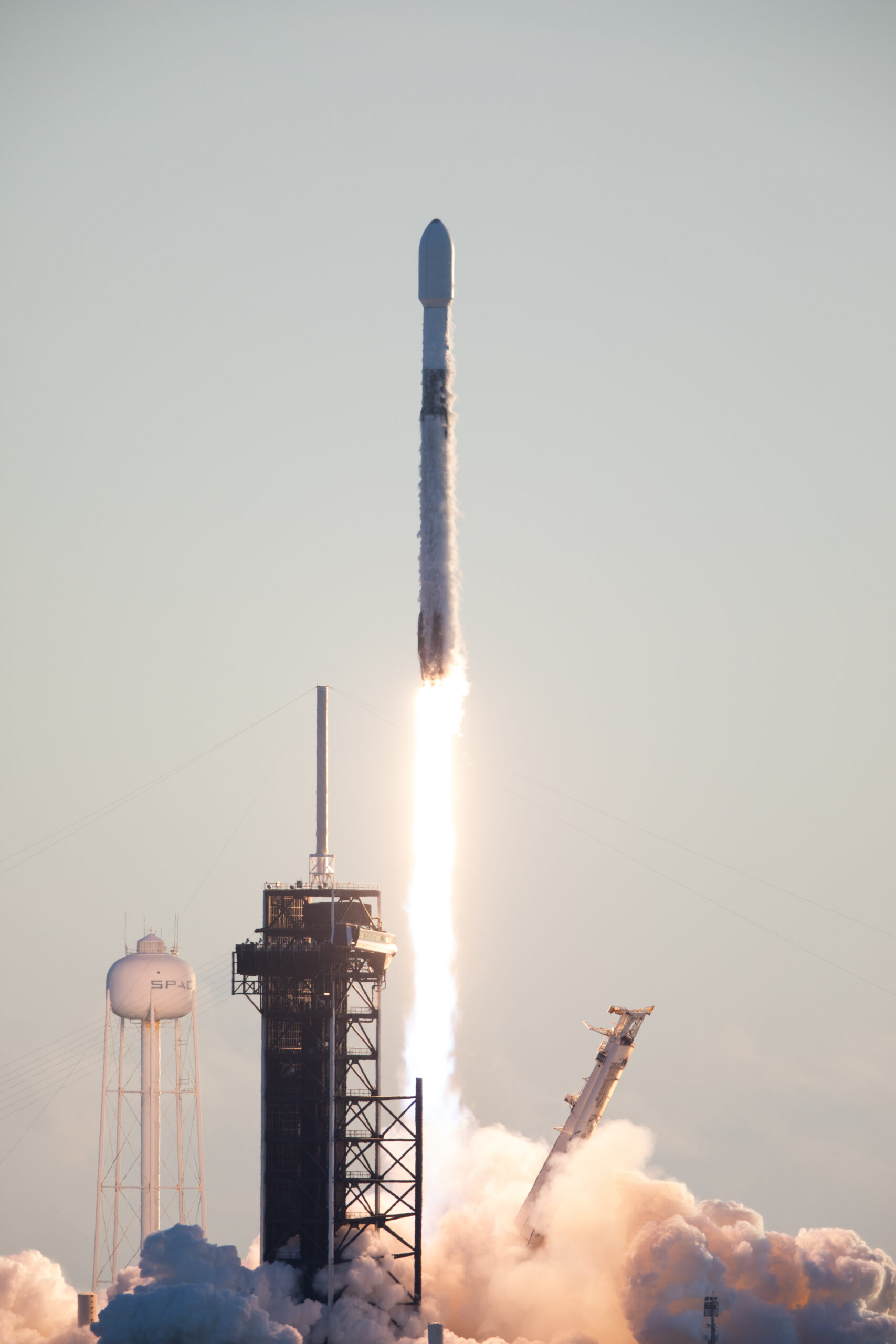
A SpaceX Falcon 9 lifted off from NASA’s Kennedy Space Center in Florida on Sept. 24, 2025, carrying a three‑mission payload dedicated to understanding the Sun’s influence across the solar system. NASA’s Interstellar Mapping and Acceleration Probe (IMAP), the agency’s Carruthers Geocorona Observatory, and the National Oceanic and Atmospheric Administration’s (NOAA) Space Weather Follow On–Lagrange 1 (SWFO‑L1) will investigate the solar wind and space weather from their origins at the Sun to the outer reaches of the heliosphere. Source: NASA.
Missions at a glance
- IMAP (NASA): Focused on how particles are accelerated and how the solar wind interacts with the interstellar medium. From the Sun–Earth L1 region, IMAP will build comprehensive maps of the heliosphere’s boundary to refine models of particle transport and the radiation environment affecting spacecraft and astronauts.
- Carruthers Geocorona Observatory (NASA): An Earth‑orbiting small satellite studying hydrogen in Earth’s extended exosphere, or geocorona. Its ultraviolet observations will track variability driven by solar activity, improving understanding of atmospheric escape and the near‑Earth environment relevant to satellite operations.
- SWFO‑L1 (NOAA): Positioned at the Sun–Earth L1 point to provide continuous, real‑time measurements of solar wind plasma and the interplanetary magnetic field. These data underpin operational forecasts of geomagnetic storms that can disrupt power grids, satellites, communications, and navigation systems.
Why this trio matters
Together, the three spacecraft provide a coordinated view of the Sun–Earth system. IMAP probes the global structure and particle dynamics of the heliosphere, SWFO‑L1 delivers continuous upstream monitoring for space weather forecasting, and the Carruthers Geocorona Observatory connects solar variability to changes in Earth’s extended atmosphere. This end‑to‑end approach strengthens the scientific basis for predicting space weather impacts and helps engineers harden infrastructure and spacecraft against disturbances.
The solar wind shapes the radiation and plasma environment throughout interplanetary space. Improved knowledge of its composition, timing, and variability enhances mission planning for human and robotic exploration, supports satellite operators managing drag and charging risks, and informs agencies responsible for safeguarding critical ground systems.
Launch and deployment
The flight from Kennedy Space Center delivered the three payloads to begin their transfer trajectories and early checkouts. IMAP and SWFO‑L1 will cruise to the Sun–Earth L1 region, about 1.5 million kilometers sunward of Earth, while the Carruthers Geocorona Observatory will operate from Earth orbit. Following commissioning and instrument calibrations, each mission will transition to routine science and, for SWFO‑L1, operational data delivery.
What to watch next
- Spacecraft commissioning milestones as teams verify health, power, thermal performance, and instrument functionality.
- Trajectory maneuvers placing IMAP and SWFO‑L1 into stable orbits around L1 for sustained observations.
- Initial datasets: geocoronal ultraviolet measurements from Carruthers, solar wind and magnetic field readings from SWFO‑L1, and energetic neutral atom maps from IMAP.
With complementary vantage points and objectives, IMAP, the Carruthers Geocorona Observatory, and SWFO‑L1 are poised to deliver an integrated picture of how the Sun drives conditions from Earth’s near‑space environment to the vast boundary of the heliosphere.