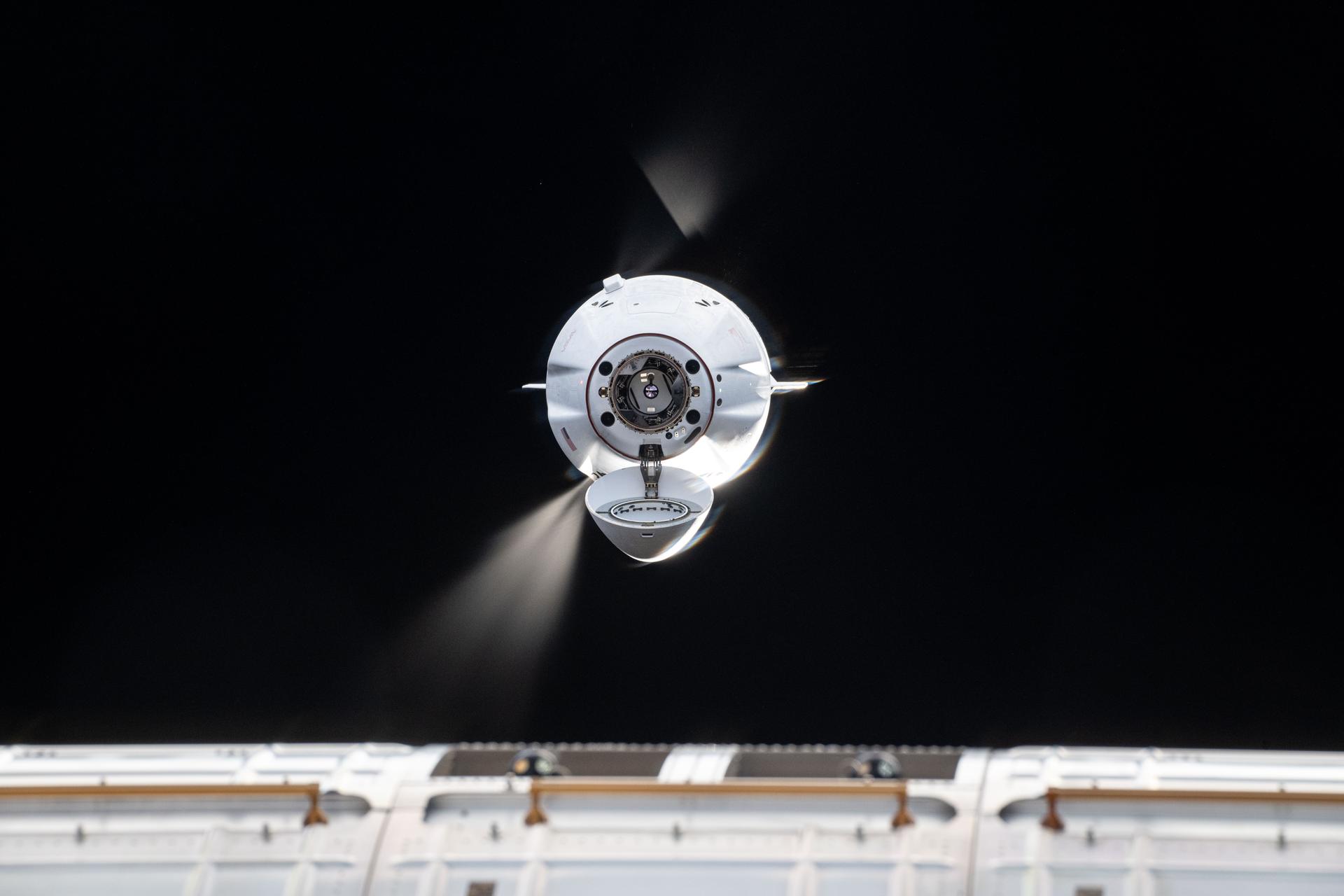
Expedition 73 continued a full slate of human research as a planned International Space Station reboost using SpaceX’s Dragon cargo spacecraft was halted mid-burn on Thursday. Ground controllers manually aborted the maneuver about 3 minutes, 45 seconds into a planned 19-minute, 22-second firing of the vehicle’s trunk-mounted Draco thrusters after an expected fuel tank swap did not occur. All station systems and crew operations remain nominal. A follow-up attempt is targeted for Friday, Sept. 26, at 2:24 p.m. EDT, pending data review, according to a NASA blog update.
Reboost status
The maneuver is one of a series used to counter atmospheric drag and fine-tune the station’s orbit for visiting vehicle traffic and debris avoidance. Controllers from SpaceX and NASA’s Mission Control Center in Houston commanded the abort to conserve propellant when telemetry indicated the Dragon’s internal fuel tank configuration did not transition as planned. Dragon previously completed a full-duration ISS reboost on Sept. 3.
Operational impact and next steps
ISS operations and research schedules were unaffected by the interrupted burn. Engineering teams are analyzing propulsion and tank management data to validate a near-term reboost opportunity and confirm propellant margins. Such reboosts are routine and can be provided by visiting spacecraft depending on mission availability and configuration.
On-orbit research highlights
While flight controllers assessed reboost options, the crew advanced multiple investigations focused on protecting astronaut health on future long-duration missions:
- Vision and fluid shift (SANS): NASA’s Jonny Kim and JAXA’s Kimiya Yui evaluated a specialized thigh cuff aimed at mitigating headward fluid shifts linked to Spaceflight Associated Neuro-ocular Syndrome. The session in ESA’s Columbus module included blood pressure readings, Ultrasound 2 vein scans, and ocular imaging.
- Gastrointestinal adaptation: Roscosmos’ Sergey Ryzhikov and Alexey Zubritsky conducted abdominal ultrasound for a long-running study of digestion, metabolism, and nutrient delivery in microgravity.
- Integrated health monitoring (CIPHER): NASA’s Zena Cardman completed a 48-hour stint with the Bio-Monitor headband and vest, then downlinked biometric data for comparison across pre-, in-, and post-flight phases.
- Payload and airlock operations: NASA’s Mike Fincke prepared the NanoRacks Bishop airlock in the Tranquility module for upcoming payload activity. Bishop can be repositioned with Canadarm2 for external experiments, satellite deployments, and logistics.
- Life support and environment: Roscosmos’ Oleg Platonov serviced the Elektron oxygen generator in Zvezda, performed maintenance on Nauka’s plumbing hardware, and collected air samples across the Russian segment.
Why reboosts matter
Even at orbital altitude, residual atmospheric drag gradually lowers the ISS’s path over time. Periodic reboosts restore altitude, optimize phasing for cargo and crew traffic, and help maintain geometry for safe operations and potential avoidance maneuvers.
Timeline at a glance
- Sept. 3: Dragon completes a full-duration ISS reboost.
- Sept. 25: Planned 19:22 burn aborted at ~3:45 due to tank swap behavior.
- Sept. 26, 2:24 p.m. EDT: Follow-up reboost targeted pending engineering review.
For additional operational details and research updates, see NASA’s latest ISS status post.