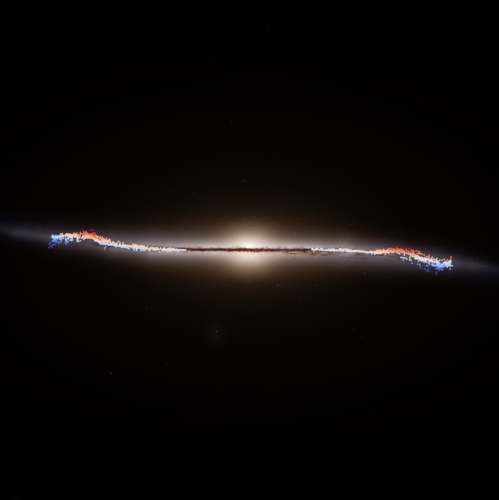
ESA’s Gaia mission has mapped a massive stellar ripple sweeping across the Milky Way‘s outer disc, revealing a large-scale vertical corrugation propagating outward from the Galactic center. The result adds a wave-like component to the Galaxy’s known rotation, warp, and wobble, and extends across tens of thousands of light-years. The agency’s mission update is available here.
Using six-dimensional phase-space data (3D positions plus 3D velocities), Gaia’s top-down and edge-on maps show alternating regions where stars sit above or below the already warped disc. The pattern spans a large portion of the outer disc, indicating a coherent structure on Galactic scales.
Key findings
- Scale and location: The ripple affects stars roughly 30,000–65,000 light-years from the Galactic center, covering a broad swath of the outer disc.
- Geometry: Alternating zones lie above and below the warped disc, visible in both face-on and edge-on perspectives.
- Kinematics: Stars’ vertical motions are shifted in phase relative to their vertical positions, a hallmark of a traveling wave.
- Tracers: The structure is charted with young giant stars and Cepheids, whose predictable variability enables distance measurements across large ranges.
How the signal was traced
By combining precise parallaxes, proper motions, and line-of-sight velocities, Gaia isolates the vertical displacement and motion of stars across the disc. Young stellar populations, including Cepheids, move with the wave, suggesting that interstellar gas may also participate in the oscillation and that newly formed stars preserve its imprint.
Possible origins and links
The driver of the Galaxy’s great wave remains uncertain. A past interaction with a dwarf galaxy is a leading possibility, but internal dynamical processes or halo substructure could also contribute. The feature may connect to, but is distinct from, the nearby Radcliffe Wave: that filamentary structure is smaller and located much closer to the Sun. Any relationship between the two remains to be established.
Why it matters for galactic dynamics
- Large-scale corrugations probe the Milky Way’s mass distribution and gravitational potential in the outer disc and halo.
- They preserve signatures of past satellite encounters and disc heating, informing the Galaxy’s interaction history.
- The coupling of stars and gas in the wave has implications for outer-disc star formation and interstellar medium dynamics.
- High-precision phase-space maps provide stringent tests for numerical models of disc warps, bending modes, and external perturbations.
What comes next
The upcoming Gaia DR4 will deliver improved positions and motions for Milky Way stars, including variable stars such as Cepheids, enabling sharper maps of the wave and more decisive tests of its origin. Technical details are presented in Astronomy & Astrophysics: doi:10.1051/0004-6361/202451668.