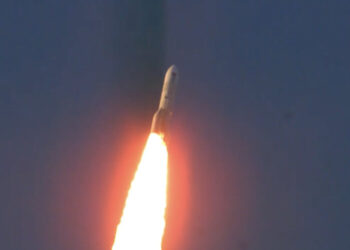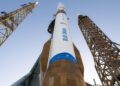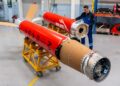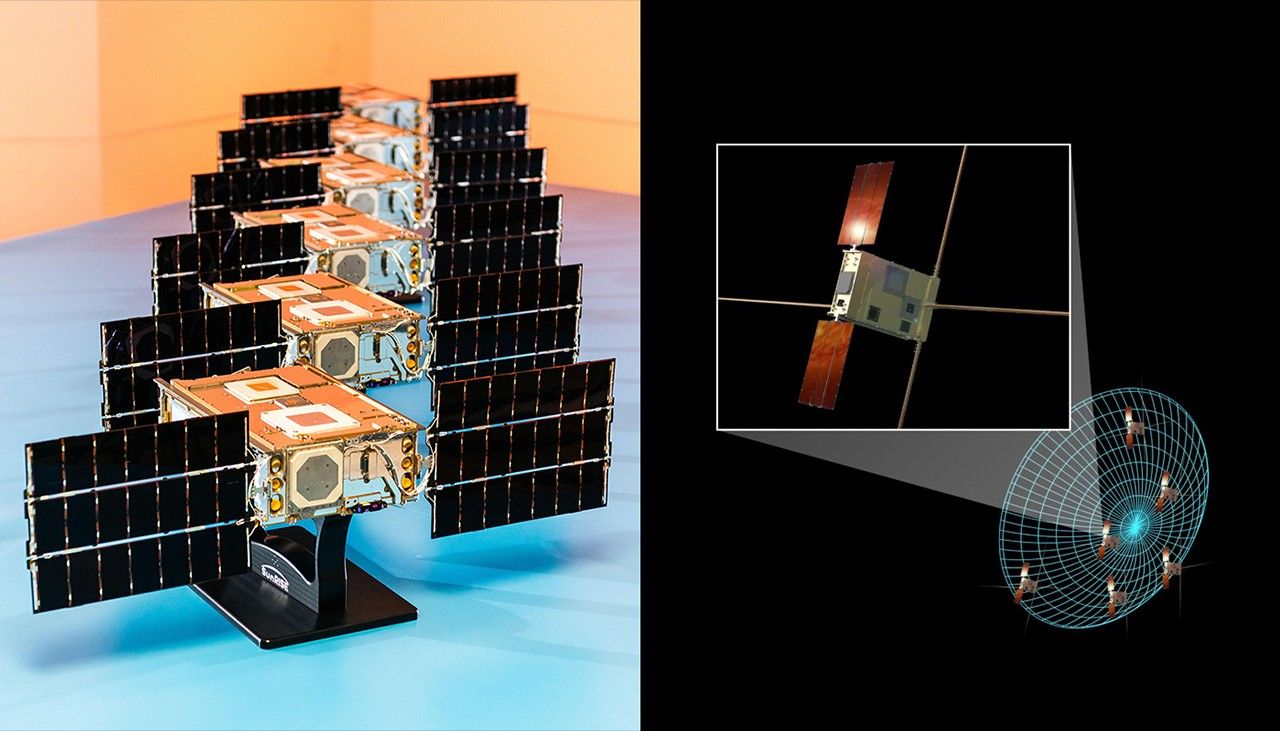
NASA has set a target of summer 2026 to launch the Sun Radio Interferometer Space Experiment (SunRISE) on a rideshare aboard a United Launch Alliance Vulcan Centaur rocket. Sponsored by the United States Space Force’s Space Systems Command, the mission aims to map solar radio bursts and the Sun’s magnetic environment from the outer corona into interplanetary space—data that can sharpen space weather forecasting and risk planning for spacecraft and crewed missions.
Mission overview
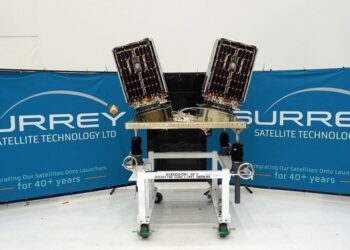
SunRISE comprises a constellation of six SmallSats, each roughly the size of a toaster oven. Flying in formation to create a virtual aperture about 10 kilometers wide, the network will function as a single radio telescope via interferometry. By precisely synchronizing time and position, the team will combine signals from the distributed sensors to image the approximate location of solar radio bursts and infer the direction energetic particles are streaming.
Operating at radio wavelengths absorbed by Earth’s ionosphere, SunRISE leverages a space-based vantage point to access frequencies unavailable to ground observatories. The mission will downlink science and navigation data through NASA’s Deep Space Network.
Launch plan and architecture
The constellation is slated to deploy as a rideshare payload on a Vulcan Centaur, targeting Earth orbit for formation flying. The rideshare approach is designed to reduce launch cost while meeting mission geometry needs for baseline spacing. Following deployment, commissioning will validate timing, positioning, and cross-link performance before beginning routine observations.
Why it matters for operators
Solar radio bursts are signatures of energy release in the Sun’s magnetic field that can accelerate particles to high speeds. These particles can reach interplanetary space quickly and, depending on trajectory, pose hazards to spacecraft electronics, communications, and crew health outside Earth’s magnetosphere. SunRISE is designed to improve the timeliness and directional context of alerts.
- Earlier situational awareness for radiation storms that may follow radio bursts
- Improved directional estimates of particle streams to assess which assets are most exposed
- Refined inputs for space weather models used in satellite operations and mission planning
- Support to risk mitigation strategies for deep space missions and EVA scheduling
Program and team
SunRISE is a Mission of Opportunity under the Heliophysics Division of NASA’s Science Mission Directorate and part of the Explorers Program managed by NASA’s Goddard Space Flight Center. The science investigation is led by the University of Michigan, which also provides the science operations center. NASA’s Jet Propulsion Laboratory manages the project and provides the mission operations center. Utah State University’s Space Dynamics Laboratory built the spacecraft.
Context and next steps
SunRISE will complement NASA’s heliophysics fleet, including Solar TErrestrial RElations Observatory, Parker Solar Probe, and Solar Orbiter (an ESA-NASA collaboration), by adding radio imaging of burst locations and particle-stream directions. As integration and rideshare manifesting proceed toward the 2026 window, mission teams will finalize formation-flying calibrations and data-processing pipelines to transition quickly into operations after launch.
Source: NASA mission update