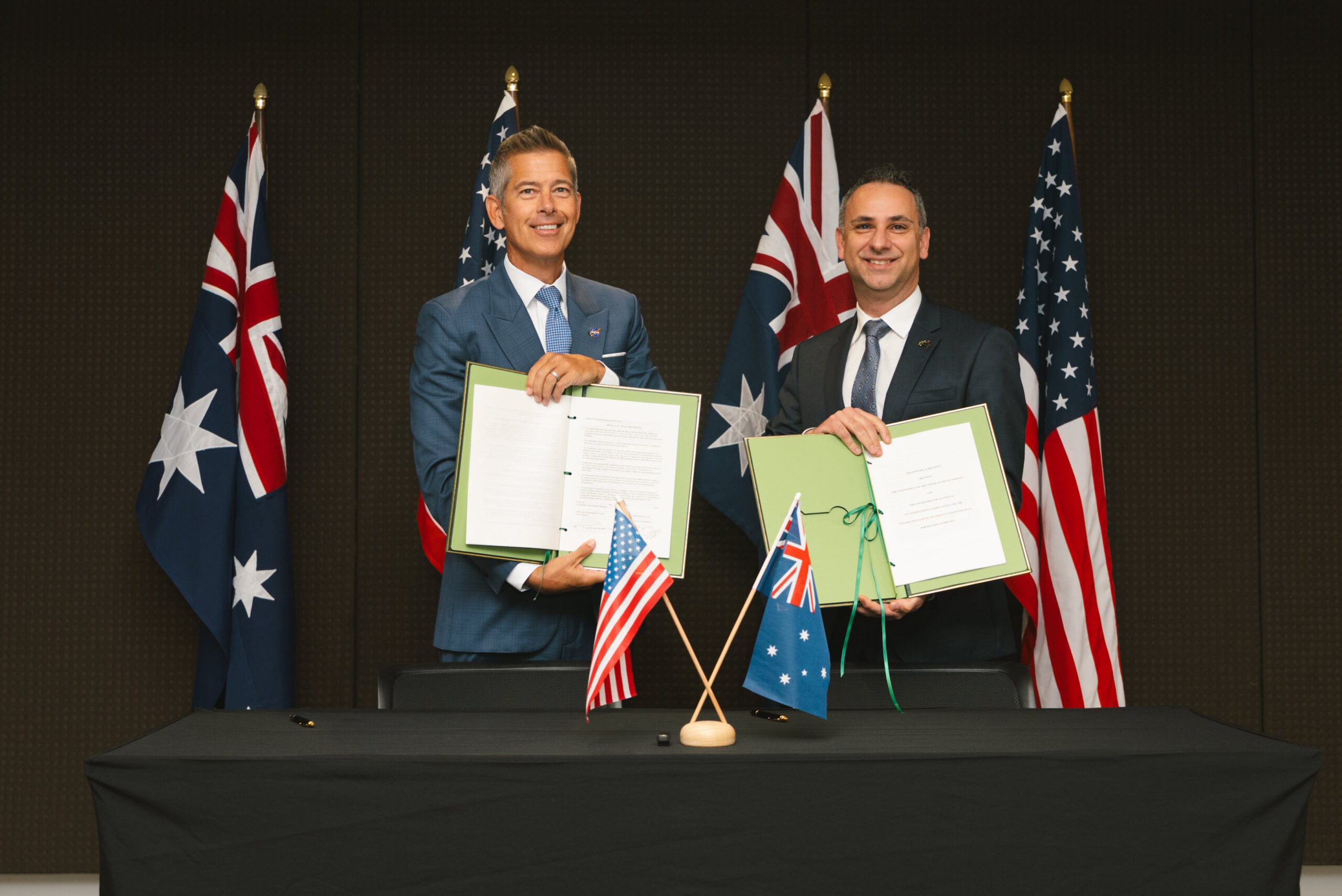
The United States and Australia have signed a new framework to broaden cooperation in aeronautics and space, formalizing a wider scope of joint work between NASA and the Australian Space Agency. The agreement was concluded on Sept. 30, 2025, on the sidelines of the International Astronautical Congress in Sydney, and is designed to streamline collaborative research, missions, and technology development conducted for peaceful purposes.
What the Framework Covers
Formally titled the Framework Agreement between the Government of the United States of America and the Government of Australia on Cooperation in Aeronautics and the Exploration and Use of Airspace and Outer Space for Peaceful Purposes, the pact establishes the legal basis for future projects and data sharing. It identifies key areas where the two nations plan to expand cooperation:
- Space exploration and human spaceflight activities
- Space science, planetary science, and astrophysics
- Earth science, including geodesy and climate-related observations
- Space medicine and life sciences
- Aeronautics research and flight innovation
- Advanced space and flight technologies
The framework is intended to enable faster initiation of joint initiatives, reduce administrative barriers, and align standards and practices across agencies and partner institutions in both countries.
A Partnership with Deep Roots
NASA–Australia civil space cooperation dates to 1960, when the nations signed their first cooperative space agreement. Australia’s Canberra Deep Space Communication Complex, part of NASA’s global Deep Space Network, has supported numerous missions, notably assisting the Apollo program and the Apollo 13 emergency operations. The complex continues to provide critical communications and navigation services for both robotic and crewed missions.
Australia was an original signatory to the Artemis Accords in October 2020, joining a set of principles developed to guide responsible space exploration. Representatives from many of the Accords’ 56 signatory countries met in Sydney during the IAC to advance implementation discussions, underscoring a broader international push for transparent, sustainable activities in space.
Programs and Near-Term Impacts
Under an existing partnership, Australia is developing a semi-autonomous lunar rover that will carry a NASA analysis instrument, with delivery targeted by the end of the decade through NASA’s Commercial Lunar Payload Services (CLPS) initiative. The new framework is expected to ease coordination on such missions, while opening further avenues in Earth observation, technology maturation, and aeronautics research.
- Facilitated mission planning and operations across joint exploration and science campaigns
- Expanded data sharing and interoperability for ground systems and mission support
- Opportunities for collaborative research in life sciences and human performance for deep-space missions
- Closer alignment on flight testing and aeronautics innovations
NASA positions this agreement as part of a wider strategy to leverage international partnerships for the Artemis campaign and eventual human exploration of Mars. For Australia, it reinforces industrial and research pathways connected to lunar surface systems, communications infrastructure, and scientific payload development.
Why It Matters
By codifying roles, responsibilities, and legal protections, the framework provides predictable structures for government agencies, universities, and industry on both sides. That foundation can shorten timelines for joint proposals, clarify export-control considerations, and support long-duration projects that rely on shared infrastructure such as the Deep Space Network. It also affirms both nations’ commitment to peaceful, transparent, and sustainable operations in airspace and outer space.
Additional details are available in NASA’s announcement: U.S. and Australia Sign Framework to Expand NASA–ASA Collaboration.