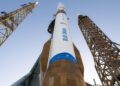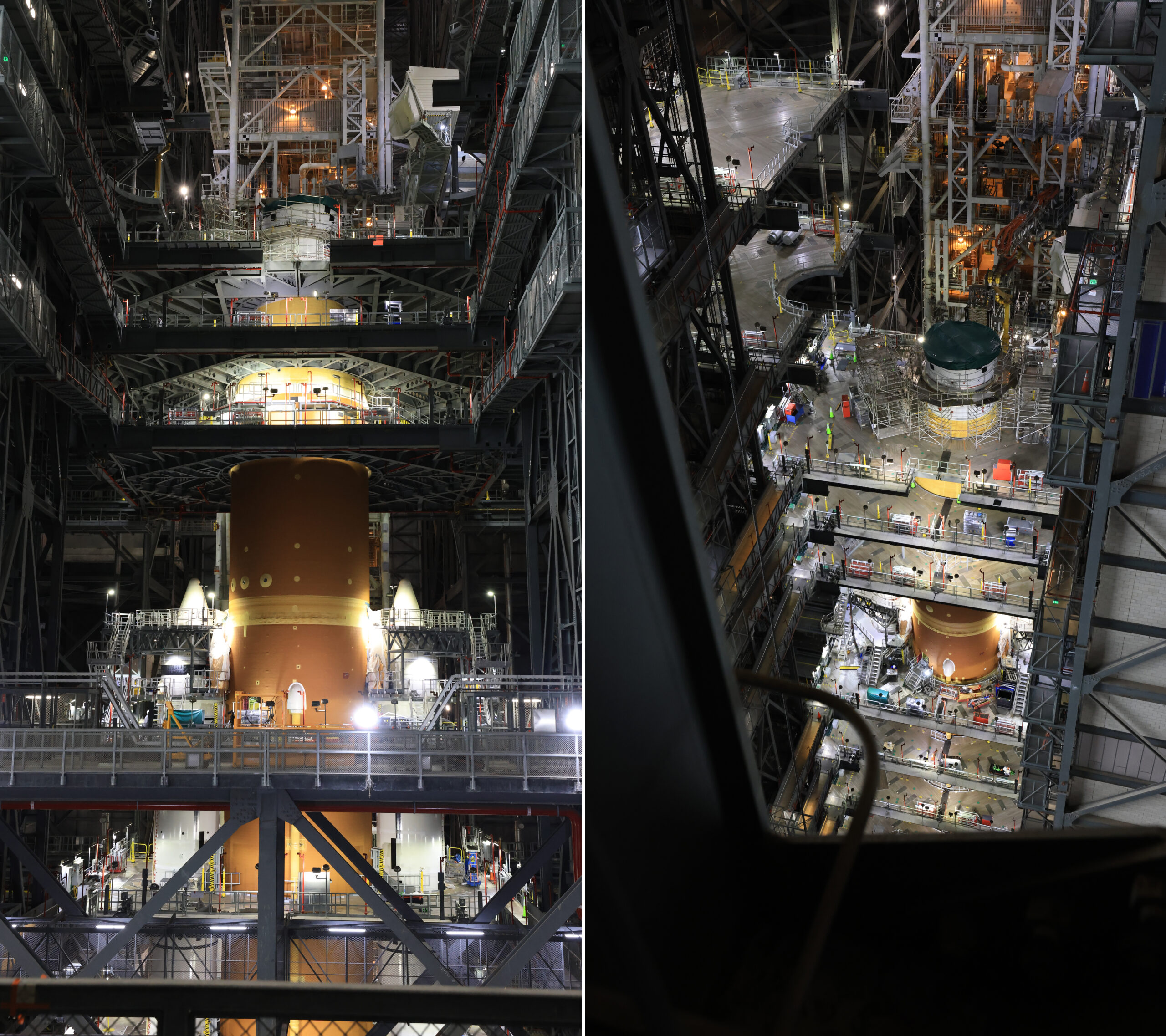
NASA has installed the Orion Stage Adapter (OSA) on the Space Launch System (SLS) rocket for Artemis II, marking a key step toward the mission now targeting no earlier than April 2026. The integration occurred inside the Vehicle Assembly Building at Kennedy Space Center, advancing final assembly ahead of Orion spacecraft mating in the coming weeks. The OSA was built at Marshall Space Flight Center and links the SLS interim cryogenic propulsion stage (ICPS) to the Orion spacecraft.
What the Orion Stage Adapter Does
The adapter is designed to provide both structural and mission-critical functions between the ICPS and Orion:
- Connects the upper stage to the Orion spacecraft.
- Houses a composite diaphragm to isolate Orion from hazardous gases generated during launch.
- Provides a deployment platform for secondary payloads.
- Supports a planned maneuvering test during the Artemis II mission.
Secondary Payloads: Four 12U CubeSats
Following Orion’s departure to a safe distance, the OSA will deploy four 12U CubeSats into high Earth orbit. These small spacecraft, developed by international partners in South Korea, Germany, Argentina, and Saudi Arabia, will conduct science and technology demonstrations. Each 12U conforms to a standardized unit of 10 cm x 10 cm x 10 cm, allowing modular configurations for mission-specific instruments.
Schedule and Next Steps
NASA plans to integrate the Orion spacecraft atop SLS in the coming weeks. Mission teams continue testing and simulations to prepare for launch no earlier than April 2026. The OSA’s inclusion enables final interface checks between the ICPS and Orion, clearing the way for stack closeout and integrated vehicle testing.
Artemis III Hardware Progress
Work on future lunar missions continues in parallel. Marshall engineers have flipped the Artemis III Orion stage adapter to begin bracket, avionics, and cable installation, with its diaphragm slated for installation later this fall. This parallel production flow is intended to sustain cadence for subsequent crewed lunar missions.
Why It Matters
Artemis II will be the first crewed flight of SLS and Orion, paving the way for sustained lunar exploration and building the foundation for future crewed missions to Mars. The OSA’s integration consolidates several mission-critical roles—structural connection, environmental protection, and secondary payload deployment—into a single component, reducing complexity during ascent and early mission phases.