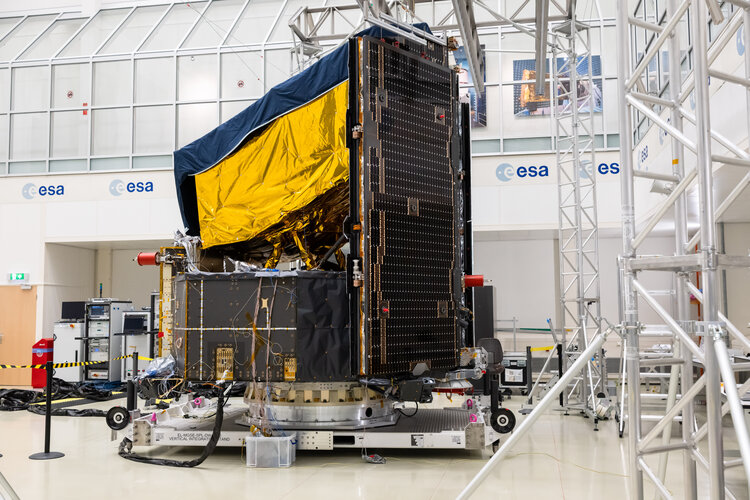
The European Space Agency has completed the build of PLATO, its exoplanet-hunting spacecraft, by attaching the combined sunshield and solar-array module at ESA’s Test Centre in the Netherlands. With structural assembly finished, the mission now moves into a final qualification campaign ahead of a targeted December 2026 launch on Ariane 6.
Final assembly and deployment checks
The last major module was aligned and mounted on 9 September in a clean-room operation. Engineers subsequently performed two ground deployments of the left and right solar wings on 16 and 22 September using offload rigs to simulate microgravity. After full extension, a calibrated light source was used to verify electrical power generation and distribution, confirming correct mechanical deployment and system performance.
The structure doubles as a sunshield, keeping the payload in shadow to ensure thermal stability. This is essential to maintain the spacecraft’s science detectors at their operating temperature near -80°C.
What the test campaign includes
Over the coming months, PLATO will undergo environmental testing to qualify for launch and space operations:
- Vibration testing to simulate rocket-induced loads
- Acoustic testing to expose the spacecraft to high sound pressure levels
- Thermal-vacuum trials in ESA’s Large Space Simulator to validate performance in vacuum and extreme temperatures
- Comprehensive functional and end-to-end avionics, power, and deployment checks
Mission goals and payload
PLATO (PLAnetary Transits and Oscillations of stars) is designed to detect and characterize terrestrial exoplanets, including candidates in or near the habitable zones of Sun-like stars. The spacecraft’s architecture and thermal design are optimized for stable, long-duration photometry.
- 26 cameras for high-precision, wide-field photometry
- Simultaneous monitoring of more than 150,000 bright stars
- Detectors regulated near -80°C for sensitivity and stability
- Sun-facing structure hosts power systems while shielding the science payload from solar heating
By measuring minute, periodic dips in stellar brightness, PLATO will expand the catalog of known exoplanets and provide high-quality targets for mass and atmosphere follow-up with complementary observatories.
Schedule and industrial team
Pending successful completion of environmental tests, PLATO remains on track for a December 2026 launch on Ariane 6. The mission is a medium-class project in ESA’s Cosmic Vision program.
The scientific instrumentation is provided by the PLATO Mission Consortium, a collaboration of European research institutions and industry. The industrial core team assembling the spacecraft is led by OHB, with Thales Alenia Space and Beyond Gravity as major partners.
Source: ESA update