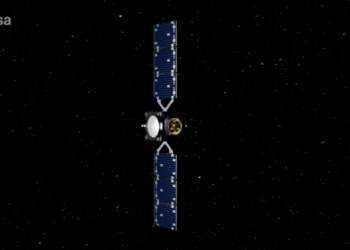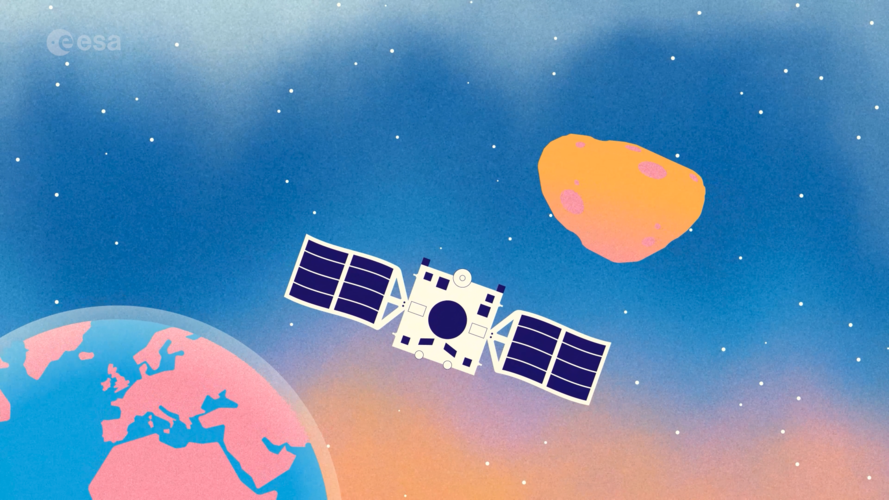
The European Space Agency is advancing plans for the Rapid Apophis Mission for Space Safety (Ramses), a proposed rendezvous with asteroid 99942 Apophis ahead of its 13 April 2029 Earth flyby. If approved, the spacecraft would launch about a year prior, meet Apophis months before closest approach, and accompany it through the encounter to measure how Earth’s gravity perturbs the asteroid in real time. ESA states that Apophis poses no danger during the 2029 passage.
Mission overview
Ramses is being developed within ESA’s Space Safety Programme as a cornerstone of its Planetary Defence segment. The 2029 event offers a rare chance to observe an asteroid before, during, and after a strong gravitational interaction with a planet.
- Target: Near-Earth asteroid Apophis, approximately 375 meters in diameter
- Flyby distance: Less than 32,000 km from Earth, inside the ring of geostationary satellites
- Visibility: Expected to be visible to the naked eye from parts of Europe and Africa during the approach
- Launch profile: Approximately one year before the flyby, pending mission approval
- Companion assets: Two smaller spacecraft planned for close-up investigations
Why the 2029 flyby matters
Apophis will briefly pass closer to Earth than many satellites, providing a natural experiment to study how an asteroid responds to a significant external force. Such close encounters for an object of this size occur roughly once every seven millennia, making the 2029 passage a unique opportunity to validate models of tidal effects, surface dynamics, and trajectory evolution under Earth’s gravity.
Science objectives
Ramses would employ a suite of scientific instruments to characterize Apophis and track any changes induced by the flyby:
- Measure size and shape to refine 3D models and volume estimates
- Determine composition and assess surface properties
- Monitor rotation and spin-state evolution
- Refine trajectory and evaluate post-encounter orbital changes
- Detect signs of surface disturbance, mass movement, or structural response to tidal stresses
Operations concept
- Launch roughly one year before the flyby and cruise to intercept Apophis
- Rendezvous months ahead of closest approach for global mapping and baseline measurements
- Deploy two smaller spacecraft at the asteroid for close-range observations
- Escort Apophis through its closest approach inside geostationary altitude
- Conduct post-encounter monitoring to capture any measurable changes
Implications for planetary defence
Beyond scientific return, Ramses is designed to demonstrate Europe’s ability to rapidly design, launch, and operate a mission to a high-priority near-Earth object. By directly observing how Apophis behaves under Earth’s gravitational influence, the mission aims to improve hazard assessment methods and inform future strategies for deflecting or mitigating potentially hazardous asteroids.
More details are available via ESA’s official presentation of the concept: ESA Ramses mission overview.