European researchers on the International Space Station have begun the first in-orbit mapping of fin-film condensation to refine spacecraft thermal control. The Condensation on Fins experiment, operating inside ESA’s new Heat Transfer Host 2 (HTH2) facility, examines how liquid films form and redistribute on cooled surfaces when gravity-driven drainage and buoyant convection are removed. The resulting dataset is intended to validate and unify models that predict condensation rates from film thickness distribution. Full technical context is available via the ESA mission update.
Microgravity reshapes condensation
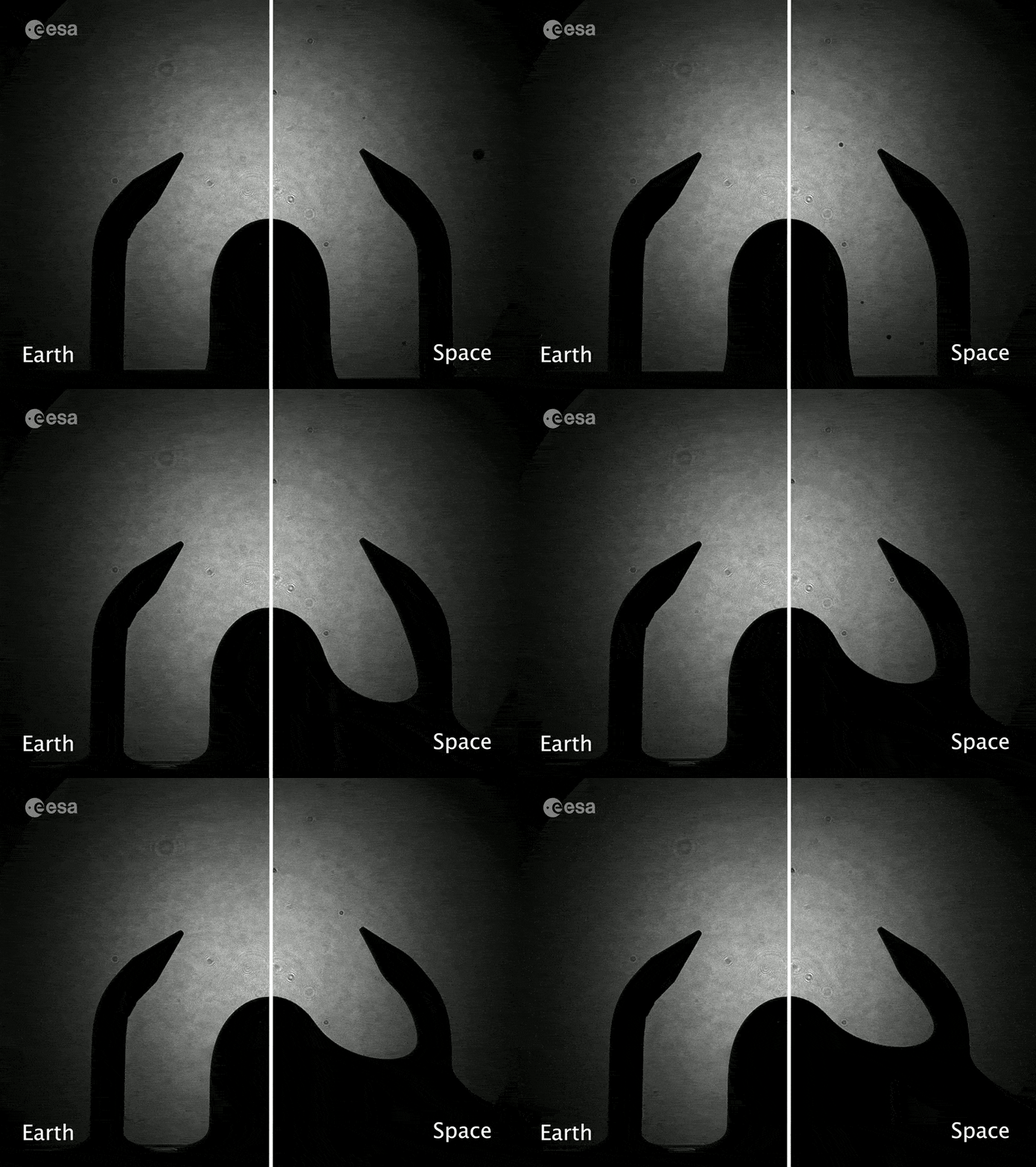
On Earth, condensate tends to pool at the base of a cooled fin. In microgravity, early runs show that liquid accumulates across the fin surface instead, guided primarily by capillary pressure and surface energy rather than weight. This fundamental shift changes heat-transfer pathways and challenges ground-based assumptions used in spacecraft thermal design.
Inside the Condensation on Fins experiment
The payload uses a one-centimetre-tall fin machined from aluminum alloy and exposed to a low surface-tension refrigerant. Condensed liquid is continuously wicked to the fin’s foot by a porous element, pumped away, and re-evaporated in a closed loop to maintain steady conditions. Two nickel-iron reference features enable precise spatial calibration.
A high-precision interferometer records temperature and vapour concentration fields while tracking the liquid film thickness with high spatial and temporal resolution. The microgravity setting allows larger fins and cleaner boundary conditions than parabolic flights, avoiding gravity drainage and reducing vapour convection that can obscure measurements on Earth.
- Facility: Heat Transfer Host 2 within European Drawer Rack-2 in the Columbus laboratory
- Installation: 30 September 2025, following delivery on the 23rd Northrop Grumman cargo resupply mission (NG-23)
- Focus: Capillary-driven film condensation and fin-shape optimization for heat transfer
- Instrumentation: Interferometry-based mapping of film thickness, temperature, and vapour concentration
Why it matters for spacecraft and Earth
The experiment targets high-fidelity datasets that can consolidate competing theoretical models linking film thickness distribution to condensation rate. A more predictive framework would enable lighter, more efficient heat exchangers and thermal management systems for spacecraft avionics and life support, where mass, volume, and reliability margins are critical.
Insights are also applicable on the ground. Improved understanding of capillary effects during film condensation can inform cooling strategies for consumer electronics and computing hardware, and help optimise industrial coating processes that depend on controlled thin films.
What comes next
HTH2 is designed for modular investigations of heat and mass transfer in microgravity. Following Condensation on Fins, the campaign will examine Marangoni-driven instabilities in evaporating films, extending the dataset to flows dominated by surface-tension gradients. Together, these studies are expected to sharpen design rules for fin geometry, surface treatments, and working fluids across orbital and terrestrial systems.
For mission details and visuals, see the ESA overview: Condensation defying gravity.