NASA is preparing to launch the Carruthers Geocorona Observatory, a heliophysics mission designed to map Earth’s faint ultraviolet “halo” from Lagrange Point 1 (L1)space weather forecasting that supports crewed lunar operations and satellite resilience.
What the mission will study
Earth’s exosphere—the outermost atmospheric layer beginning about 300 miles above the surface—extends at least halfway to the Moon. It is dominated by hydrogen atoms that scatter solar ultraviolet light, creating the geocorona. As solar eruptions reach Earth, they interact first with this region, setting off processes that can intensify radiation, disrupt communications, and affect spacecraft. Tracking how hydrogen responds and escapes to space also informs why Earth retains water while some planets do not, offering context for exoplanet habitability assessments.
How the observatory will work
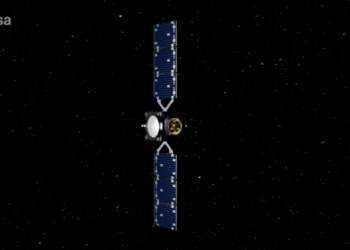
From L1, roughly 1 million miles sunward and about four times farther than the Moon, Carruthers will maintain a stable, continuous view of the full exosphere. Two ultraviolet cameras—a near‑field imager and a wide‑field imager—will map hydrogen distributions close to Earth and across the system’s full expanse, producing time‑resolved datasets for models of atmospheric escape and geomagnetic disturbance pathways.
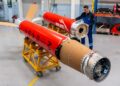
- Spacecraft mass: 531 pounds; roughly loveseat size.
- Orbit: Sun–Earth L1 for uninterrupted geocorona viewing.
- Payload: Dual UV imagers (near‑field and wide‑field) for complementary coverage.
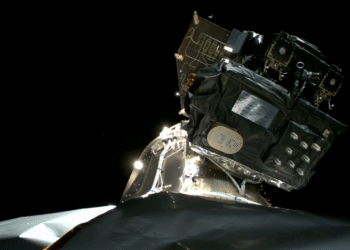
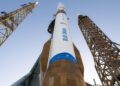
- Rideshare: SpaceX Falcon 9 with IMAP and NOAA’s SWFO‑L1.
- Timeline: ~4‑month cruise to L1, ~1‑month checkout; two‑year prime science phase beginning March 2026.
- Data products: Global hydrogen maps and movies linking exosphere dynamics to solar activity for model assimilation.
Why it matters for the space industry
Better characterization of the exosphere’s response to solar events is expected to sharpen real‑time and predictive models of radiation and plasma conditions along translunar trajectories and in cislunar space. This supports Artemis mission planning, spacecraft hardening strategies, and satellite operations. Results will complement in situ and remote measurements from IMAP and SWFO‑L1, strengthening a multi‑mission architecture for monitoring the Sun–Earth system.
Program and partners
The mission is led by the University of Illinois Urbana‑Champaign. The Space Sciences Laboratory at the University of California, Berkeley leads implementation and payload development with the Space Dynamics Laboratory. The spacecraft was built by BAE Systems. NASA’s Goddard Space Flight Center manages the project under the agency’s Heliophysics Division.
Source: NASA announcement.