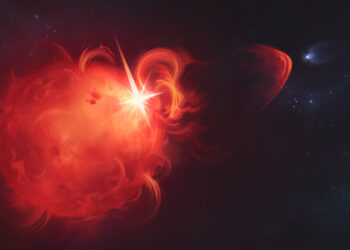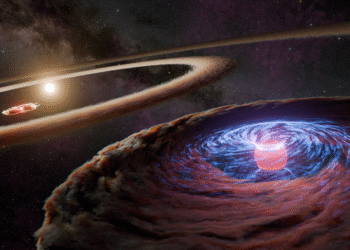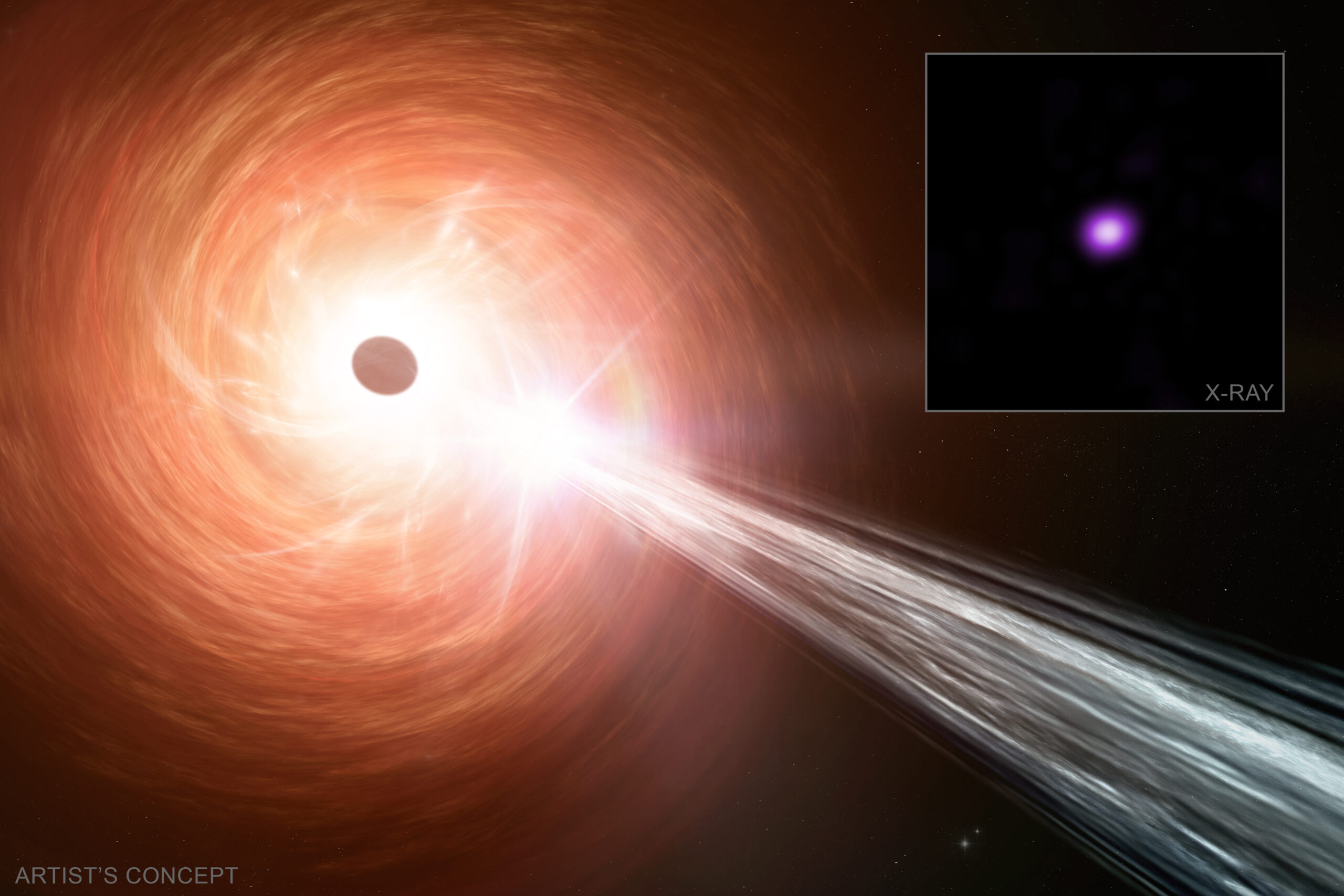
NASA’s Chandra X-ray Observatory has identified a fast-growing supermassive black hole in the early universe that appears to be accreting above the classical Eddington limit. The quasar RACS J0320-35, located about 12.8 billion light-years away and seen only ~920 million years after the big bang, is producing an exceptionally bright X-ray signal that points to extraordinary growth.
What Chandra Saw
New Chandra observations taken in 2023 reveal an X-ray spectrum consistent with matter falling into the black hole at a rate exceeding the Eddington limit by a factor of roughly 2.4. Modeling of the emission implies a mass of about one billion Suns and an estimated inflow of 300 to 3,000 solar masses per year. The source is also launching a relativistic jet, an uncommon feature among quasars, suggesting a possible link between rapid accretion and jet production.
- Distance: ~12.8 billion light-years (observed 0.92 billion years after the big bang)
- Black hole mass: ~1 billion solar masses
- Accretion rate: ~2.4 times the Eddington limit (model-dependent)
- Estimated growth: ~300–3,000 solar masses per year
- Features: Bright X-ray emission and a jet moving at near-light speed
Why This Matters
Quasars with billion-solar-mass black holes so soon after cosmic dawn pose a longstanding formation puzzle. If growth is capped near the Eddington limit, early black holes likely require very massive “heavy seeds” (on the order of 10,000 solar masses or more), potentially formed by the direct collapse of pristine, metal-poor gas clouds. However, sustained super-Eddington accretion, as indicated for RACS J0320-35, opens a different pathway: a “light seed” formed by the death of a massive star (tens of solar masses) could still reach a billion solar masses within a billion years. The detection also informs how extreme accretion might power jets, an area of active research in high-energy astrophysics.
How It Was Found
RACS J0320-35 was initially identified through radio and optical surveys, then characterized across wavelengths to establish its distance and power:
- Discovery and radio selection via the Australian Square Kilometre Array Pathfinder (ASKAP)
- Optical imaging and confirmation with the Dark Energy Camera (DECam)
- Spectroscopic distance measurement using the Gemini South telescope
- X-ray characterization with Chandra to determine accretion rate and spectral shape
The combined dataset points to a black hole growing faster than the classical radiation-pressure limit would allow, offering a laboratory for testing models of early black hole assembly, accretion physics, and jet launching.
What Comes Next
Further high-resolution X-ray and radio monitoring, along with infrared spectroscopy, can refine estimates of mass, accretion geometry, and the jet’s energetics. Larger samples of high-redshift, super-Eddington candidates will be critical to determine whether this object is an outlier or part of a broader population that shaped the earliest quasars and protogalaxies.
A paper detailing these findings has been accepted by The Astrophysical Journal. For more information, see NASA’s coverage via the Chandra program: source.