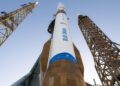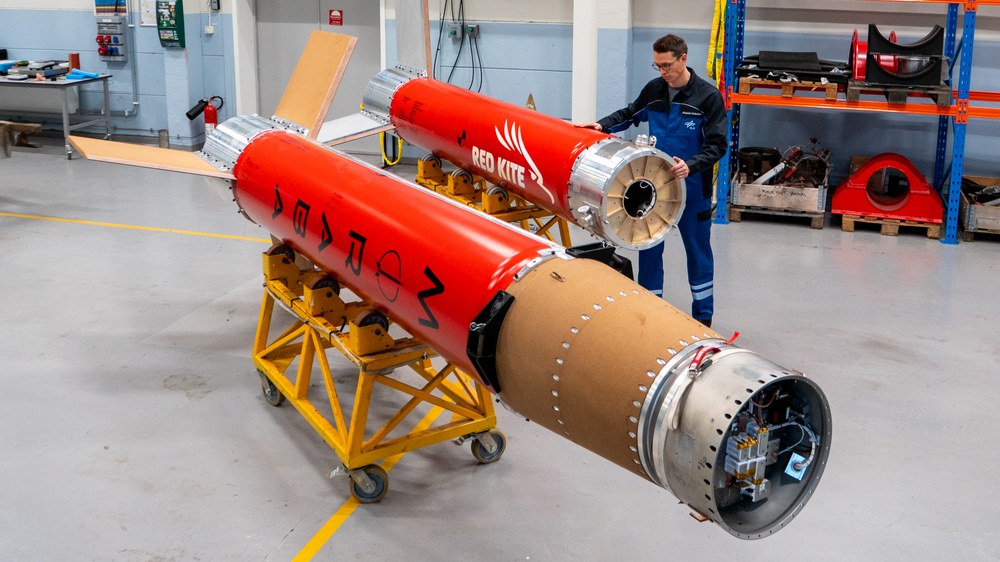
Germany’s DLR advanced its suborbital research capability with the MAPHEUS-16 sounding rocket, which launched on 12 November 2025 from the SSC Esrange Space Center in Sweden. The flight carried 21 experiments and delivered more than six minutes of microgravity, setting a programme payload record with roughly 500 kilograms on board. It was the first mission to combine two Red Kite solid rocket motors.
Mission highlights
- Launch: 05:05 CET, 12 November 2025, Esrange (SSC), Sweden
- Vehicle: over 13 metres tall; launch mass approximately three tonnes
- Propulsion: two Red Kite solid stages; motors jettisoned after burn
- Apogee: almost 260 kilometres
- Microgravity: more than six minutes; total flight time 14 minutes 41 seconds
- Payload: approximately 500 kilograms; 21 experiments
- Recovery: payload returned via two parachutes and was retrieved by helicopter
Propulsion and performance
Under its red casing, each Red Kite stage is a high-thrust solid motor that burns about one tonne of propellant in roughly 13 seconds, enabling demanding suborbital profiles. The Red Kite completed its inaugural flight in November 2023; MAPHEUS-16 is the first demonstration of a twin-stage configuration, increasing performance and payload capacity. The motor is a joint development by DLR and Bayern-Chemie, with operations planned and executed by DLR’s MORABA team. The MAPHEUS programme is targeting longer weightless periods on future flights, aiming for up to 10 minutes of microgravity.
Modular payload and experiment mix
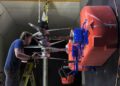
MAPHEUS-16 flew three MOSAIC segments (Micro-Experiments On Sounding Rockets As Insert Cubes). Each segment accommodates eight compact cubes measuring 10 centimetres per side. Standardised electrical, data and mechanical interfaces support a plug-and-play approach, packing more experiments into limited volume and power budgets. Industry partners including adesso, igus and Lamb Space Tec have contributed to MOSAIC developments across recent missions.
Research focus areas
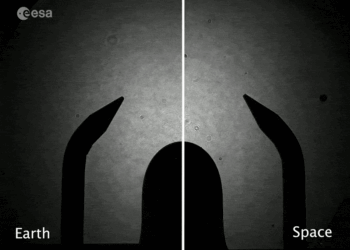
- Additive manufacturing: a specialised 3D-printing setup produced a sample in microgravity. Post-flight analysis will compare its microstructure and mechanical properties to a ground-made counterpart to assess feasibility and robustness of in-space manufacturing.
- Biomedicine: organoids, cells and biological membranes were exposed to reduced gravity to study physiological responses and mechanisms relevant to human spaceflight and terrestrial medicine. Partners include University Hospital Bonn, the GSI Helmholtz Centre for Heavy Ion Research, the University of Bordeaux and La Trobe University.
Why it matters
Sounding rockets provide rapid, cost-effective access to microgravity for technology maturation and scientific discovery. Since 2009, DLR’s MAPHEUS programme has offered regular flights to validate models, iterate hardware and derisk future orbital applications. The twin-Red-Kite MAPHEUS-16 mission extends the programme’s mass and time-in-microgravity envelope, opening further opportunities for materials science, engineering demonstrations and life sciences, and strengthening a German supply chain for suborbital research services.
Source: DLR news release