The Space Feed | Latest Space News
  • Home
  • News
    • Launches
    • Space Technology
    • Human Spaceflight
    • Space Exploration
    • Astronomy
  • Launch Schedule
    • Upcoming Launches
    • Completed Launches
  • Knowledge Base
    • All Missions
    • All Rockets
No Result
View All Result
  • Home
  • News
    • Launches
    • Space Technology
    • Human Spaceflight
    • Space Exploration
    • Astronomy
  • Launch Schedule
    • Upcoming Launches
    • Completed Launches
  • Knowledge Base
    • All Missions
    • All Rockets
No Result
View All Result
The Space Feed | Latest Space News

ESA Expands Estrack: New 35 m Deep-Space Antenna to Boost European Mission Communications

October 3, 2025
in Space Technology

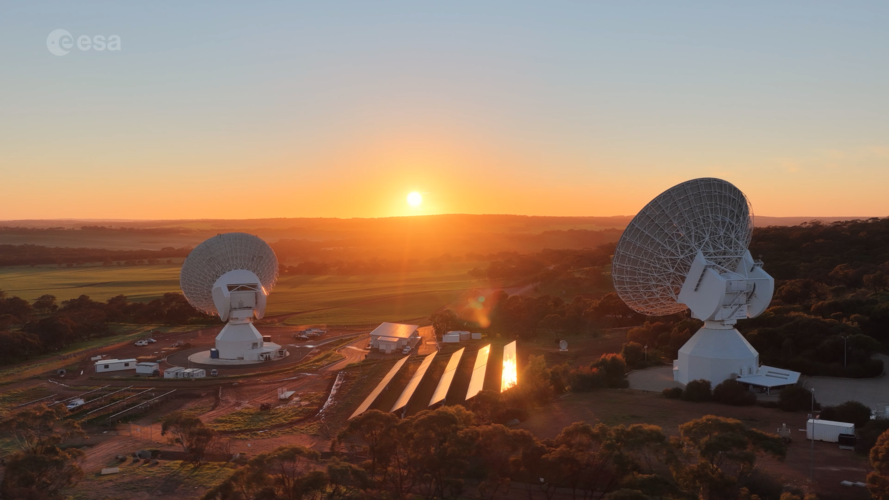
The European Space Agency (ESA) is expanding its Estrack satellite tracking network with a new 35 m deep-space antenna at New Norcia, Australia. The addition—Estrack’s fourth dish of this class—targets rising command, telemetry and science data demands from current and upcoming European missions across Earth orbit, Lagrange points and deep-space destinations. The milestone coincides with Estrack’s 50th anniversary, underscoring the network’s role as a core communications bridge between spacecraft and ESA’s European Space Operations Centre (ESOC) in Darmstadt, Germany. Source: ESA.

Why it matters

  • Capacity boost: The additional 35 m antenna increases downlink throughput for science data and uplink availability for time-critical commands.
  • Scheduling flexibility: More dish time reduces bottlenecks during busy mission phases, enabling better support for simultaneous spacecraft.
  • Resilience and redundancy: Co-locating a second deep-space antenna at New Norcia enhances operational robustness during maintenance or high-demand periods.
  • Scalability for future missions: The upgrade positions ESA to serve more complex trajectories and longer-distance operations.

Estrack at 50: a strategic European asset

Established in 1975, Estrack has grown into a network of six stations across six countries, providing global coverage for mission operations. The network connects spacecraft with ESOC for real-time tracking, telemetry and telecommand, supporting a diverse portfolio that spans Earth-orbiting satellites, comet and asteroid explorers, missions stationed at Sun–Earth Lagrange points, and probes traveling deep into the Solar System. Estrack also tracks European launchers during ascent, maintaining situational awareness from liftoff through orbital insertion.

  • Continuous visibility for spacecraft across multiple longitudes and hemispheres
  • High-precision tracking to enable navigation and timing
  • Science data relay to European science teams and archives

New Norcia’s expanded role

The new antenna will join the existing New Norcia dish to strengthen deep-space coverage in the Southern Hemisphere. Consolidating two large apertures at one site improves resource allocation and enables tighter coordination for mission-critical passes, especially during planetary encounters, commissioning, and anomaly resolution.

  1. Coordinated operations from ESOC to optimize pass planning and data return
  2. Improved link margins for long-range spacecraft and high-rate downlinks
  3. Added flexibility during launch and early orbit phases for European vehicles

With demand for ground segment services rising, the antenna expansion is a practical step to sustain European mission cadence and scientific return while reinforcing long-term operational resilience.

For more details and related media from ESA, visit the source: Tracking satellites at the speed of light.
Previous Post

UK backs satellite laser-threat detection sensors to safeguard critical space services

Next Post

ESA opens New Norcia 3 to strengthen deep-space communications and mission support

Related Posts

Space Technology

DLR’s MAPHEUS-16 Sets Microgravity Payload Record with Twin Red Kite Motors

November 12, 2025
Space Technology

ESA flags X5.1 flare and fast CMEs driving severe G4 storm with satellite and GNSS risk

November 12, 2025
Space Technology

Sentinel-1D Lifts Off on Ariane 62; DLR to Calibrate SAR for Copernicus Continuity

November 5, 2025
Space Technology

ESA’s AI quake-mapping models move toward operational use under CNES-led Charter

October 29, 2025
Space Technology

ESA’s Henon CubeSat clears CDR to demo deep-space comms, ion propulsion, and solar-storm early warning

October 29, 2025
Space Technology

ISS study maps fin-film condensation to advance spacecraft cooling systems

October 23, 2025
Next Post

ESA opens New Norcia 3 to strengthen deep-space communications and mission support

Leave a Reply Cancel reply

Your email address will not be published. Required fields are marked *

  • Trending
  • Comments
  • Latest

NASA and SpaceX Conduct Crew-11 Dry Run Ahead of Launch

July 29, 2025

SpaceX Dragon Missions: Crew Prepares for Departure and Arrival at ISS

July 30, 2025

NASA Advances Supersonic Parachute Technology for Mars Missions

July 30, 2025

Upcoming Suborbital Rocket Launches from NASA Wallops: July 28-August 8, 2025

July 28, 2025

Dragonfly Mission Hits Major Test Milestones, Targets 2028 Falcon Heavy Launch

1

ESA Initiates Construction of LISA Mission to Detect Gravitational Waves

0

UK-France MicroCarb Satellite Launches to Enhance Global CO₂ Monitoring

0

NASA’s SpaceX Crew-11 Arrives at Kennedy Space Center for Upcoming Launch

0

ESCAPADE Reset to Nov. 13 After G4 Storm; Blue Origin VADR Launch Preserves Mars Trajectory

November 13, 2025

Brazil, INPE and ESA plan uptake of Biomass P-band radar data for Amazon carbon monitoring

November 13, 2025

LOFAR and XMM-Newton confirm coronal mass ejection from a red dwarf, threatening exoplanet atmospheres

November 12, 2025

DLR’s MAPHEUS-16 Sets Microgravity Payload Record with Twin Red Kite Motors

November 12, 2025

Popular Stories

  • NASA and SpaceX Conduct Crew-11 Dry Run Ahead of Launch

    0 shares
    Share 0 Tweet 0
  • SpaceX Dragon Missions: Crew Prepares for Departure and Arrival at ISS

    0 shares
    Share 0 Tweet 0
  • NASA Advances Supersonic Parachute Technology for Mars Missions

    0 shares
    Share 0 Tweet 0
  • Upcoming Suborbital Rocket Launches from NASA Wallops: July 28-August 8, 2025

    0 shares
    Share 0 Tweet 0
  • SpaceX Crew-11 Prepares for Launch: Final Steps Before Hatch Closure

    0 shares
    Share 0 Tweet 0
  • About
  • Advertise
  • Privacy & Policy
  • Contact
The Space Feed

© 2025 Stride Interactive Group

No Result
View All Result
  • Home
  • News
    • Launches
    • Space Technology
    • Human Spaceflight
    • Space Exploration
    • Astronomy
  • Launch Schedule
    • Upcoming Launches
    • Completed Launches

© 2025 Stride Interactive Group