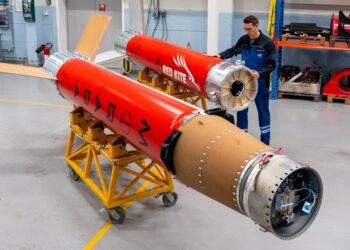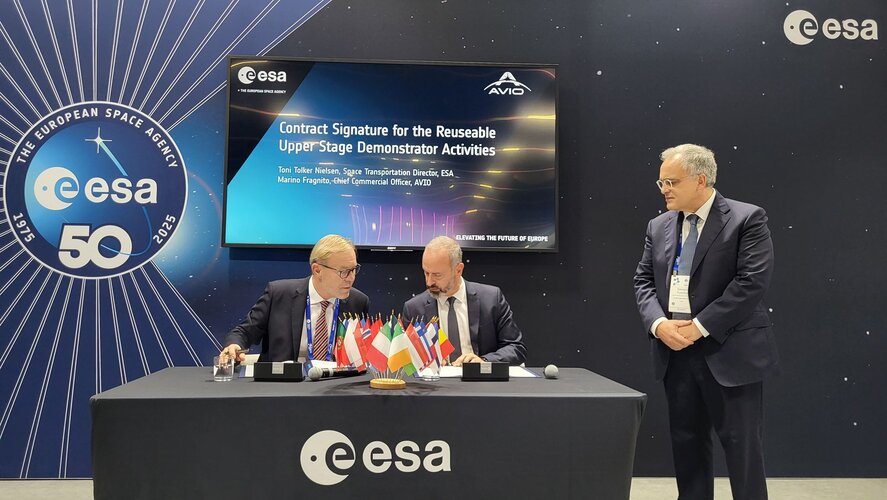
The European Space Agency (ESA) has awarded €40 million to Avio for a 24-month program to mature a reusable upper stage demonstrator. Signed during the International Astronautical Congress in Sydney, the contract initiates system definition, technology maturation, and preliminary design work for both flight and ground segments that could lead to an in‑flight demonstration and eventual reuse of an orbital stage.
Scope of the contract
The activity is structured to reduce technical and programmatic risk ahead of a demonstration mission. Key elements include:
- Mission and system requirements for a reusable upper-stage demonstrator
- Trade studies and concept selection across recovery and refurbishment options
- Preliminary design for the flight segment, including propulsion, structures, GNC, TPS, and avionics
- Design of ground segment and operations, including recovery and turnaround flows
- Mission analysis for ascent, orbit operations, deorbit, reentry, and landing or recovery
Technologies under study
- Advanced liquid propulsion with liquid oxygen–methane cycles for restart and throttle capability
- Reentry and thermal protection systems to survive orbital return
- Guidance, navigation, and control tailored to deorbit, reentry, and precision recovery
- Lightweight structures and reusable avionics for rapid refurbishment
- Recovery architectures, from propulsive return to aerodynamic deceleration and capture
Industrial and program context
The work builds on European developments in return technologies and ongoing studies into reusable lower stages. It is intended to complement multiple launcher pathways, including evolutions of the Vega family and concepts for fully reusable European launch systems. Avio’s parallel work on methalox engines and flight stages, together with heritage from Europe’s Space Rider reentry vehicle program, informs the approach to recoverability and reuse.
Why it matters for Europe
- Potential to lower recurring launch costs and increase flight cadence
- Greater flexibility for orbital missions through restartable upper-stage capability
- Strengthening of European industrial competitiveness in a market shifting to reusability
- Progress toward future space transportation architectures and in‑orbit logistics hubs
Timeline and what to watch
- System and technology consolidation during the 24‑month phase, culminating in preliminary design reviews
- Down‑selection of recovery and refurbishment concepts based on performance, cost, and operability
- Definition of an in‑flight demonstration profile and potential integration paths with current or next‑generation European launchers
The effort underscores ESA’s strategy to de‑risk critical technologies for full vehicle reusability while preserving optionality across launcher architectures. Further program decisions will hinge on outcomes of the design phase, funding profiles, and coordination with European industry.
Source: ESA announcement on the reusable upper stage demonstration mission.