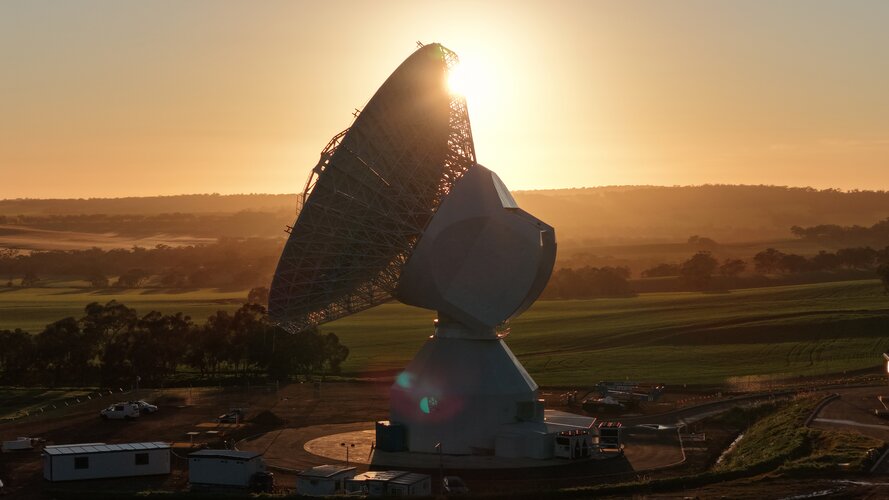
The European Space Agency has inaugurated New Norcia 3, a 35-meter deep-space antenna near New Norcia, Western Australia, expanding the capacity of ESA’s Estrack network to communicate with spacecraft across the Solar System. Located about 115 km north of Perth, the new dish is the network’s fourth deep-space antenna and the second at the New Norcia site. It is slated to enter operational service in 2026.
Built to address rapidly growing data demands from scientific, exploration and space safety missions, the antenna is designed to strengthen Europe’s autonomy in deep-space operations while enhancing international cross-support with partner agencies and commercial operators. With two deep-space antennas on the same site, New Norcia becomes ESA’s first ground station configured for dual deep-space coverage, complementing Estrack stations in Malargüe (Argentina) and Cebreros (Spain) for near-continuous global visibility.
Key capabilities
New Norcia 3 integrates cryogenically cooled front-end receivers operating near −263°C to boost sensitivity for extremely weak signals from distant spacecraft. Uplink capability is provided by a 20 kW radio-frequency amplifier for command transmission over millions to billions of kilometers. The system adds precision timing and advanced RF tools to support deep-space navigation and science downlinks.
Mission support
Once operational, the antenna will support ongoing and upcoming missions across ESA’s portfolio and partner fleets, including:
- Current: Juice, Solar Orbiter, BepiColombo, Mars Express, Hera
- Upcoming: PLATO, EnVision, ARIEL, Ramses, Vigil
- Cross-support: NASA, JAXA, ISRO and commercial deep-space missions
During final calibration, the antenna has already received a test signal from ESA’s Euclid observatory, validating receive-chain performance ahead of commissioning.
Industrial delivery and investment
Construction began in 2021 and was delivered on schedule. The project’s estimated cost is EUR 62.3 million, covering the antenna, station upgrades and services, with EUR 3 million contributed by the Australian Space Agency. European industry led the build, with Thales Alenia Space (France) and Schwartz Hautmont Construcciones Metálicas (Spain) as co-prime contractors, and Australian companies including TIAM Solutions, Thales Australia, Fredon and Westforce Construction contributing locally. The station is operated on-site by CSIRO, Australia’s national science agency, which also operates NASA’s Tidbinbilla Deep Space Communication Complex.
Broader site role in Western Australia
Beyond deep-space links, the New Norcia site hosts a 4.5-meter antenna that tracks Ariane 6 and Vega-C during ascent, securing critical launcher telemetry over Western Australia. It also includes a custom transponder supporting calibration for ESA’s Biomass mission, launched in 2025, during periodic overflights throughout the satellite’s planned five-year survey.
Why it matters
New Norcia 3 is intended to increase data return, improve scheduling flexibility across hemispheres and raise resiliency for Europe’s deep-space infrastructure. The station’s geographic location enables around-the-clock coverage when combined with Estrack’s other deep-space sites, while cross-support arrangements are expected to boost science yield and operational efficiency globally. The facility is planned for a multi-decade service life, deepening European–Australian cooperation in communications, space safety and mission operations.
Source: ESA