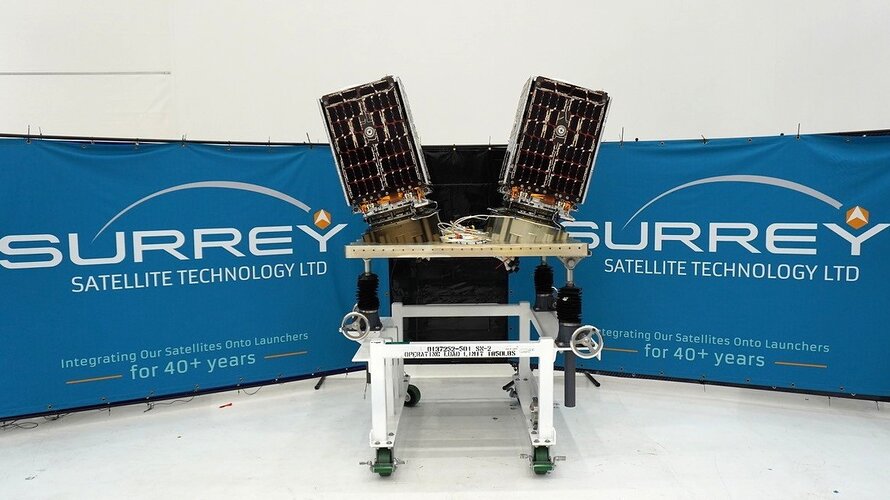
The European Space Agency is preparing its twin HydroGNSS microsatellites for launch on SpaceX’s Falcon 9 during the Transporter-15 rideshare mission from Vandenberg Space Force Base in California. The mission marks ESA’s first Scout venture under the FutureEO programme and will use GNSS reflectometry to observe key variables in Earth’s water cycle.
Launch preparations at Vandenberg
After arriving at the launch site at the end of September, the pair completed final processing and are advancing toward fairing closure. The identical spacecraft will share their ride to orbit with several other small satellites.
- Functional testing completed
- Propellant loading performed
- Battery charging completed
- Integration with the launch adapter finished
The liftoff is scheduled for this month, pending final checks and mission readiness milestones.
Mission objectives and measurement approach
HydroGNSS will employ Global Navigation Satellite System (GNSS) reflectometry, comparing signals broadcast by systems such as GPS and Galileo with their reflections off Earth’s surface. Variations in the reflected L-band signals carry information about surface and near-surface conditions linked to the water cycle. Once in orbit, the two satellites will fly approximately 180 degrees apart to maximise global coverage and revisit rates.
The mission focuses on variables recognised as Essential Climate Variables (ECVs) or closely related parameters:
- Soil moisture
- Freeze–thaw state over permafrost
- Inundation extent
- Above-ground biomass
These data are intended to support climate research, agricultural planning, flood monitoring, wetland assessment, permafrost dynamics studies and improved understanding of forest carbon storage.
Part of ESA’s agile Scout line
HydroGNSS is developed within ESA’s Earth Observation FutureEO Scout framework, which aims to deliver targeted science rapidly and affordably by leveraging small satellites and streamlined development cycles. The prime contractor is Surrey Satellite Technology Ltd (SSTL) in the UK.
- From kick-off to launch in roughly three years
- End-to-end mission budget capped at €35 million, including in-orbit commissioning
The mission’s measurements will be provided as a data service to the scientific community and ESA to accelerate Earth system understanding.
What’s next
With adapter integration complete, the next step is closing the rocket fairing ahead of liftoff. Following separation in orbit, the satellites will enter commissioning to verify performance, calibrate instruments and begin routine GNSS-R acquisitions for downstream science and applications.
Source: ESA