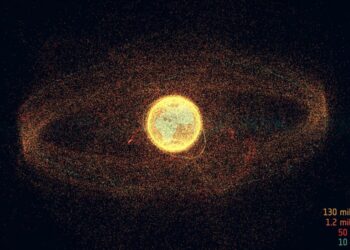
Europe is sharpening its approach to space risk in 2025 as the European Space Agency outlines a refreshed Space Safety agenda ahead of its Ministerial Conference. The plan advances independent, continuous access to critical space safety data and services for Europe while scaling technologies to detect, predict and mitigate hazards ranging from solar storms and asteroids to the growing challenge of space debris. The priorities reflect both operational needs and a push for long-term sustainability in orbit.
Key pillars for 2025
- Vigil space weather mission: ESA is preparing its deep-space sentry to deliver earlier warnings of solar activity that can disrupt satellites, navigation, power grids and aviation operations. Positioned at a unique vantage point in space, Vigil is designed to increase lead time for operators on the ground and in orbit.
- Planetary defence readiness: The programme continues to enhance asteroid detection and prediction capabilities while maturing response options. Missions including Hera and Ramses are being developed to refine Europe’s ability to characterize threats and practice deflection-readiness tactics if warranted.
- Zero Debris standards and design: ESA is accelerating measures to prevent the creation of new debris by promoting sustainable satellite design, rigorous end‑of‑life practices and a stronger compliance culture across the European space ecosystem.
- Active debris removal and in‑orbit servicing: Demonstrations and early services target life‑extension, refuelling and the safe disposal of defunct hardware, laying groundwork for a future circular economy in space.
- Collision avoidance and traffic management: ESA is expanding tools to detect, track and mitigate conjunction risks, including the evolving CREAM platform to support satellite operators with timely, actionable collision avoidance services.
- Independent access to critical data: The agenda seeks resilient European data streams for space weather, debris monitoring and navigation support, reinforcing continuity of services in a period of geopolitical uncertainty.
Why it matters for Europe
Space infrastructure underpins communications, navigation, Earth observation and security. ESA’s Space Safety Programme aims to reduce operational risk and safeguard economic activity by improving forecasting accuracy for solar storms, tightening space traffic management and ensuring satellites can be protected or safely deorbited. The Zero Debris drive, paired with active debris removal and servicing, is intended to curb collision risk and preserve access to heavily used orbits. Enhancements to planetary defence also strengthen Europe’s ability to detect and characterize near‑Earth objects and plan proportionate responses.
Beyond immediate risk reduction, the agenda supports industrial competitiveness by accelerating technologies such as autonomous navigation, high‑fidelity space environment monitoring and standardized operations for safe disposal and servicing. Together, these measures are intended to lower mission uncertainty, cut insurance and avoidance costs, and stabilize long‑term access to orbit.
What to watch next
- Decisions at the 2025 ESA Ministerial Conference on funding lines for Space Safety expansion and service delivery.
- Vigil mission development milestones, including ground segment integration and data product readiness for earlier storm alerts.
- Operational growth of collision avoidance services via the CREAM platform, targeting faster conjunction screening and coordination with operators.
- Progress toward Zero Debris implementation, including new mission design rules, compliance pathways and community adoption across European industry.
- Continued maturation of planetary defence activities, including Hera and Ramses, to refine threat assessment and response options.
ESA’s 2025 agenda signals a concerted shift from isolated projects to an integrated, service‑oriented model for space safety. By coupling early‑warning capabilities, debris prevention and removal, and more robust traffic management, Europe is positioning its space sector for safer operations and sustainable growth over the coming decade.
Source: ESA