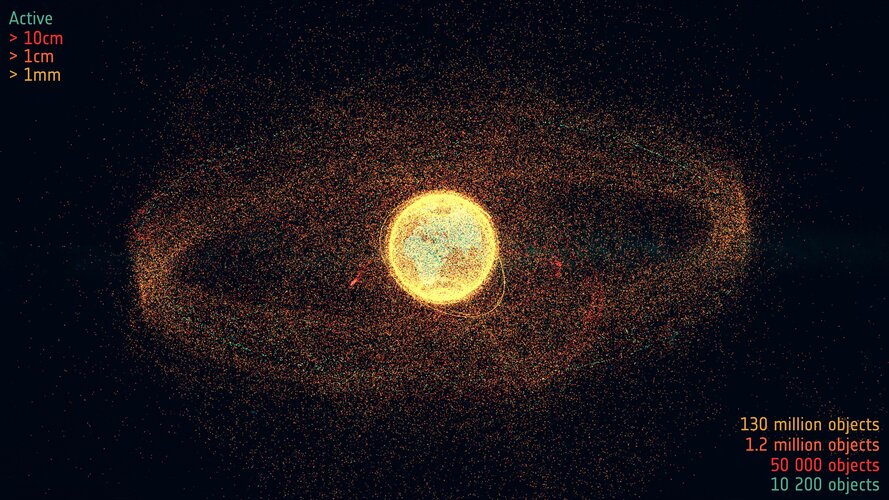
Europe’s space sector has a new tool to measure the long-term impact of satellite missions on Earth’s orbital environment. The European Space Agency (ESA) has introduced the Space Environment Health Index, a single-number indicator added to its annual Space Environment Report to track how crowded and collision-prone orbits are expected to become over a 200-year horizon.
What the Index Measures
The index condenses complex orbital dynamics and operator behavior into one score reflecting whether the environment is trending toward stability or increasing risk. A value of 1 represents a proposed sustainability threshold for long-term operations. This benchmark is grounded in 2014 Inter-Agency Space Debris Coordination Committee (IADC) mitigation guidelines, predating the surge in large constellations.
ESA reports that the global index now sits near level 4, indicating a risk roughly four times higher than the threshold. Even in 2014, projections already pointed to a risk level about three times the minimum desirable state; sustained growth in satellites and debris has pushed the forecast further upward, despite broader adoption of mitigation practices.
How the Score Is Computed
The metric evaluates each object or mission and aggregates their effects into a global outlook. Key inputs include:
- Size and shape: Cross-section and geometry influence collision probability and drag.
- Orbital lifetime: Natural reentry timelines or planned removal determine persistence.
- Collision avoidance capability: Propulsion and tracking affect maneuverability and conjunction risk.
- Passivation: Post-mission safing reduces on-orbit explosion potential.
- Fragmentation risk: Likelihood and consequences of breakups increase debris counts.
Combined, these factors estimate a mission’s debris-generation potential, the knock-on collision risk to neighboring spacecraft, and cumulative environmental impact over two centuries. Higher scores indicate a greater negative contribution; lower scores reflect more sustainable behavior. In the future, the index could enable clear sustainability ratings for mission portfolios.
Current Outlook
The global Health Index nearing level 4 signals that the orbital environment is trending away from long-term stability under current practices. Rising traffic in low-Earth orbit (LEO), fragmentation events, and extended on-orbit lifetimes are compounding collision probabilities, elevating operational risk and potential service disruption over time.
Use Cases for Industry and Policy
- Mission design: Set low-score targets via shorter orbital lifetimes, reliable end-of-life disposal, and robust collision avoidance.
- Licensing and regulation: Integrate index thresholds into licensing criteria and risk assessments.
- Insurance and procurement: Use scores in underwriting, contracting, and ecodesign pipelines to reward lower-risk architectures.
- Standards evolution: Track progress against the threshold to inform updates to debris mitigation guidelines.
The framework aligns with ESA’s Zero Debris approach, which targets elimination of debris generation from ESA missions by 2030 and encourages harmonized practices across the sector.
Why It Matters Now
Orbital debris risk accumulates. Breakups today can amplify collision probabilities for decades, and growth in large constellations accelerates congestion. Long before orbits become unusable, operators could face higher costs, increased shielding and maneuvering demands, and reduced access to preferred orbital regimes, with implications for human spaceflight and critical services.
A transparent, comparable metric enables accountability and coordinated action across operators, regulators, and insurers. By turning system-level risk into a clear score, the Space Environment Health Index aims to guide design choices, licensing decisions, and investment strategies toward a more sustainable orbital economy.
Further details and methodology are available in ESA’s announcement and the latest Space Environment Report: official release.