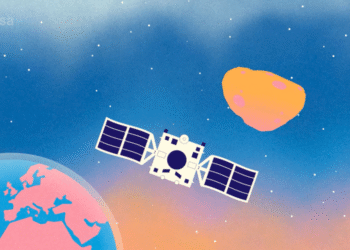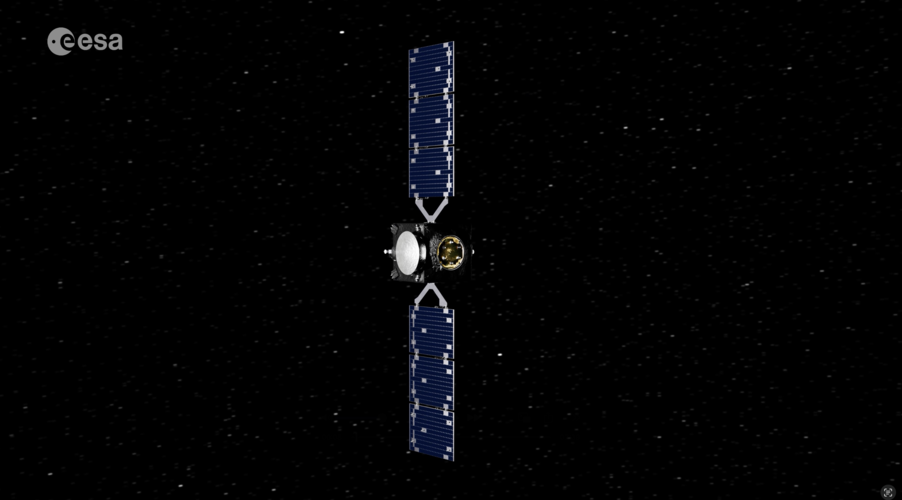
ESA’s Hera mission has completed its first year in deep space, achieving a Mars flyby, validating autonomous navigation techniques, and remaining on schedule for a Didymos arrival in 2026. The planetary defence spacecraft is now cruising toward aphelion on a trajectory to the Didymos–Dimorphos binary asteroid system, where it will conduct the post-impact survey of NASA’s 2022 DART test.
Year one milestones
- Executed a gravity-assist Mars flyby to set up the approach to Didymos.
- Ran autonomous-navigation trials using optical observations of Earth and the Moon to prepare for close-proximity operations around the asteroids.
- Captured its first asteroid image from about 3 million km, validating the performance of the Asteroid Framing Camera.
- Continued nominal cruise operations while heading toward aphelion, the mission’s furthest distance from the Sun.
Launch window and trajectory
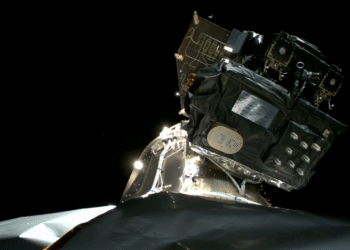
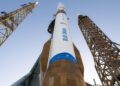
Hera launched on 7 October 2024 under a narrowly preserved window after its launcher had been grounded due to a prior anomaly and Hurricane Milton approached Cape Canaveral. The Mars gravity assist was time-critical; missing it would have extended the flight by years. Weather clearance and authorization shortly before liftoff enabled the nominal ascent and injection onto the interplanetary trajectory required for the 2026 arrival.
What to watch before arrival
Through 2025–2026, the team plans continued cruise operations, software updates, and instrument calibrations to refine approach-phase performance. The emphasis remains on robust, fault-tolerant autonomous navigation to support safe, close-range mapping of the binary system.
- Deep-space cruise through aphelion with regular health checks and navigation updates.
- Approach rehearsals and optical navigation campaigns to sharpen tracking of Didymos and Dimorphos.
- Final preparations for arrival in autumn 2026, followed by detailed characterization of the system.
Once on station, Hera will document the DART impact outcome on the smaller moonlet, Dimorphos, and place the kinetic-impact test in geological and dynamical context. The measurements are intended to strengthen models for asteroid deflection and improve planning for future planetary defence campaigns.
Source and mission update video: ESA: Hera’s first year in space.