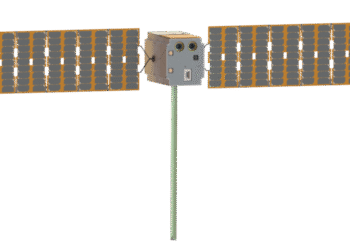
ESA has outlined plans for RISE, its first in-orbit servicing mission designed to extend the working lives of geostationary satellites. The mission aims to launch in 2029 and will be developed and operated with D-Orbit. According to the Agency’s latest update and video, RISE will rendezvous and dock with a client spacecraft in geostationary orbit (GEO) to provide attitude and orbit control support, enabling continued operations for satellites that remain otherwise functional. Source: ESA: RISE mission overview.
What RISE will demonstrate
RISE is a commercial in-orbit servicing pathfinder focused on safe, repeatable proximity operations and docking in the GEO belt. The demonstration is intended to validate a service architecture that can be scaled to multiple clients following initial trials.
- Rendezvous and proximity operations with a GEO client using established safety protocols.
- Non-intrusive docking to a satellite that requires assistance with station-keeping and attitude control.
- Provision of orbit and attitude support to extend the client’s mission life.
- Adherence to ESA’s Zero Debris approach for safe operations and disposal.
Industry roles and commercial pathway
D-Orbit serves as prime contractor and operator for the mission and is a co-founder of the service concept. Following successful validation of performance during the first docking and assist cycle, D-Orbit plans to transition RISE into commercial life-extension services for GEO operators. The target market includes satellites nearing propellant limits or facing attitude/orbit-control constraints but still delivering payload performance.
Strategic context: sustainability and GEO economics
RISE aligns with ESA’s Space Safety programme and the Agency’s Zero Debris objectives, which aim to halt the creation of new debris by 2030 through safe mission design and end-of-life practices. Life-extension services are a key lever for a more circular economy in orbit, potentially reducing replacement launch cadence, optimizing asset utilization, and preparing the ground for future capabilities such as refuelling, refurbishment and in-orbit assembly.
As GEO operators face pressure to manage costs and limit debris, standardized servicing could become an integral part of fleet sustainment strategies. Demonstrating reliable rendezvous and docking, combined with predictable service terms, will be central to adoption.
Timeline and what to watch
- Mission development toward a planned 2029 launch.
- Demonstration of safe rendezvous, docking and assist functions with a GEO client.
- Transition to commercial services contingent on performance verification.
Key milestones to monitor include spacecraft integration and testing, licensing and safety reviews for GEO proximity operations, interface standardization with prospective clients, and service-readiness criteria for post-demonstration operations. If executed as planned, RISE would establish a European-operated servicing option in GEO and support the broader maturation of on-orbit services across refuelling, repair and assembly in the coming decade.