The Space Feed | Latest Space News
  • Home
  • News
    • Launches
    • Space Technology
    • Human Spaceflight
    • Space Exploration
    • Astronomy
  • Launch Schedule
    • Upcoming Launches
    • Completed Launches
  • Knowledge Base
    • All Missions
    • All Rockets
No Result
View All Result
  • Home
  • News
    • Launches
    • Space Technology
    • Human Spaceflight
    • Space Exploration
    • Astronomy
  • Launch Schedule
    • Upcoming Launches
    • Completed Launches
  • Knowledge Base
    • All Missions
    • All Rockets
No Result
View All Result
The Space Feed | Latest Space News

Falcon 9 Deploys IMAP, Carruthers, and SWFO-L1 to L1 for Enhanced Space-Weather Coverage

September 25, 2025
in Launches

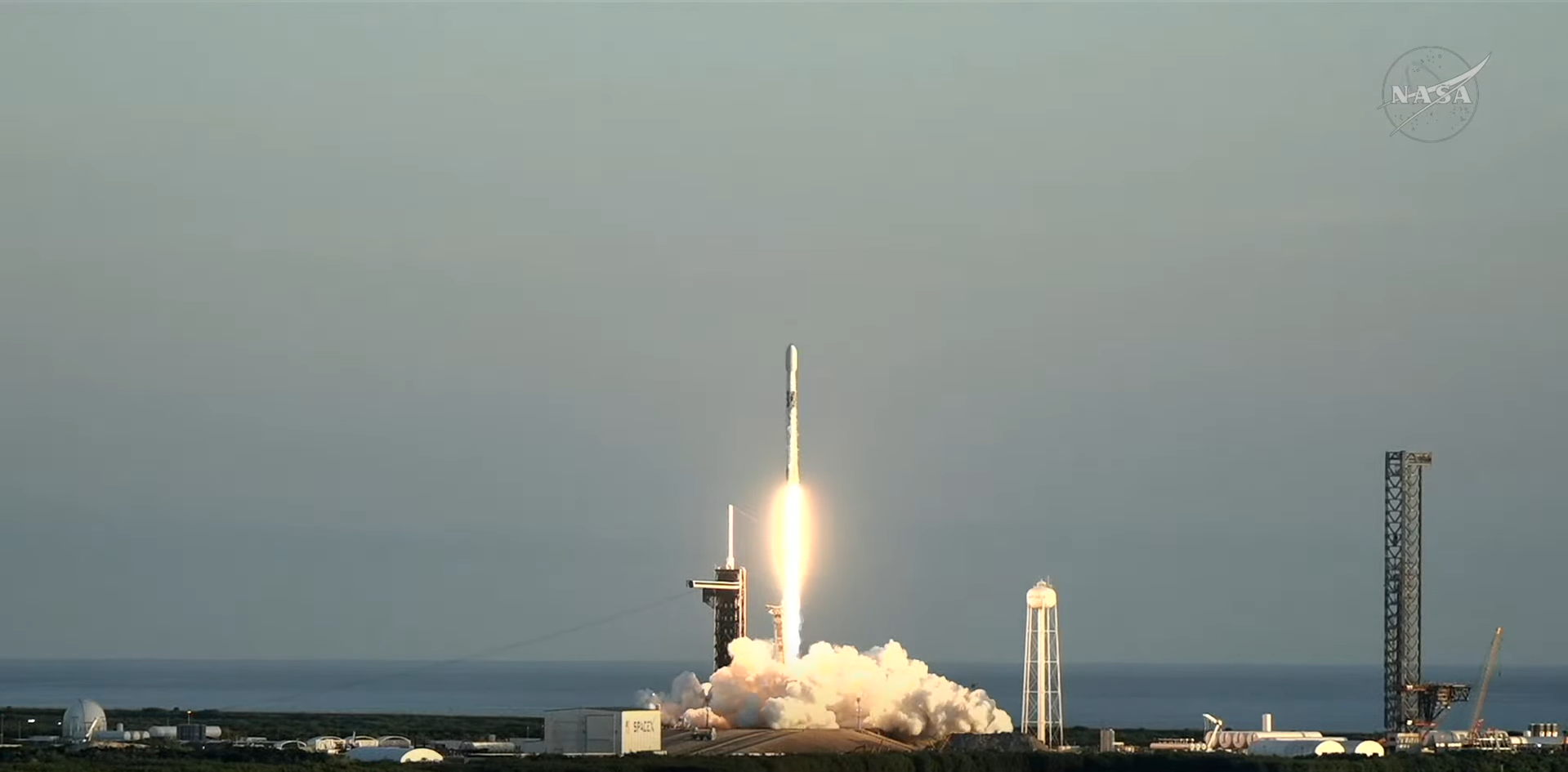
SpaceX’s Falcon 9 has deployed three spacecraft — NASA’s IMAP, the Carruthers Geocorona Observatory, and NOAA’s SWFO-L1 — on a trajectory to the Sun–Earth Lagrange Point 1 (L1), expanding operational and scientific coverage of space weather. The mission lifted off at 7:30 a.m. EDT on Sept. 24, 2025, from Launch Complex 39A at NASA’s Kennedy Space Center. Following nominal ascent, all payloads separated and established communications as planned.

Why it matters

Enhanced space-weather monitoring and heliophysics research at L1 will improve forecasting of solar activity that can affect satellites, communications, navigation, power grids, and crewed exploration beyond low Earth orbit. The trio combines operational vigilance with fundamental science, linking the Sun’s variability to conditions at Earth and the boundary of the heliosphere.

Missions at a glance

  • IMAP (Interstellar Mapping and Acceleration Probe): Charts the structure and dynamics of the heliosphere and samples particles from the solar wind and interstellar boundary to investigate how energetic particles are accelerated and transported.
  • Carruthers Geocorona Observatory (also referred to as GLIDE): Images Earth’s geocorona in ultraviolet to track how the exosphere responds to solar storms and seasonal variations, advancing understanding of the upper-atmosphere–space environment interface.
  • SWFO-L1 (Space Weather Follow On – L1): NOAA’s first dedicated, full-time operational space-weather observatory at L1, providing continuous solar wind, magnetic field, and imagery data to support faster, more accurate forecasts and alerts.

Operations and trajectory

The spacecraft are bound for L1, a gravitational balance point about one million miles (1.5 million kilometers) sunward of Earth that offers an unobstructed, real-time view of the Sun and the upstream solar wind. After cruise and insertion, each spacecraft will complete instrument checkouts and calibrations before entering routine operations.

  1. Launch and separation from Falcon 9 from KSC LC-39A.
  2. Cruise phase to Sun–Earth L1 over the coming months.
  3. Commissioning at L1, followed by transition to science and operational data delivery.

Agency and industry roles

  • NASA: Leads IMAP and the Carruthers mission through the Science Mission Directorate and Goddard Space Flight Center; Launch Services Program at Kennedy managed the launch service.
  • NOAA: Manages SWFO-L1 as an operational space-weather asset, developed with NASA Goddard and commercial partners.
  • Princeton University: IMAP principal investigator leadership.
  • Johns Hopkins Applied Physics Laboratory: Built and will operate the IMAP spacecraft.
  • University of Illinois Urbana–Champaign: Leads the Carruthers mission science.
  • UC Berkeley Space Sciences Laboratory: Designed and built the Carruthers ultraviolet imagers.
  • BAE Systems: Built the Carruthers spacecraft bus.
  • SpaceX: Provided launch via Falcon 9.

What to watch next

Upon arrival at L1 and completion of commissioning, SWFO-L1 will begin continuous operational data return to support forecast centers, while IMAP and Carruthers will commence science campaigns that link solar drivers to geospace and the heliosphere. Results are expected to refine models of solar particle acceleration, improve nowcasting and warning lead times, and strengthen resilience for spacecraft, infrastructure, and future crewed missions.

Source: NASA news release.
Previous Post

SWFO-L1 Checks In: NOAA Space Weather Sentinel Begins Trek to L1

Next Post

NASA and NOAA Deploy IMAP, Carruthers, and SWFO-L1 to L1 to Boost Space Weather Forecasts

Related Posts

Launches

ESCAPADE Reset to Nov. 13 After G4 Storm; Blue Origin VADR Launch Preserves Mars Trajectory

November 13, 2025
Launches

Ariane 6 Places Sentinel-1D in Orbit, Expanding Copernicus SAR and AIS Coverage

November 7, 2025
Launches

ESA readies twin HydroGNSS GNSS-R microsats for Transporter-15 liftoff from Vandenberg

November 6, 2025
Launches

Ariane 6 places Sentinel-1D in orbit, restoring dual SAR coverage and enhancing AIS updates

November 5, 2025
Launches

Ariane 6 places Sentinel-1D in orbit, boosting Copernicus SAR and ship-tracking capacity

November 5, 2025
Launches

Ariane 6 deploys Copernicus Sentinel-1D, expanding C-band SAR and AIS coverage

November 4, 2025
Next Post

NASA and NOAA Deploy IMAP, Carruthers, and SWFO-L1 to L1 to Boost Space Weather Forecasts

Leave a Reply Cancel reply

Your email address will not be published. Required fields are marked *

  • Trending
  • Comments
  • Latest

NASA and SpaceX Conduct Crew-11 Dry Run Ahead of Launch

July 29, 2025

SpaceX Dragon Missions: Crew Prepares for Departure and Arrival at ISS

July 30, 2025

NASA Advances Supersonic Parachute Technology for Mars Missions

July 30, 2025

Upcoming Suborbital Rocket Launches from NASA Wallops: July 28-August 8, 2025

July 28, 2025

Dragonfly Mission Hits Major Test Milestones, Targets 2028 Falcon Heavy Launch

1

ESA Initiates Construction of LISA Mission to Detect Gravitational Waves

0

UK-France MicroCarb Satellite Launches to Enhance Global CO₂ Monitoring

0

NASA’s SpaceX Crew-11 Arrives at Kennedy Space Center for Upcoming Launch

0

ESCAPADE Reset to Nov. 13 After G4 Storm; Blue Origin VADR Launch Preserves Mars Trajectory

November 13, 2025

Brazil, INPE and ESA plan uptake of Biomass P-band radar data for Amazon carbon monitoring

November 13, 2025

LOFAR and XMM-Newton confirm coronal mass ejection from a red dwarf, threatening exoplanet atmospheres

November 12, 2025

DLR’s MAPHEUS-16 Sets Microgravity Payload Record with Twin Red Kite Motors

November 12, 2025

Popular Stories

  • NASA and SpaceX Conduct Crew-11 Dry Run Ahead of Launch

    0 shares
    Share 0 Tweet 0
  • SpaceX Dragon Missions: Crew Prepares for Departure and Arrival at ISS

    0 shares
    Share 0 Tweet 0
  • NASA Advances Supersonic Parachute Technology for Mars Missions

    0 shares
    Share 0 Tweet 0
  • Upcoming Suborbital Rocket Launches from NASA Wallops: July 28-August 8, 2025

    0 shares
    Share 0 Tweet 0
  • SpaceX Crew-11 Prepares for Launch: Final Steps Before Hatch Closure

    0 shares
    Share 0 Tweet 0
  • About
  • Advertise
  • Privacy & Policy
  • Contact
The Space Feed

© 2025 Stride Interactive Group

No Result
View All Result
  • Home
  • News
    • Launches
    • Space Technology
    • Human Spaceflight
    • Space Exploration
    • Astronomy
  • Launch Schedule
    • Upcoming Launches
    • Completed Launches

© 2025 Stride Interactive Group