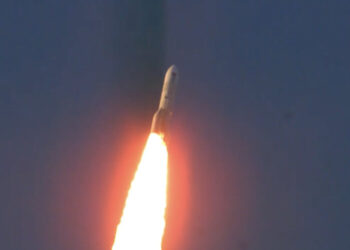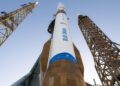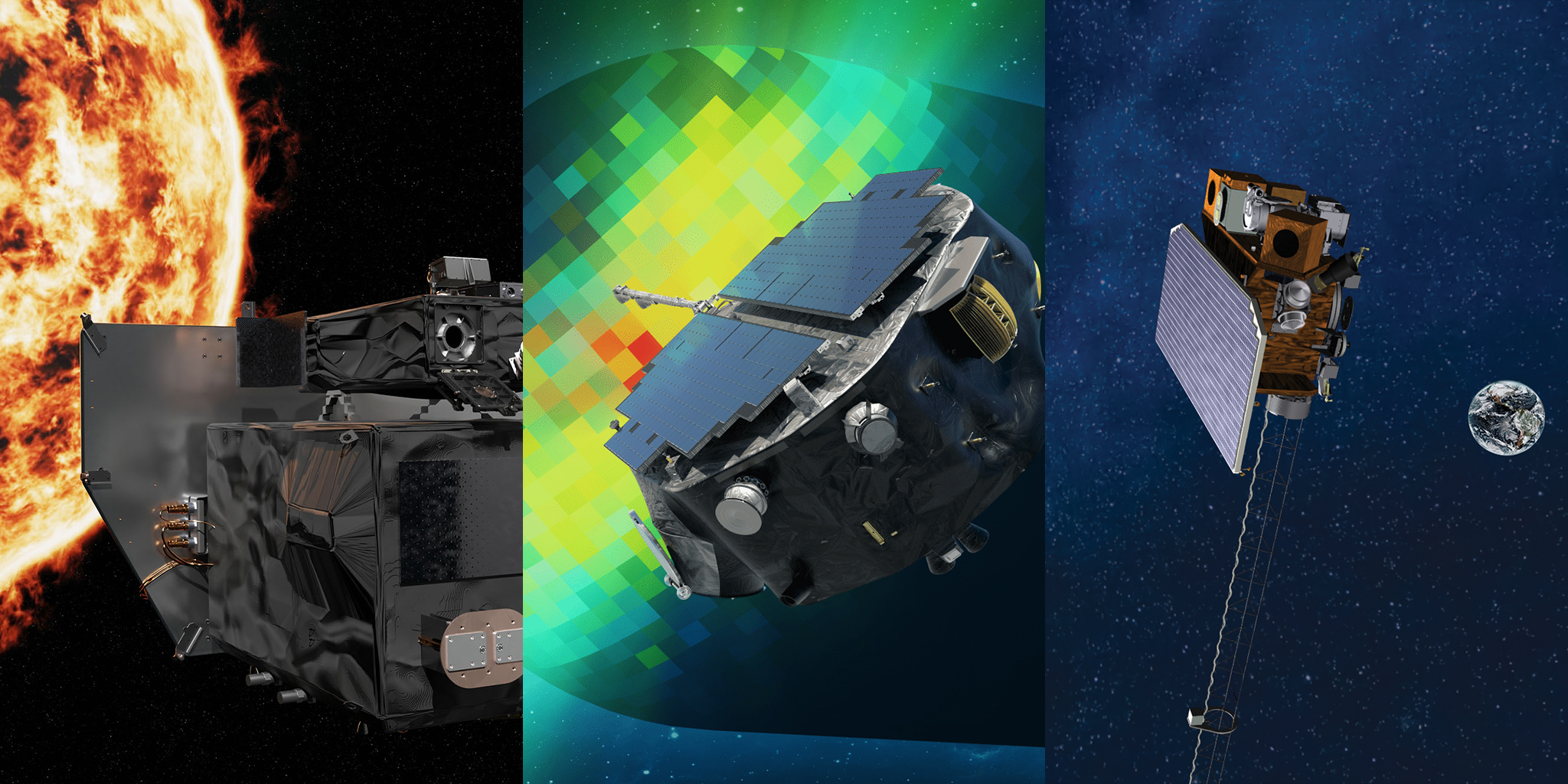
SpaceX’s Falcon 9 is targeting 7:32 a.m. EDT, Tuesday, Sept. 23, to launch three space-weather missions from Launch Complex 39A at NASA’s Kennedy Space Center. The primary payload, NASA’s Interstellar Mapping and Acceleration Probe (IMAP), will fly with two rideshares: NOAA’s Space Weather Follow On-L1 (SWFO-L1) and NASA’s Carruthers Geocorona Observatory (GLIDE). NASA launch coverage is scheduled to begin at 6:40 a.m. EDT on NASA+ and other platforms.
What the missions will do
- IMAP: Investigates how the Sun’s energy and particles interact with the heliosphere to map its boundaries and improve understanding of space weather, energetic particles, and radiation environments affecting spacecraft and human explorers.
- SWFO-L1 (NOAA): Provides continuous, operational monitoring of the solar wind and solar storms as an early warning capability for potentially disruptive space-weather events that can affect power grids, satellites, communications, and aviation.
- Carruthers Geocorona Observatory (GLIDE): Observes Earth’s exosphere by imaging the ultraviolet glow of the geocorona, extending measurements first conducted during Apollo-era observations to refine models of Earth’s outer atmosphere and its response to solar activity.
Destination and operations
All three spacecraft are bound for Lagrange Point 1 (L1), about one million miles sunward of Earth. From this vantage, the missions will measure the solar wind upstream of our planet and characterize the heliospheric environment in near real time, while Carruthers provides complementary context on the outermost reaches of Earth’s atmosphere.
How to follow launch coverage
NASA will provide multi-platform coverage leading up to liftoff. All times are Eastern and subject to change based on real-time operations:
- Sun., Sept. 21 – 2:30 p.m.: Prelaunch news conference on the space-weather missions.
- Sun., Sept. 21 – 3:45 p.m.: NASA/NOAA science briefing on mission objectives and expected data products.
- Mon., Sept. 22 – 11:30 a.m.: In-person media interview opportunities; remote requests due Sept. 18.
- Tue., Sept. 23 – 6:40 a.m.: Live launch coverage begins on NASA+, Amazon Prime, and additional outlets; Spanish-language coverage available on NASA+ and the agency’s Spanish-language YouTube channel.
- Tue., Sept. 23 – 7:32 a.m.: Targeted liftoff of Falcon 9 with IMAP, SWFO-L1, and Carruthers.
NASA’s website will host a live blog with countdown milestones beginning no earlier than 6 a.m. Streaming video and imagery will be available on demand shortly after liftoff. Audio-only options will be carried on NASA’s V-circuits, alongside a mission-audio feed without media commentary. Media accreditation for in-person coverage is closed.
Why it matters
Improved space-weather monitoring and heliophysics science at L1 directly support spacecraft operations, crew safety, and terrestrial infrastructure resiliency. IMAP’s mapping of the heliosphere, SWFO-L1’s operational monitoring, and Carruthers’ exospheric imaging form a coordinated capability to enhance forecast lead times and sharpen models used by government and commercial space operators.
Key details
- Rocket: SpaceX Falcon 9
- Launch site: LC-39A, Kennedy Space Center, Florida
- Targeted liftoff: 7:32 a.m. EDT, Sept. 23
- Destination: Lagrange Point 1 (~1 million miles sunward)
- Payloads: IMAP (NASA) with rideshares SWFO-L1 (NOAA) and Carruthers Geocorona Observatory (NASA)
- Coverage: NASA+, agency website, and social channels; Spanish-language coverage available
Source: NASA advisory