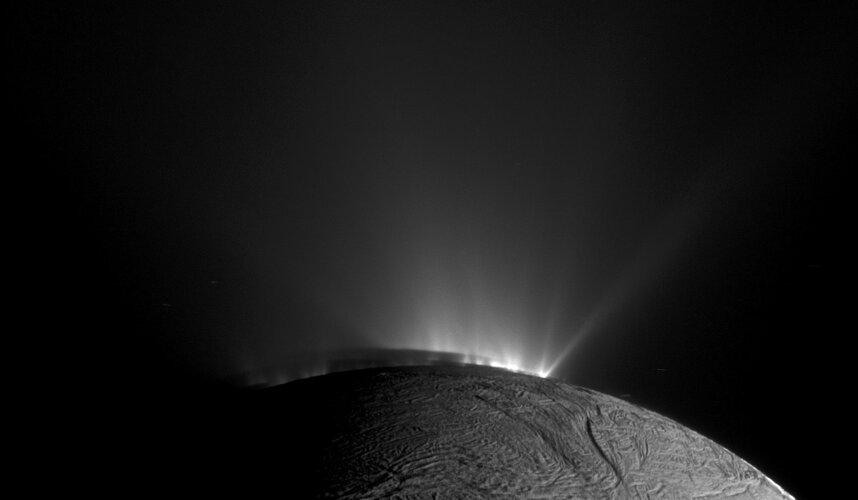
Fresh analysis of legacy Cassini data has uncovered complex organic molecules in newly ejected particles from the plume of Saturn’s moon Enceladus, reinforcing momentum behind the European Space Agency’s planning for a combined orbiter–lander mission. The findings, published in Nature Astronomy, indicate that intricate chemistry is taking place within Enceladus’s subsurface ocean and that some molecular pathways could lead toward biologically relevant compounds.
What Cassini Detected
The Cassini spacecraft first revealed Enceladus’s hidden ocean in 2005 via jets erupting from fractures near the south pole. While many earlier measurements sampled grains that had spent long periods in Saturn’s E ring, the newly reported analysis focuses on fresh ice grains Cassini encountered during a 2008 plume fly-through. These grains, expelled only minutes before impact, struck the Cosmic Dust Analyzer (CDA) at roughly 18 km/s, a regime that suppresses water clustering in the instrument and exposes otherwise masked organic signatures.
Organic Inventory From the Ocean
Researchers identified both familiar and previously unseen molecular fragments in the fresh grains. The suite includes aliphatic components; (hetero)cyclic ester/alkenes; ethers/ethyl species; and tentative nitrogen- and oxygen-bearing compounds. The presence of these organics directly in recently ejected particles supports an origin within the ocean, rather than being artifacts of long-term radiation processing in space. On Earth, similar molecular groups participate in reaction networks that can yield more complex organics relevant to prebiotic chemistry. The results strengthen the case that Enceladus hosts conditions consistent with habitability, while stopping short of any claim of life.
Implications for ESA Mission Planning
ESA studies are underway for a dedicated mission concept that would orbit Enceladus, fly repeatedly through the jets, and land on the south polar terrain to collect and analyze samples. The new CDA-driven insights provide guidance for instrument selection and measurement strategies, prioritizing high-fidelity detection and characterization of volatile and refractory organics directly at the source.
- Plume sampling during multiple fly-throughs to capture temporal and compositional variability.
- Surface investigations in active south polar regions to characterize fresh deposits.
- High-resolution mass spectrometry and dust analysis to constrain complex organics and their formation pathways.
- Integrated habitability assessment using water chemistry, energy availability, and key elements.
Why It Matters
Enceladus continues to satisfy major criteria for a potentially habitable environment: liquid water, energy sources, essential chemical elements, and detectable complex organics. A mission capable of direct sampling both in the plume and on the surface would provide decisive evidence to evaluate habitability and to explore whether biological processes are present—or to understand why life might not emerge even when conditions appear favorable.
Program Context
The Cassini–Huygens mission was a collaboration of NASA, ESA, and the Italian Space Agency, comprising the Cassini orbiter and Huygens probe. Cassini’s CDA, led by the University of Stuttgart, continues to yield discoveries long after the mission’s prime operations, underscoring the enduring value of its dataset for shaping next-generation exploration of ocean worlds.
Source: ESA: Cassini proves complex chemistry in Enceladus ocean. Related paper: Nature Astronomy, DOI: 10.1038/s41550-025-02655-y.