The Space Feed | Latest Space News
  • Home
  • News
    • Launches
    • Space Technology
    • Human Spaceflight
    • Space Exploration
    • Astronomy
  • Launch Schedule
    • Upcoming Launches
    • Completed Launches
  • Knowledge Base
    • All Missions
    • All Rockets
No Result
View All Result
  • Home
  • News
    • Launches
    • Space Technology
    • Human Spaceflight
    • Space Exploration
    • Astronomy
  • Launch Schedule
    • Upcoming Launches
    • Completed Launches
  • Knowledge Base
    • All Missions
    • All Rockets
No Result
View All Result
The Space Feed | Latest Space News

Gaia builds 3D atlas of nearby stellar nurseries and ionised gas

September 16, 2025
in Astronomy

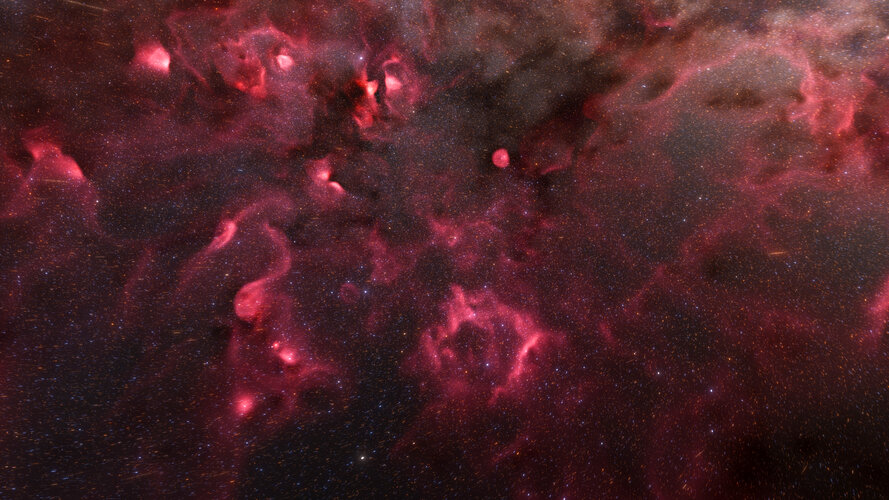
Europe’s Gaia mission has enabled the most detailed 3D atlas to date of nearby stellar nurseries and ionised gas in the Milky Way, charting the structure of dust and hot, young star environments out to roughly 4000 light-years from the Sun. Built from Gaia’s precision measurements of stellar positions, distances and light extinction, the atlas reconstructs where interstellar dust resides and infers where ionised hydrogen is present—key tracers of ongoing star formation.

What Gaia mapped

The new model synthesises Gaia observations of 44 million ordinary stars with a curated set of 87 O-type stars, whose intense ultraviolet radiation carves and illuminates surrounding gas. By combining these datasets, researchers produced a coherent picture of local star-forming regions and ionisation bubbles around massive stars.

  • 3D distribution of interstellar dust and associated ionised gas across the solar neighbourhood, centred on the Sun.
  • Coverage extends to approximately 4 kly, providing a contiguous, top-down view of local Galactic structure.
  • Identification and context for well-known complexes, including the Gum Nebula, North America Nebula, California Nebula and the Orion–Eridanus superbubble.
  • Evidence that some clouds have opened, with streams of gas and dust venting into a large, low-density cavity.

How the 3D atlas was built

Gaia does not image cold clouds directly. Instead, it measures the dimming of starlight by dust (extinction) and the precise distances to those stars. Inverting these data yields a volumetric dust map. The locations and luminosities of nearby O-type stars are then used to estimate regions where hydrogen is likely ionised (H II), consistent with characteristic emission at the H-alpha spectral line (656.3 nm). This fusion of dust distribution and ionising radiation sources produces a physically grounded view of where star formation feedback is shaping the interstellar medium.

Why it matters

The atlas provides a quantitative framework for studying how massive stars sculpt their natal environments: how far their radiation penetrates, where cavities and superbubbles link, and how ionisation fronts interact with cold molecular clouds. It improves constraints on feedback-driven turbulence, cloud dispersal and triggered star formation, and offers a more realistic local context for simulations of the Milky Way’s disk. The 3D perspective also aligns disparate 2D observations across optical, infrared and radio wavelengths, enabling more robust cross-survey comparisons.

What comes next

High-resolution reconstruction demanded substantial computation and was limited to about 4 kly for this release. The methodology is designed to scale with forthcoming Gaia data, and future expansions are expected as the mission delivers improved astrometry and photometry. The work builds on prior 3D dust mapping and incorporates a new census of nearby hot stars to visualise ionised regions with greater fidelity.

Data and resources

Agency overview and media, including interactive visualisations and fly-throughs, are available via the European Space Agency: ESA source. Technical details and validation are presented in peer-reviewed publications in Monthly Notices of the Royal Astronomical Society: MNRAS Letters and MNRAS.

Previous Post

Falcon 9 to Launch IMAP, SWFO-L1 and Carruthers on Sept. 23; NASA Outlines Coverage

Next Post

Roman to Map 20 Billion Milky Way Stars and 3D Dust, Data to Be Public After Launch

Related Posts

Astronomy

LOFAR and XMM-Newton confirm coronal mass ejection from a red dwarf, threatening exoplanet atmospheres

November 12, 2025
Astronomy

PLATO Assembly Complete; Final Tests Ahead of 2026 Ariane 6 Launch

October 10, 2025
Astronomy

Protoplanet WISPIT 2b Imaged Inside Disk Gap, Marking a Planet-Formation First

October 1, 2025
Astronomy

Gaia maps a massive stellar ripple sweeping the Milky Way’s outer disk

September 30, 2025
Astronomy

Webb Spots Carbon-Rich Circumplanetary Disk Around CT Cha b, Illuminating Moon Formation

September 29, 2025
Astronomy

JWST maps carbon chemistry in circumplanetary disk around CT Cha b, a likely moon nursery

September 29, 2025
Next Post

Roman to Map 20 Billion Milky Way Stars and 3D Dust, Data to Be Public After Launch

Leave a Reply Cancel reply

Your email address will not be published. Required fields are marked *

  • Trending
  • Comments
  • Latest

NASA and SpaceX Conduct Crew-11 Dry Run Ahead of Launch

July 29, 2025

SpaceX Dragon Missions: Crew Prepares for Departure and Arrival at ISS

July 30, 2025

NASA Advances Supersonic Parachute Technology for Mars Missions

July 30, 2025

Upcoming Suborbital Rocket Launches from NASA Wallops: July 28-August 8, 2025

July 28, 2025

Dragonfly Mission Hits Major Test Milestones, Targets 2028 Falcon Heavy Launch

1

ESA Initiates Construction of LISA Mission to Detect Gravitational Waves

0

UK-France MicroCarb Satellite Launches to Enhance Global CO₂ Monitoring

0

NASA’s SpaceX Crew-11 Arrives at Kennedy Space Center for Upcoming Launch

0

ESCAPADE Reset to Nov. 13 After G4 Storm; Blue Origin VADR Launch Preserves Mars Trajectory

November 13, 2025

Brazil, INPE and ESA plan uptake of Biomass P-band radar data for Amazon carbon monitoring

November 13, 2025

LOFAR and XMM-Newton confirm coronal mass ejection from a red dwarf, threatening exoplanet atmospheres

November 12, 2025

DLR’s MAPHEUS-16 Sets Microgravity Payload Record with Twin Red Kite Motors

November 12, 2025

Popular Stories

  • NASA and SpaceX Conduct Crew-11 Dry Run Ahead of Launch

    0 shares
    Share 0 Tweet 0
  • SpaceX Dragon Missions: Crew Prepares for Departure and Arrival at ISS

    0 shares
    Share 0 Tweet 0
  • NASA Advances Supersonic Parachute Technology for Mars Missions

    0 shares
    Share 0 Tweet 0
  • Upcoming Suborbital Rocket Launches from NASA Wallops: July 28-August 8, 2025

    0 shares
    Share 0 Tweet 0
  • SpaceX Crew-11 Prepares for Launch: Final Steps Before Hatch Closure

    0 shares
    Share 0 Tweet 0
  • About
  • Advertise
  • Privacy & Policy
  • Contact
The Space Feed

© 2025 Stride Interactive Group

No Result
View All Result
  • Home
  • News
    • Launches
    • Space Technology
    • Human Spaceflight
    • Space Exploration
    • Astronomy
  • Launch Schedule
    • Upcoming Launches
    • Completed Launches

© 2025 Stride Interactive Group