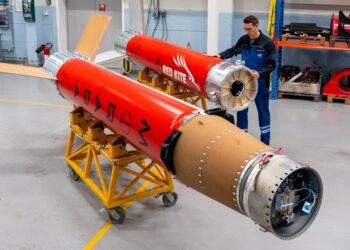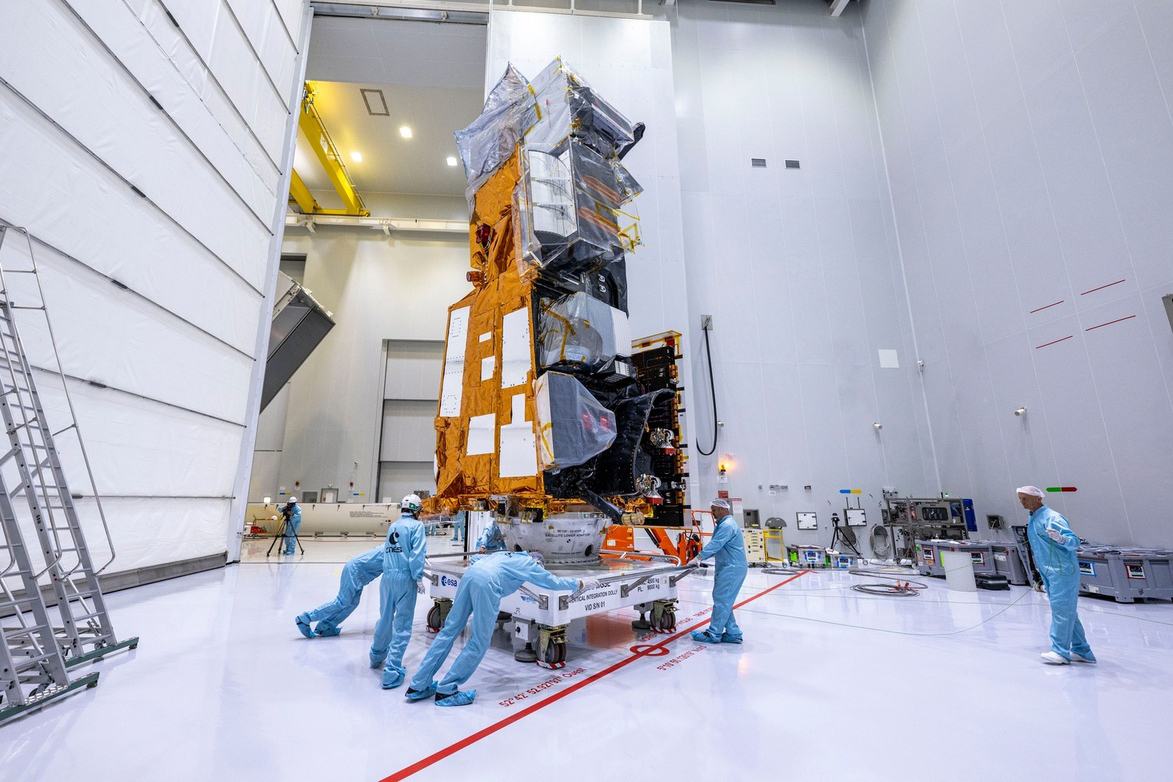
The first unit of IASI-NG (Infrared Atmospheric Sounding Interferometer – New Generation) has entered service on Europe’s MetOp‑SG A1 satellite launched by Ariane 6 in August 2025, opening a new era of high-fidelity infrared sounding for weather forecasting and climate monitoring. With improved spectral resolution and lower radiometric noise, the instrument is designed to sharpen global numerical weather prediction and secure a homogeneous atmospheric data record through 2045.
Enhanced infrared sounding
IASI-NG measures thermal infrared radiation naturally emitted by Earth across 3.6–15.5 micrometres. Compared with the first-generation IASI, the new instrument doubles spectral resolution and significantly reduces radiometric noise. For each scene, IASI-NG samples approximately 16,900 spectral points (versus about 8,400 previously), enabling more precise retrievals of temperature and humidity profiles and improved discrimination of key atmospheric constituents such as water vapor, carbon dioxide, ozone, sulfur dioxide and aerosols.
The higher information content improves the vertical resolution and accuracy of atmospheric profiles assimilated into global and regional forecast models, directly benefiting short-range to medium-range predictions.
Forecasting impact and operations
By better characterizing humidity fluxes and thermal structure, especially over data-sparse oceans, IASI-NG strengthens the initial state used by data assimilation systems that run multiple cycles per day. This upgrade is expected to refine track, intensity and precipitation forecasts linked to storm development, including tropical cyclogenesis, and to enhance guidance for mid-latitude weather systems over the Atlantic and Europe.
- Higher-quality observations for assimilation in global NWP centers
- Improved storm evolution, track and rainfall guidance
- More robust analysis over oceans and remote regions
- Continuity for air-quality and atmospheric composition applications
Program status and schedule
The MetOp-SG series will field three identical IASI-NG instruments flown sequentially: A1 (launched 2025), A2 (planned 2032) and A3 (planned 2039). The program targets at least two decades of operations. CNES led the instrument’s development with Airbus Defence and Space as prime contractor, working closely with European and national meteorological services to streamline data ingestion and operational readiness.
Climate data continuity to 2045
IASI-NG extends an atmospheric climate data record initially established by IASI over nearly two decades. Of the 54 Essential Climate Variables (ECVs), 16 relate to the atmosphere; IASI/IASI-NG observations support all 16, including surface temperature, greenhouse gases and aerosol properties. To ensure consistency between generations, Metop‑C (carrying IASI) will fly in tandem with MetOp‑SG A1 for inter-calibration, with the two spacecraft nominally separated by about 30 seconds. This approach helps maintain uniformity of measurements across platforms and epochs, sustaining a comparable record through 2045.
European capability and resilience
While global data exchanges remain foundational to meteorology, Europe’s investment in MetOp-SG and IASI-NG reinforces strategic autonomy for critical services. Reliable, independent space-based observations underpin hazard mitigation, transport safety, agricultural planning, renewable energy management and broader civil protection needs across the continent.
Key specifications at a glance
- Spectral coverage: 3.6–15.5 µm (thermal infrared)
- Spectral sampling: ~16,900 points per scene (about 2× previous generation)
- Improved radiometric noise for sharper retrievals
- Three identical flight models on MetOp‑SG A1/A2/A3 (2025/2032/2039)
- Polar, sun-synchronous orbit as part of the MetOp‑SG meteorological constellation
- Near-real-time data delivery for global numerical weather prediction and atmospheric composition monitoring
Source: CNES – Weather and climate: better forecasting and mitigation with IASI-NG