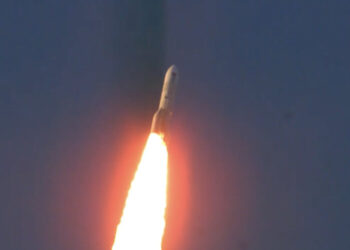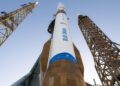
NASA has begun live launch coverage for a three-spacecraft heliophysics and space-weather stack heading to the Sun–Earth Lagrange Point 1 (L1): IMAP (Interstellar Mapping and Acceleration Probe), the Carruthers Geocorona Observatory, and NOAA’s SWFO‑L1 (Space Weather Follow On–L1). Liftoff is targeted from Launch Complex 39A at NASA’s Kennedy Space Center in Florida on Sept. 24, 2025, with weather currently assessed as 90% favorable, constrained primarily by the cumulus cloud rule.
What This Launch Delivers
The trio targets complementary pieces of the Sun–Earth system, from fundamental heliophysics to operational space-weather monitoring:
- IMAP will map how particles are accelerated and transported across the heliosphere, the vast magnetic bubble inflated by the solar wind. From its L1 post, IMAP will study interactions between the solar wind and the local interstellar medium and provide an unobstructed view of solar activity.
- Carruthers Geocorona Observatory is a small satellite focused on Earth’s outermost atmospheric layer, the exosphere, by observing the faint ultraviolet glow of the geocorona.
- NOAA’s SWFO‑L1 will continuously monitor space weather and offer early detection of solar storms, supporting warnings for potentially disruptive events that can affect satellites, power grids, and communications.
IMAP’s Science Focus
IMAP is designed to address four core questions in heliophysics:
- What are the properties of the local interstellar medium?
- How do magnetic fields connect from the Sun through the local interstellar medium?
- How do the solar wind and interstellar medium interact at the heliosphere’s boundaries?
- How are particles accelerated to high energies throughout the solar system?
Operating roughly 1 million miles (1.6 million kilometers) sunward of Earth at L1, IMAP’s vantage point supports continuous measurements of solar wind conditions. These data, together with operational monitoring from SWFO‑L1, are expected to enhance early warning timelines for radiation and geomagnetic disturbances that can impact astronauts and spacecraft near Earth.
Why L1 Matters
L1 offers a stable gravitational balance point with an uninterrupted line of sight to the Sun. Placing both science and operational assets at L1 enables persistent solar monitoring, faster detection of solar eruptions, and improved context for how solar wind structures evolve on their way to Earth. This capability is increasingly relevant as NASA advances human exploration plans, including Artemis II and future deep space missions.
How to Follow
Live coverage is underway across NASA’s broadcast platforms, with English and Spanish streams available. For official updates and mission details, see the NASA post: NASA Broadcast Begins for IMAP Mission.