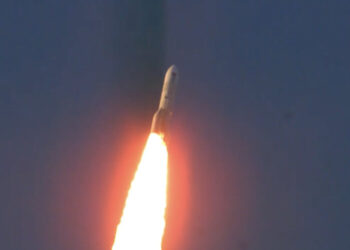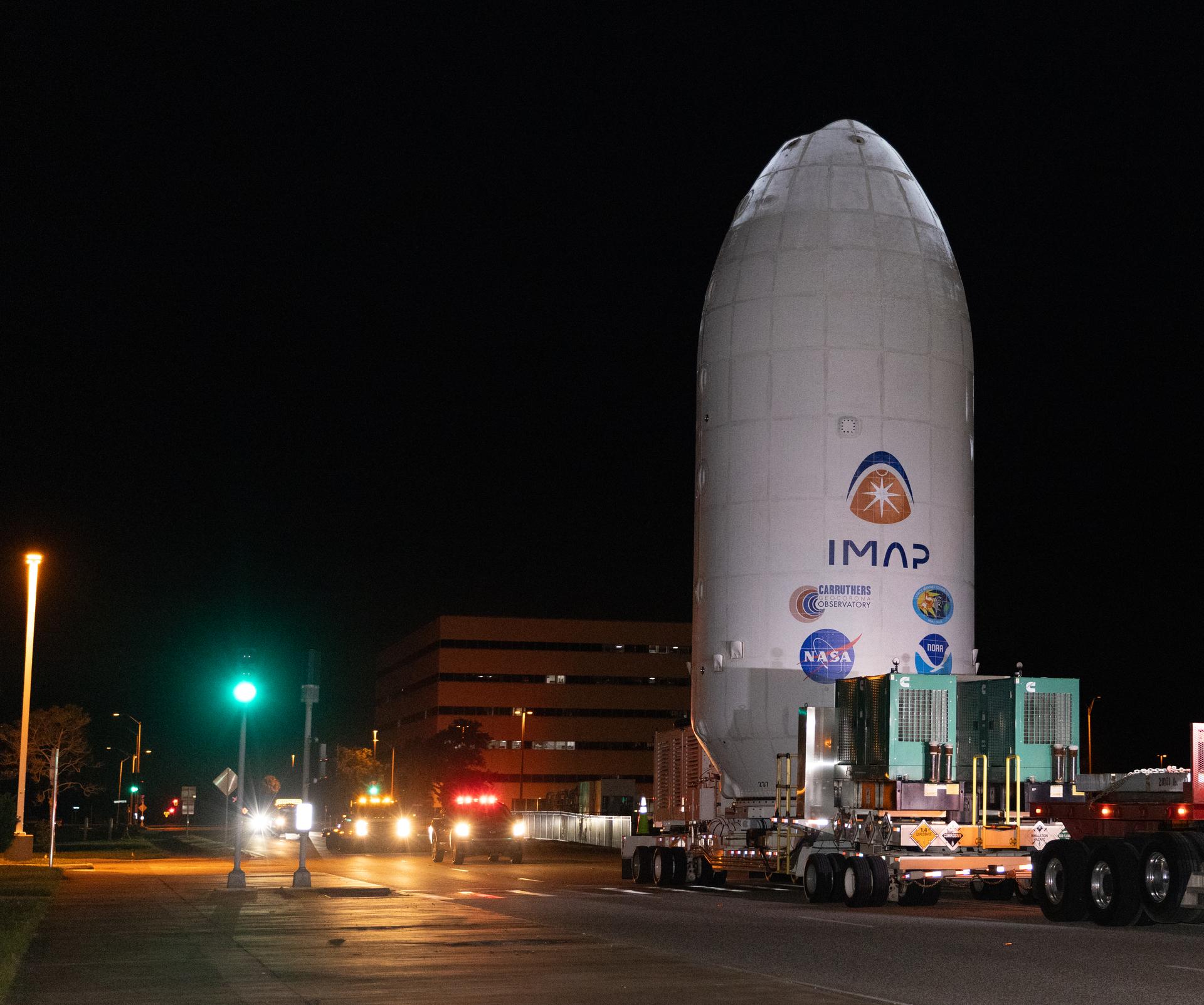
NASA has completed integration and encapsulation of the Interstellar Mapping and Acceleration Probe (IMAP)Falcon 9 launch no earlier than 7:32 a.m. EDT on Tuesday, Sept. 23, from Launch Complex 39A at Kennedy Space Center. The milestone follows a successful Flight Readiness Review, confirming the mission’s readiness to proceed with final launch preparations. Source: NASA.
Mission stack completes integration
At Astrotech in Titusville, technicians mated the Carruthers Geocorona Observatory and NOAA’s SWFO‑L1 to an Evolved Secondary Payload Adapter (ESPA) ring, joined the ring to the Payload Attach Fitting, and mounted the IMAP observatory to its payload adapter. The team then completed final integration by mating the adapter to the ring—combining all three spacecraft into a single launch stack.
On Sept. 16, the integrated payload was encapsulated inside the Falcon 9 payload fairing, which will protect the observatories during ascent before separating approximately three minutes after liftoff. SpaceX plans to recover the fairing halves. Following health checks, the encapsulated assembly was transported on Sept. 18 from Astrotech to the SpaceX hangar at LC‑39A for mating to the launch vehicle.
Schedule and launch coverage
With the review complete, teams are proceeding toward liftoff on Sept. 23. NASA plans to begin live launch coverage at 6:40 a.m. EDT on NASA+ and additional platforms, with Spanish-language coverage also scheduled.
Science and operations at L1
After launch, all three spacecraft will cruise to the Sun–Earth Lagrange Point 1 (L1), roughly one million miles from Earth. From L1, IMAP will map the boundaries of the heliosphere and investigate how solar particles are accelerated to high energies. IMAP will also provide near real-time observations of the solar wind and energetic particles that feed the IMAP Active Link in Real-Time (I‑ALiRT) system, designed to improve space weather understanding and forecasting.
The Carruthers Geocorona Observatory will study Earth’s exosphere, the outermost layer of the atmosphere. NOAA’s SWFO‑L1 will deliver operational space weather monitoring to support alerts and warnings that help protect satellites, power grids, communications, and other critical infrastructure.
Program and partners
IMAP is led by Princeton University with a team of 27 international partners. The Johns Hopkins Applied Physics Laboratory built and operates the spacecraft. IMAP is the fifth mission in NASA’s Solar Terrestrial Probes program under the agency’s Heliophysics Division. NASA’s Launch Services Program at Kennedy manages the launch service.
Key milestones at a glance
- Sept. 16: Payload stack encapsulated inside the Falcon 9 fairing at Astrotech.
- Sept. 18: Encapsulated payload transported to the SpaceX hangar at LC‑39A.
- Flight Readiness Review: Complete; teams approved to proceed to launch.
- Targeted liftoff: No earlier than 7:32 a.m. EDT, Tuesday, Sept. 23, from LC‑39A.
- Post-launch: Fairing separation at ~T+3 minutes; operations en route to Sun–Earth L1.
The triple-payload rideshare combines operational and science objectives at L1, advancing heliophysics research while strengthening near real-time space weather monitoring for exploration and terrestrial infrastructure.