The Space Feed | Latest Space News
  • Home
  • News
    • Launches
    • Space Technology
    • Human Spaceflight
    • Space Exploration
    • Astronomy
  • Launch Schedule
    • Upcoming Launches
    • Completed Launches
  • Knowledge Base
    • All Missions
    • All Rockets
No Result
View All Result
  • Home
  • News
    • Launches
    • Space Technology
    • Human Spaceflight
    • Space Exploration
    • Astronomy
  • Launch Schedule
    • Upcoming Launches
    • Completed Launches
  • Knowledge Base
    • All Missions
    • All Rockets
No Result
View All Result
The Space Feed | Latest Space News

IMAP, GLIDE and SWFO-L1 Set for Falcon 9 Liftoff to Strengthen Space Weather Monitoring

September 24, 2025
in Launches

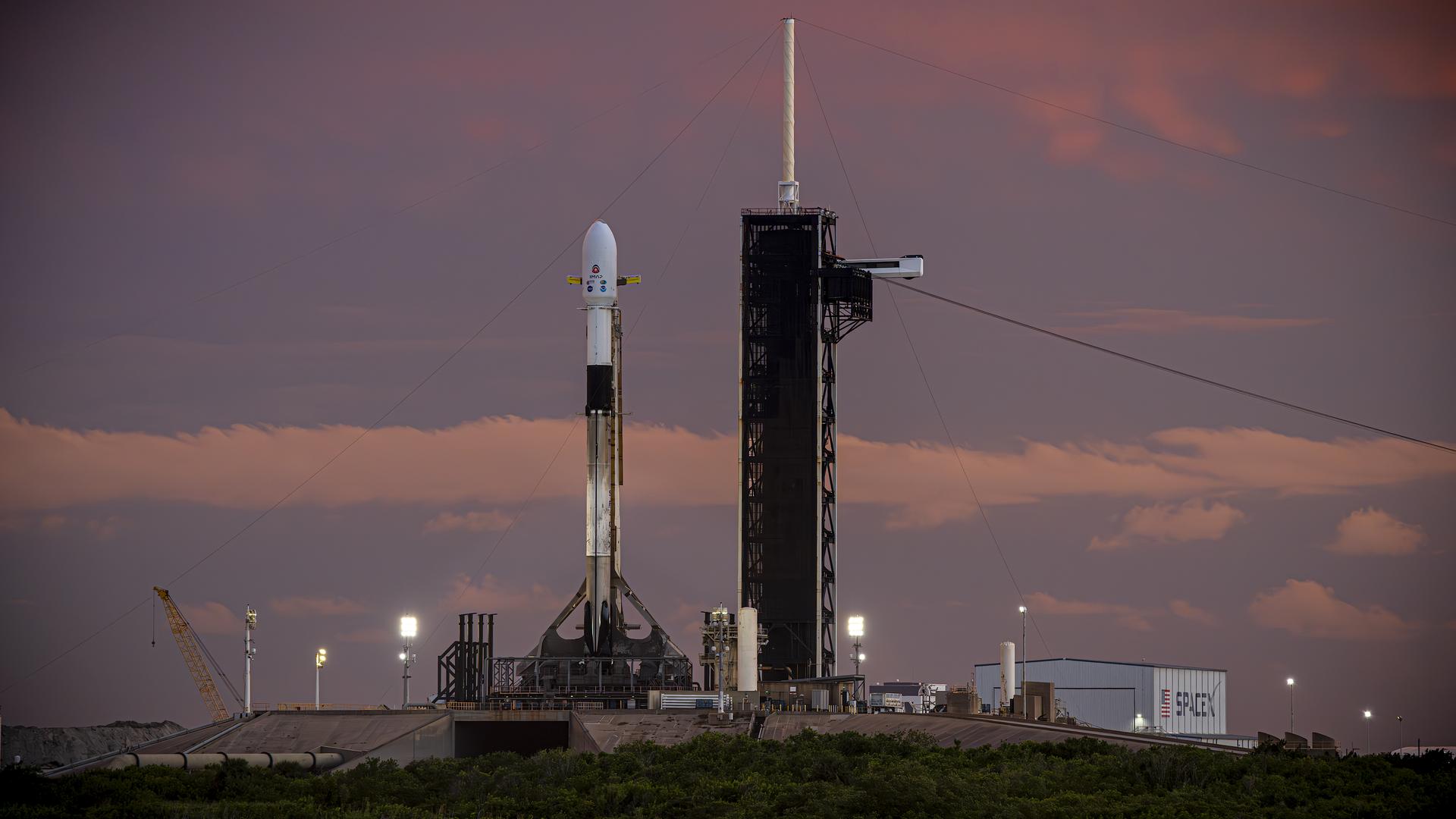
A SpaceX Falcon 9 is set to launch three heliophysics missions that aim to strengthen global space weather monitoring and research. NASA is targeting liftoff at 7:30 a.m. EDT from Launch Complex 39A at Kennedy Space Center, with live coverage beginning at 6:40 a.m. EDT on NASA’s digital platforms. The flight will deploy NASA’s Interstellar Mapping and Acceleration Probe (IMAP), the Carruthers Geocorona Observatory (GLIDE), and NOAA’s Space Weather Follow-On – Lagrange 1 (SWFO-L1). Full mission details are available via the official announcement on NASA Science.

What’s Launching

The three-spacecraft payload brings complementary capabilities that span basic heliophysics research and operational space weather vigilance:

  • IMAP (NASA): Equipped with 10 science instruments, IMAP will study and map the heliosphere—the vast magnetic bubble surrounding the Sun that shields the solar system from interstellar radiation. The mission will analyze the composition and transport of charged particles and investigate how the Sun accelerates those particles. IMAP will also continuously monitor solar wind and cosmic radiation to improve situational awareness of the near-Earth space environment.
  • GLIDE (NASA’s Carruthers Geocorona Observatory): GLIDE will observe Earth’s geocorona—the tenuous outer reaches of the upper atmosphere where it interacts with solar radiation—to refine understanding of the Sun–Earth connection and the variability of the near-Earth environment.
  • SWFO-L1 (NOAA): NOAA’s operational satellite is designed to support space weather monitoring from the Sun–Earth Lagrange 1 point, providing continuous, upstream observations that contribute to forecasting and alerts.

Why It Matters

Improved measurement and modeling of the heliosphere and the solar wind are central to protecting technology and operations that depend on space-based infrastructure. The IMAP mission’s particle and field observations, combined with GLIDE’s geocorona imaging and SWFO-L1’s operational vantage point, are expected to enhance understanding of solar activity and its impacts across the Earth–Sun system.

Data from these missions can inform early warnings of solar disturbances and help organizations evaluate risk, plan mitigation, and harden assets against adverse conditions.

  • Human spaceflight: Monitoring radiation and charged particle environments supports crew safety.
  • Satellites: Improved forecasts aid anomaly mitigation, mission planning, and asset protection.
  • Power grids: Earlier alerts of geomagnetic disturbances can reduce the likelihood of transformer damage and service disruptions.

Launch and Coverage

NASA reports that online coverage is underway ahead of the targeted 7:30 a.m. EDT liftoff from Kennedy’s LC-39A. Live launch programming begins at 6:40 a.m. EDT on NASA+, the agency’s website, and its official YouTube channel. Spanish-language coverage will also begin at 6:40 a.m. EDT on NASA+ and the agency’s Spanish-language YouTube channel. For updated timelines and mission resources, see the NASA Science mission blog.

Outlook for the Space Industry

The combined launch underscores growing demand for multi-mission deployments that pair foundational science with operational monitoring. For satellite operators, launch providers, mission planners, and power utilities, the resulting data stream—ranging from heliospheric mapping to real-time solar wind measurements—can support more resilient architectures and more accurate risk modeling for space weather events.
Previous Post

IMAP, SWFO-L1, and GLIDE: Falcon 9 Countdown and Deployment Timeline Revealed

Next Post

IMAP to Deliver 30-Minute Radiation Alerts from L1 to Safeguard Missions

Related Posts

Launches

ESCAPADE Reset to Nov. 13 After G4 Storm; Blue Origin VADR Launch Preserves Mars Trajectory

November 13, 2025
Launches

Ariane 6 Places Sentinel-1D in Orbit, Expanding Copernicus SAR and AIS Coverage

November 7, 2025
Launches

ESA readies twin HydroGNSS GNSS-R microsats for Transporter-15 liftoff from Vandenberg

November 6, 2025
Launches

Ariane 6 places Sentinel-1D in orbit, restoring dual SAR coverage and enhancing AIS updates

November 5, 2025
Launches

Ariane 6 places Sentinel-1D in orbit, boosting Copernicus SAR and ship-tracking capacity

November 5, 2025
Launches

Ariane 6 deploys Copernicus Sentinel-1D, expanding C-band SAR and AIS coverage

November 4, 2025
Next Post

IMAP to Deliver 30-Minute Radiation Alerts from L1 to Safeguard Missions

Leave a Reply Cancel reply

Your email address will not be published. Required fields are marked *

  • Trending
  • Comments
  • Latest

NASA and SpaceX Conduct Crew-11 Dry Run Ahead of Launch

July 29, 2025

SpaceX Dragon Missions: Crew Prepares for Departure and Arrival at ISS

July 30, 2025

NASA Advances Supersonic Parachute Technology for Mars Missions

July 30, 2025

Upcoming Suborbital Rocket Launches from NASA Wallops: July 28-August 8, 2025

July 28, 2025

Dragonfly Mission Hits Major Test Milestones, Targets 2028 Falcon Heavy Launch

1

ESA Initiates Construction of LISA Mission to Detect Gravitational Waves

0

UK-France MicroCarb Satellite Launches to Enhance Global CO₂ Monitoring

0

NASA’s SpaceX Crew-11 Arrives at Kennedy Space Center for Upcoming Launch

0

ESCAPADE Reset to Nov. 13 After G4 Storm; Blue Origin VADR Launch Preserves Mars Trajectory

November 13, 2025

Brazil, INPE and ESA plan uptake of Biomass P-band radar data for Amazon carbon monitoring

November 13, 2025

LOFAR and XMM-Newton confirm coronal mass ejection from a red dwarf, threatening exoplanet atmospheres

November 12, 2025

DLR’s MAPHEUS-16 Sets Microgravity Payload Record with Twin Red Kite Motors

November 12, 2025

Popular Stories

  • NASA and SpaceX Conduct Crew-11 Dry Run Ahead of Launch

    0 shares
    Share 0 Tweet 0
  • SpaceX Dragon Missions: Crew Prepares for Departure and Arrival at ISS

    0 shares
    Share 0 Tweet 0
  • NASA Advances Supersonic Parachute Technology for Mars Missions

    0 shares
    Share 0 Tweet 0
  • Upcoming Suborbital Rocket Launches from NASA Wallops: July 28-August 8, 2025

    0 shares
    Share 0 Tweet 0
  • SpaceX Crew-11 Prepares for Launch: Final Steps Before Hatch Closure

    0 shares
    Share 0 Tweet 0
  • About
  • Advertise
  • Privacy & Policy
  • Contact
The Space Feed

© 2025 Stride Interactive Group

No Result
View All Result
  • Home
  • News
    • Launches
    • Space Technology
    • Human Spaceflight
    • Space Exploration
    • Astronomy
  • Launch Schedule
    • Upcoming Launches
    • Completed Launches

© 2025 Stride Interactive Group