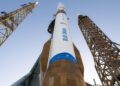
NASA has released a detailed countdown and deployment timeline for the upcoming SpaceX Falcon 9 mission carrying the agency’s Interstellar Mapping and Acceleration Probe (IMAP), NOAA’s Space Weather Follow-On – L1 (SWFO-L1), and NASA’s Carruthers Geocorona Observatory (GLIDE). The rocket rolled to Launch Complex 39A at Kennedy Space Center ahead of liftoff, with all times below listed as approximate. Full details are available via the official mission update from NASA.
Launch overview
The rideshare flight is set to deliver three heliophysics payloads on a two-burn second-stage profile, followed by a sequence of spacecraft deployments. The mission includes a targeted first-stage return and landing shortly after the initial ascent phase.
Countdown and ascent timeline (approx.)
- T−00:38:00 — SpaceX Launch Director verifies go for propellant load
- T−00:35:00 — RP-1 (kerosene) loading begins
- T−00:35:00 — First stage LOX loading begins
- T−00:16:00 — Second stage LOX loading begins
- T−00:07:00 — Falcon 9 engine chill begins
- T−00:01:00 — Flight computer commanded for final prelaunch checks
- T−00:01:00 — Propellant tanks pressurized to flight levels
- T−00:00:45 — Launch Director verifies go for launch
- T−00:00:03 — Engine ignition sequence start
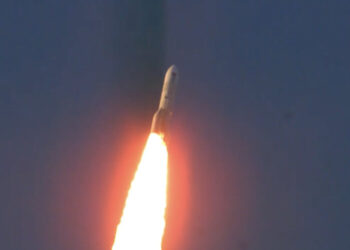
- T+00:00:00 — Falcon 9 liftoff
- T+00:01:12 — Max Q (peak dynamic pressure)
- T+00:02:29 — Main engine cutoff (MECO)
- T+00:02:32 — Stage separation
- T+00:02:40 — Second stage engine start (SES-1)
- T+00:03:12 — Fairing separation
- T+00:06:37 — First stage entry burn start
- T+00:07:07 — First stage entry burn end
- T+00:07:52 — Second stage engine cutoff (SECO-1)
- T+00:08:20 — First stage landing burn start
- T+00:08:45 — First stage landing
- T+01:12:28 — Second stage engine start (SES-2)
- T+01:13:30 — Second stage engine cutoff (SECO-2)
- T+01:23:51 — IMAP deployment
- T+01:30:26 — SWFO-L1 deployment
- T+01:36:46 — Carruthers Geocorona Observatory (GLIDE) deployment
Payloads and objectives
- IMAP: Designed to sample and map particles at the boundary of the heliosphere, improving understanding of how the Sun interacts with the local interstellar medium.
- SWFO-L1: NOAA mission to continuously monitor solar wind and space weather conditions to support forecasting and protection of technological infrastructure.
- GLIDE: NASA observatory focused on characterizing Earth’s extended hydrogen exosphere, the geocorona.
What to watch
Key mission moments include the two-burn upper-stage profile, a targeted booster recovery about T+8:45, and a staggered deployment sequence spanning roughly 13 minutes from the first to last satellite separation. These milestones provide clear markers for tracking mission progress from ignition through payload delivery.
For the full milestone list and latest official updates, see the NASA mission blog.