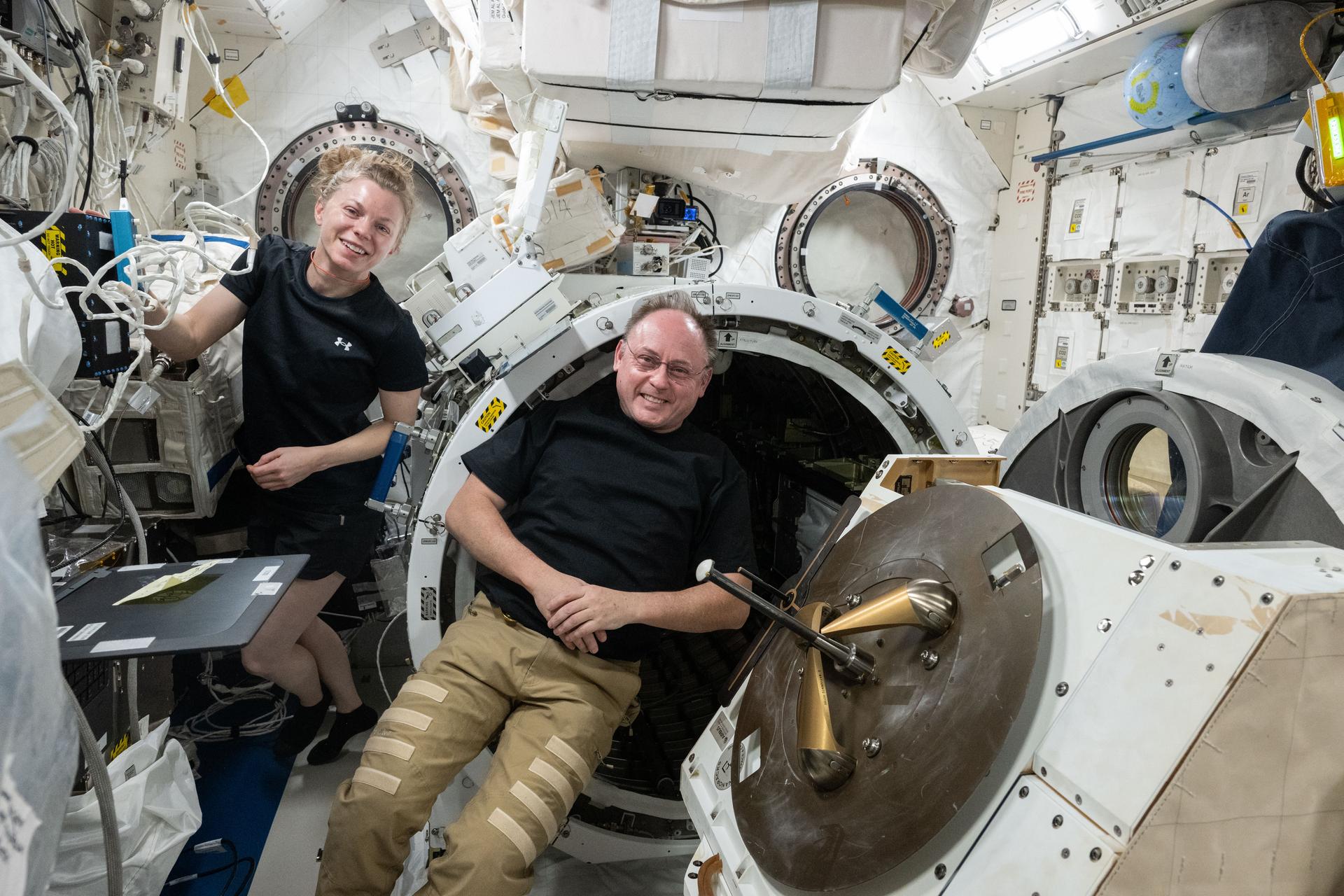
Expedition 73 advanced life support and thermal control research aboard the International Space Station, while crews completed routine inspections across U.S. and Russian segments. The day’s work centered on a humidity recycling technology demonstration in the Harmony module and the installation of new two-phase heat transfer hardware in the Columbus laboratory, alongside high-temperature materials experiments in Kibo.
Key work across the U.S. segment
NASA’s Jonny Kim installed and activated a technology demo in Harmony designed to remove moisture from the spacecraft environment for recycling. Demonstrating closed-loop water recovery in orbit supports development of regenerative life support systems for longer missions where resupply is limited.
JAXA astronaut Kimiya Yui operated the Electrostatic Levitation Furnace (ELF) inside the Kibo laboratory. ELF levitates and heats materials with lasers to ultra-high temperatures, enabling precise measurements of thermophysical properties that are difficult to obtain in Earth’s gravity.
In the Columbus module, NASA’s Mike Fincke installed the new Heat Transfer Host 2 (HTH-2) to investigate two-phase heat transfer, including condensation processes when gas turns to liquid. Insights from this fluid physics research can inform the design of advanced thermal management systems for human-rated spacecraft and surface habitats.
NASA’s Zena Cardman focused on station upkeep, transferring fluids in the Destiny lab, collecting airflow measurements, and inspecting ventilation systems throughout the U.S. segment with assistance from Kim. Cardman also examined cables and insulation in Unity and Harmony for corrosion or degradation, and briefly swapped sample cassettes in the Advanced Sample Experiment Processor-4, which explores in-space pharmaceutical manufacturing techniques.
Operations in the Russian segment
Roscosmos Commander Sergey Ryzhikov replaced power supply components in the Zarya module and later performed a scheduled treadmill fitness test in Zvezda. Flight Engineer Alexey Zubritsky serviced the Elektron oxygen generator in Zvezda and conducted an annual inspection across the Russian segment to check for moisture, corrosion, or damage. Flight Engineer Oleg Platonov conducted a study of microcirculation in the limbs using specialized cuffs and electrodes, supporting ongoing research into cardiovascular adaptation to microgravity.
Why these tests matter
- Water recovery and humidity control: Recycling moisture from cabin air reduces dependence on cargo resupply and increases mission resilience for lunar and Martian expeditions.
- Thermal management advances: Two-phase heat transfer data in microgravity can improve the efficiency and reliability of spacecraft radiators, condensers, and heat exchangers.
- Materials science at high temperature: ELF measurements fill critical data gaps for alloys, glasses, and other materials, supporting manufacturing, propulsion, and sensor development.
- Station longevity and crew health: Ventilation checks, electrical inspections, and oxygen system servicing help sustain safe operations, while circulatory studies refine countermeasures for long-duration flight.
Modules and systems touched
- Harmony (U.S.) — Humidity removal and recycling tech demo
- Kibo (JAXA) — Electrostatic Levitation Furnace operations
- Columbus (ESA) — Heat Transfer Host 2 installation
- Destiny, Unity (U.S.) — Fluid transfers and cable/insulation inspections
- Zarya, Zvezda (Roscosmos) — Power system work, Elektron service, fitness testing
Together, these activities sustain the station’s core infrastructure while advancing technologies central to future exploration architectures. For the full mission update, see the NASA blog post: ISS Crew Works Advanced Science Hardware and Conducts Lab Inspections.