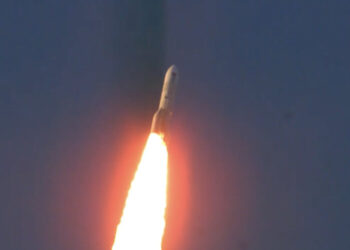
Japan is preparing its next H3 mission, with the Japan Aerospace Exploration Agency (JAXA) and Mitsubishi Heavy Industries scheduling H3 Flight 8 (H3 F8) to launch Michibiki-5 (QZSS-5) on December 7, 2025. The launch is targeted for 11:30–12:30 Japan Standard Time from the Yoshinobu Launch Complex at the Tanegashima Space Center. A reserved launch period runs from December 8, 2025 through January 31, 2026, with times varying by day. Official details are available via the JAXA press release.
Key details
- Launch date: December 7, 2025
- Launch window: 11:30–12:30 (JST)
- Reserved launch period: December 8, 2025 – January 31, 2026 (times vary)
- Launch site: Yoshinobu Launch Complex, JAXA Tanegashima Space Center
- Launch vehicle: H3 Launch Vehicle No. 8 (H3 F8)
- Payload: Michibiki-5 (Quasi-Zenith Satellite System, QZS-5)
- Operators: JAXA and Mitsubishi Heavy Industries
About the H3 and launch site
The H3 is Japan’s latest-generation orbital launch vehicle, designed to increase mission flexibility and reduce costs while supporting national civil, governmental, and commercial missions. The Yoshinobu Launch Complex at Tanegashima Space Center hosts H3 operations and provides range, tracking, and telemetry services for ascent and early orbit phases.
Role of Michibiki-5 (QZSS-5)
Michibiki-5 is part of Japan’s Quasi-Zenith Satellite System, a regional navigation augmentation constellation that enhances positioning, navigation, and timing for Japan and surrounding areas. By maintaining high elevation angles over Japan, QZSS helps improve signal availability and accuracy in urban canyons and mountainous terrain. The system supports applications across transportation, disaster management, agriculture, surveying, and infrastructure timing.
Adding QZS-5 is expected to strengthen service continuity and system resilience, supporting users who rely on multi-constellation and augmentation signals for higher reliability and precision.
What to watch on launch day
- Final weather and range status during the one-hour window
- Ascent milestones: liftoff, fairing jettison, stage separation, and targeted orbit insertion
- Spacecraft separation and initial health checks
- Early signal acquisition and orbit-raising operations (as announced by mission controllers)
Schedule outlook
If conditions are not favorable on December 7, the mission can shift within the reserved launch period through January 31, 2026. Launch timing during this period will vary. JAXA will provide updates and adjustments as needed. For official information, refer to the JAXA press release.