The Space Feed | Latest Space News
  • Home
  • News
    • Launches
    • Space Technology
    • Human Spaceflight
    • Space Exploration
    • Astronomy
  • Launch Schedule
    • Upcoming Launches
    • Completed Launches
  • Knowledge Base
    • All Missions
    • All Rockets
No Result
View All Result
  • Home
  • News
    • Launches
    • Space Technology
    • Human Spaceflight
    • Space Exploration
    • Astronomy
  • Launch Schedule
    • Upcoming Launches
    • Completed Launches
  • Knowledge Base
    • All Missions
    • All Rockets
No Result
View All Result
The Space Feed | Latest Space News

JWST Finds 8-Light-Year Protostellar Jet at Milky Way Fringe, Backing Core Accretion

September 10, 2025
in Astronomy

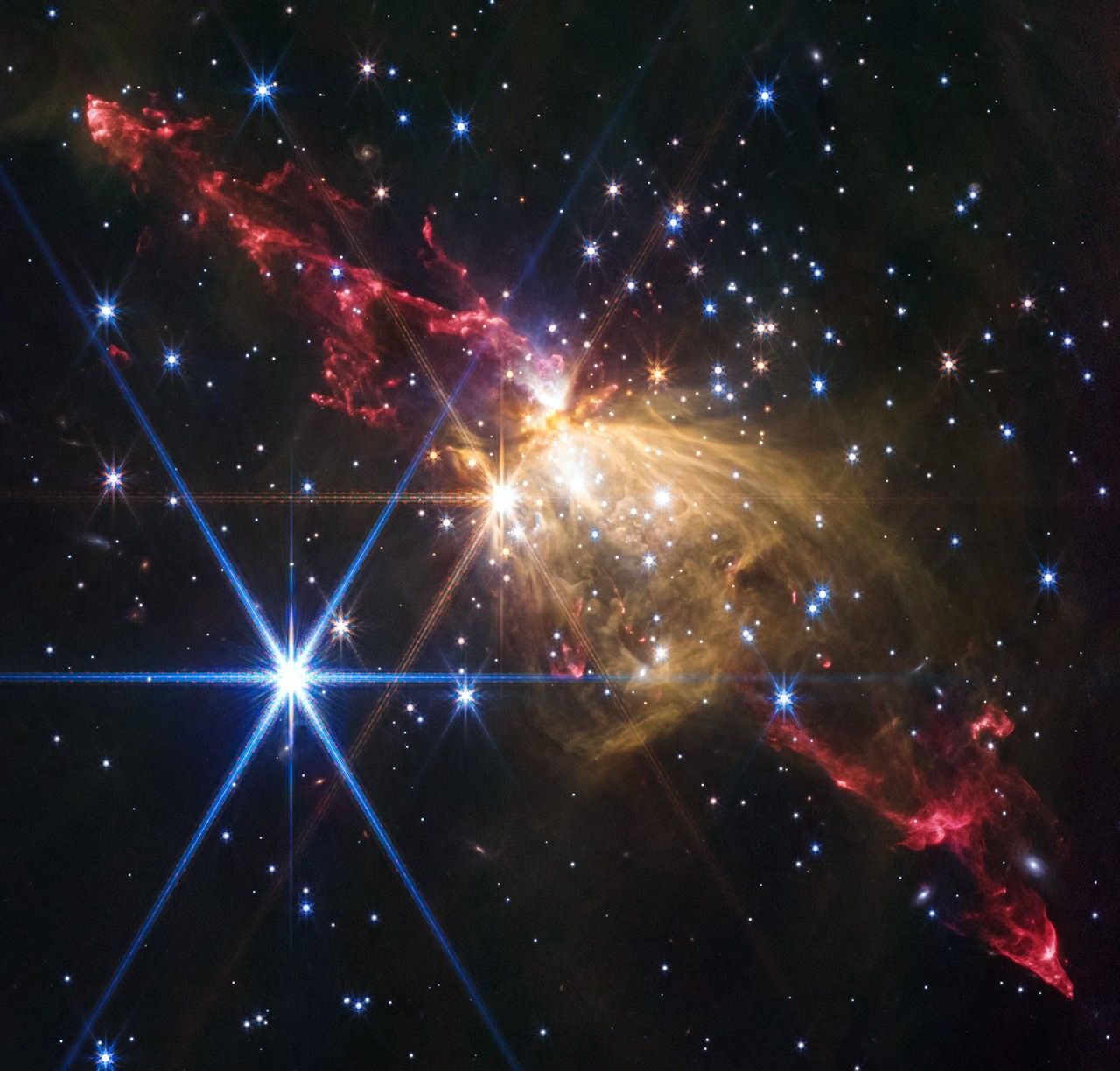
NASA’s James Webb Space Telescope (JWST) has imaged an exceptionally long protostellar jet stretching roughly 8 light-years across the Sharpless 2-284 (Sh2-284) star-forming region on the outer edge of the Milky Way. The observation provides new evidence that jet size scales with the mass of the forming star and strengthens the case for core accretion as a dominant pathway for building massive stars. The discovery, about 15,000 light-years away, is detailed in a study accepted by The Astrophysical Journal and highlighted in a NASA release.

What Webb Saw

Webb’s NIRCam infrared imaging reveals a highly collimated, twin-lobed outflow with intricate filaments, knots, and bow shocks, signatures of a jet plowing into surrounding gas and dust. The central protostar is estimated to be about 10 times the mass of the Sun and is still accreting material. The jet’s morphology encodes a long formation history, with the oldest structures extended farthest along the outflow axis and younger features trailing behind.

  • Jet length: ~8 light-years
  • Location: Sh2-284, ~15,000 light-years away
  • Driving source: ~10-solar-mass protostar (still growing)
  • Imaging instrument: JWST NIRCam
  • Environment: Low metallicity cluster on the Milky Way’s periphery

Why It Matters

Protostellar jets are powered by gravitational energy released as material accretes through a disk onto a young star. The scale and symmetry of the Sh2-284 outflow imply a relatively stable disk and magnetic launching geometry consistent with core accretion models of massive star formation. This stands in contrast to “competitive accretion” scenarios that predict more chaotic disk reorientation and corresponding jet twists. The clear, nearly antiparallel lobes in Webb’s image support mass growth through a persistent disk, with the jet acting as a regulated exhaust.

The result also indicates that jet properties scale with protostellar mass: more massive progenitors appear to drive larger, more energetic outflows. Establishing this relationship across mass regimes provides a unifying framework for jet physics from Sun-like stars to high-mass protostars.

A Frontier Laboratory for Low-Metallicity Star Formation

Sh2-284 lies nearly twice as far from the Galactic center as the Sun, in a region with fewer heavy elements. This low-metallicity environment serves as a local analog for earlier cosmic epochs, offering a window into how massive stars may have formed when the universe contained fewer metals. Within the host protocluster, hundreds of stars are still coalescing, making it a rich field for testing how metallicity influences disk stability, accretion rates, and jet feedback.

Multi-Observatory Context and Next Steps

Complementary data from the Atacama Large Millimeter/submillimeter Array (ALMA) identify an additional dense core in the region that may represent an earlier formation phase, suggesting that massive star growth is ongoing across the cluster. Future Webb spectroscopy and time-domain imaging could map jet velocities, excitation conditions, and magnetic field coupling, while longer-wavelength interferometry can probe disk structure, mass infall, and fragmentation.

Together, these observations build an increasingly coherent picture: in low-metallicity environments at the Milky Way’s outskirts, massive stars can assemble via stable, long-lived disks that launch powerful, well-aligned jets. Webb’s sensitivity and resolution in the infrared continue to reveal the mechanics of star birth across mass scales and galactic environments.

Source: NASA Science: “NASA’s Webb Observes Immense Stellar Jet on Outskirts of Our Milky Way”

Previous Post

ISS Opens Zvezda Port as Progress 93 and Cygnus XL Queue for Rapid-Fire Resupply

Next Post

ISS Experiment ZBOT-NC to Advance Zero-Boil-Off Cryogenic Propellant Storage on NG-23

Related Posts

Astronomy

LOFAR and XMM-Newton confirm coronal mass ejection from a red dwarf, threatening exoplanet atmospheres

November 12, 2025
Astronomy

PLATO Assembly Complete; Final Tests Ahead of 2026 Ariane 6 Launch

October 10, 2025
Astronomy

Protoplanet WISPIT 2b Imaged Inside Disk Gap, Marking a Planet-Formation First

October 1, 2025
Astronomy

Gaia maps a massive stellar ripple sweeping the Milky Way’s outer disk

September 30, 2025
Astronomy

Webb Spots Carbon-Rich Circumplanetary Disk Around CT Cha b, Illuminating Moon Formation

September 29, 2025
Astronomy

JWST maps carbon chemistry in circumplanetary disk around CT Cha b, a likely moon nursery

September 29, 2025
Next Post

ISS Experiment ZBOT-NC to Advance Zero-Boil-Off Cryogenic Propellant Storage on NG-23

Leave a Reply Cancel reply

Your email address will not be published. Required fields are marked *

  • Trending
  • Comments
  • Latest

NASA and SpaceX Conduct Crew-11 Dry Run Ahead of Launch

July 29, 2025

SpaceX Dragon Missions: Crew Prepares for Departure and Arrival at ISS

July 30, 2025

NASA Advances Supersonic Parachute Technology for Mars Missions

July 30, 2025

Upcoming Suborbital Rocket Launches from NASA Wallops: July 28-August 8, 2025

July 28, 2025

Dragonfly Mission Hits Major Test Milestones, Targets 2028 Falcon Heavy Launch

1

ESA Initiates Construction of LISA Mission to Detect Gravitational Waves

0

UK-France MicroCarb Satellite Launches to Enhance Global CO₂ Monitoring

0

NASA’s SpaceX Crew-11 Arrives at Kennedy Space Center for Upcoming Launch

0

ESCAPADE Reset to Nov. 13 After G4 Storm; Blue Origin VADR Launch Preserves Mars Trajectory

November 13, 2025

Brazil, INPE and ESA plan uptake of Biomass P-band radar data for Amazon carbon monitoring

November 13, 2025

LOFAR and XMM-Newton confirm coronal mass ejection from a red dwarf, threatening exoplanet atmospheres

November 12, 2025

DLR’s MAPHEUS-16 Sets Microgravity Payload Record with Twin Red Kite Motors

November 12, 2025

Popular Stories

  • NASA and SpaceX Conduct Crew-11 Dry Run Ahead of Launch

    0 shares
    Share 0 Tweet 0
  • SpaceX Dragon Missions: Crew Prepares for Departure and Arrival at ISS

    0 shares
    Share 0 Tweet 0
  • NASA Advances Supersonic Parachute Technology for Mars Missions

    0 shares
    Share 0 Tweet 0
  • Upcoming Suborbital Rocket Launches from NASA Wallops: July 28-August 8, 2025

    0 shares
    Share 0 Tweet 0
  • SpaceX Crew-11 Prepares for Launch: Final Steps Before Hatch Closure

    0 shares
    Share 0 Tweet 0
  • About
  • Advertise
  • Privacy & Policy
  • Contact
The Space Feed

© 2025 Stride Interactive Group

No Result
View All Result
  • Home
  • News
    • Launches
    • Space Technology
    • Human Spaceflight
    • Space Exploration
    • Astronomy
  • Launch Schedule
    • Upcoming Launches
    • Completed Launches

© 2025 Stride Interactive Group