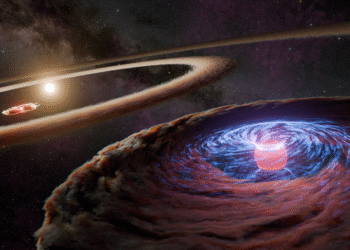
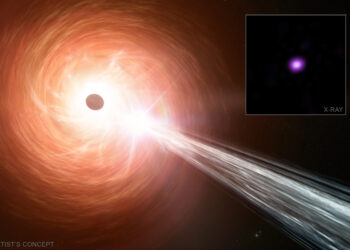
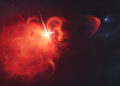
Astronomers using the Low Frequency Array (LOFAR) and ESA’s XMM-Newton have reported the first confirmed coronal mass ejection (CME) from another star, a milestone that strengthens the link between stellar activity and exoplanet habitability. The event was traced to a nearby red dwarf about 130 light-years away and appears energetic enough to strip atmospheres from closely orbiting planets. The finding, published in Nature, addresses decades of uncertainty over whether CMEs routinely escape the intense magnetic fields of other stars.
How the event was detected
As CMEs blast outward, they can generate shock waves that emit short, intense radio bursts. LOFAR captured such a signal, while XMM-Newton’s X-ray observations provided the stellar environment needed to interpret the radio data and track the ejection’s motion. Together, the instruments offered complementary coverage to distinguish a genuine mass ejection from confined stellar flares.
- Star type: active red dwarf, smaller and cooler than the Sun, with rapid rotation and an exceptionally strong magnetic field.
- Distance: approximately 130 light-years.
- Radio signature: a brief, low-frequency burst consistent with a CME-driven shock escaping the stellar magnetosphere.
- Derived speed: about 2400 km/s, comparable to the rarest and most energetic solar CMEs.
- Atmospheric impact: likely capable of removing atmospheres of closely orbiting planets.
Implications for exoplanet atmospheres
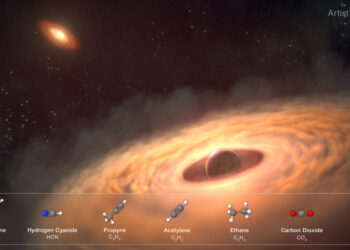
Red dwarfs host the majority of known exoplanets and often exhibit intense magnetic activity. Frequent, powerful CMEs can erode or completely strip planetary atmospheres, even for worlds located in the nominal “habitable zone.” This raises critical questions for the long-term stability of atmospheres around M-dwarf systems and the prevalence of surface liquid water. The new result provides direct observational evidence to model how often atmospheres survive in harsh stellar environments.
Context for space weather and future studies
The study extends the physics of space weather beyond the Sun by confirming that CME-driven shocks can escape other stars. It enables more realistic assessments of radiation environments, magnetospheric dynamics, and atmospheric loss for nearby exoplanets. The result complements ongoing ESA efforts to monitor solar and geospace conditions through missions such as SOHO, Proba, Swarm, and Solar Orbiter, while XMM-Newton continues to chart high-energy processes across the Universe.
Upcoming facilities, including ESA’s NewAthena X-ray mission, are expected to deepen multiwavelength coverage of stellar eruptions. Coordinated radio and X-ray campaigns will help map CME occurrence rates, speeds, and densities across different stellar types, refining targets in the search for potentially habitable worlds.
Key takeaway: Confirming a coronal mass ejection from a nearby star marks a pivotal step in understanding exoplanet atmospheric survival and the true habitability of planets around active red dwarfs.
Source: European Space Agency