The Space Feed | Latest Space News
  • Home
  • News
    • Launches
    • Space Technology
    • Human Spaceflight
    • Space Exploration
    • Astronomy
  • Launch Schedule
    • Upcoming Launches
    • Completed Launches
  • Knowledge Base
    • All Missions
    • All Rockets
No Result
View All Result
  • Home
  • News
    • Launches
    • Space Technology
    • Human Spaceflight
    • Space Exploration
    • Astronomy
  • Launch Schedule
    • Upcoming Launches
    • Completed Launches
  • Knowledge Base
    • All Missions
    • All Rockets
No Result
View All Result
The Space Feed | Latest Space News

NASA Taps Katalyst to Robotically Reboost Swift, Pioneering Uncrewed Servicing in LEO

September 25, 2025
in Space Technology

NASA has selected Katalyst Space Technologies of Flagstaff, Arizona, to perform a robotic orbit reboost of the Neil Gehrels Swift Observatory, marking a first-of-its-kind commercial servicing attempt on a government satellite that was not designed for in-space servicing. The demonstration aims to extend Swift’s operational life and prove a scalable approach to uncrewed servicing in low Earth orbit.

What NASA awarded

Under a $30 million Phase III award through NASA’s Small Business Innovation Research (SBIR) Program, managed by the Space Technology Mission Directorate, Katalyst will deliver a servicing spacecraft capable of autonomous rendezvous, capture, and orbit raising of Swift. The effort leverages commercially developed technologies to accelerate schedule and reduce cost compared to replacing capabilities with a new mission.

Why it matters

If successful, this would be the first commercial robotic vehicle to capture and reboost a U.S. government, uncrewed satellite not originally built for servicing. Demonstrating this capability could broaden life-extension options for satellites in LEO, support space sustainability practices, and mature on-orbit servicing architectures for future civil and commercial use.

Timing and drivers

Swift’s orbit has been decaying faster than expected due to elevated solar activity increasing atmospheric drag. The reboost is targeted for spring 2026, with NASA monitoring solar conditions and mission readiness that could affect the schedule.

Mission profile

  • Spacecraft: Katalyst robotic servicer with capture and propulsion systems.
  • Target: NASA’s Neil Gehrels Swift Observatory, launched in 2004.
  • Objective: Autonomous rendezvous, safe capture, and altitude raise to extend Swift’s science operations.
  • Demonstration scope: A rapid-response servicing mission executed on an accelerated timeline using commercial technologies.

About Swift

Swift is a multipurpose astrophysics platform that detects and localizes gamma-ray bursts and other high-energy transients, enabling rapid cross-mission follow-up. Over two decades, it has contributed to studies of supernovae, stellar flares, active galactic nuclei, comets, asteroids, and high-energy atmospheric events on Earth.

Program and partners

The SBIR award advances small-business innovation through America’s Seed Fund, transitioning technologies into operational use for national benefit. The Swift mission is managed by NASA’s Goddard Space Flight Center with partners including Penn State, Los Alamos National Laboratory, Northrop Grumman Space Systems, the UK Space Agency, the University of Leicester, Mullard Space Science Laboratory, Brera Observatory, and the Italian Space Agency.

What to watch

  1. Final servicing architecture and capture approach for a non-cooperative satellite.
  2. Autonomous navigation and safety readiness reviews.
  3. Solar cycle–driven drag forecasts affecting the reboost window.
  4. Potential follow-on applications for life extension of other LEO spacecraft.

Source: NASA news release
Previous Post

Arkisys Wins NASA Deal to Sustain Astrobee Free-Flyers on ISS

Next Post

NASA Taps Steven Sinacore to Head Fission Surface Power, Eyes 100 kW Lunar System by 2030

Related Posts

Space Technology

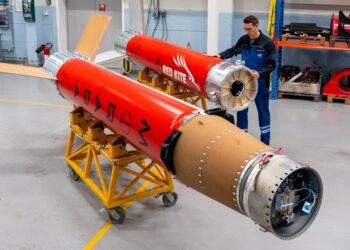
DLR’s MAPHEUS-16 Sets Microgravity Payload Record with Twin Red Kite Motors

November 12, 2025
Space Technology

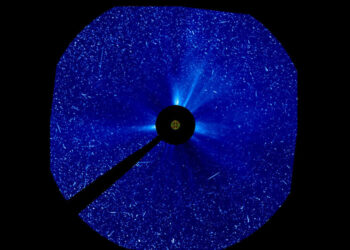
ESA flags X5.1 flare and fast CMEs driving severe G4 storm with satellite and GNSS risk

November 12, 2025
Space Technology

Sentinel-1D Lifts Off on Ariane 62; DLR to Calibrate SAR for Copernicus Continuity

November 5, 2025
Space Technology

ESA’s AI quake-mapping models move toward operational use under CNES-led Charter

October 29, 2025
Space Technology

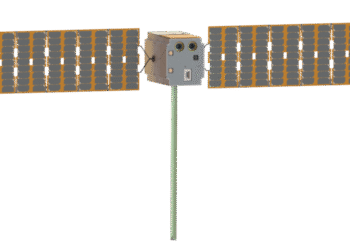
ESA’s Henon CubeSat clears CDR to demo deep-space comms, ion propulsion, and solar-storm early warning

October 29, 2025
Space Technology

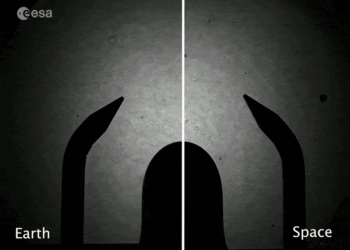
ISS study maps fin-film condensation to advance spacecraft cooling systems

October 23, 2025
Next Post

NASA Taps Steven Sinacore to Head Fission Surface Power, Eyes 100 kW Lunar System by 2030

Leave a Reply Cancel reply

Your email address will not be published. Required fields are marked *

  • Trending
  • Comments
  • Latest

NASA and SpaceX Conduct Crew-11 Dry Run Ahead of Launch

July 29, 2025

SpaceX Dragon Missions: Crew Prepares for Departure and Arrival at ISS

July 30, 2025

NASA Advances Supersonic Parachute Technology for Mars Missions

July 30, 2025

Upcoming Suborbital Rocket Launches from NASA Wallops: July 28-August 8, 2025

July 28, 2025

Dragonfly Mission Hits Major Test Milestones, Targets 2028 Falcon Heavy Launch

1

ESA Initiates Construction of LISA Mission to Detect Gravitational Waves

0

UK-France MicroCarb Satellite Launches to Enhance Global CO₂ Monitoring

0

NASA’s SpaceX Crew-11 Arrives at Kennedy Space Center for Upcoming Launch

0

ESCAPADE Reset to Nov. 13 After G4 Storm; Blue Origin VADR Launch Preserves Mars Trajectory

November 13, 2025

Brazil, INPE and ESA plan uptake of Biomass P-band radar data for Amazon carbon monitoring

November 13, 2025

LOFAR and XMM-Newton confirm coronal mass ejection from a red dwarf, threatening exoplanet atmospheres

November 12, 2025

DLR’s MAPHEUS-16 Sets Microgravity Payload Record with Twin Red Kite Motors

November 12, 2025

Popular Stories

  • NASA and SpaceX Conduct Crew-11 Dry Run Ahead of Launch

    0 shares
    Share 0 Tweet 0
  • SpaceX Dragon Missions: Crew Prepares for Departure and Arrival at ISS

    0 shares
    Share 0 Tweet 0
  • NASA Advances Supersonic Parachute Technology for Mars Missions

    0 shares
    Share 0 Tweet 0
  • Upcoming Suborbital Rocket Launches from NASA Wallops: July 28-August 8, 2025

    0 shares
    Share 0 Tweet 0
  • SpaceX Crew-11 Prepares for Launch: Final Steps Before Hatch Closure

    0 shares
    Share 0 Tweet 0
  • About
  • Advertise
  • Privacy & Policy
  • Contact
The Space Feed

© 2025 Stride Interactive Group

No Result
View All Result
  • Home
  • News
    • Launches
    • Space Technology
    • Human Spaceflight
    • Space Exploration
    • Astronomy
  • Launch Schedule
    • Upcoming Launches
    • Completed Launches

© 2025 Stride Interactive Group