The Space Feed | Latest Space News
  • Home
  • News
    • Launches
    • Space Technology
    • Human Spaceflight
    • Space Exploration
    • Astronomy
  • Launch Schedule
    • Upcoming Launches
    • Completed Launches
  • Knowledge Base
    • All Missions
    • All Rockets
No Result
View All Result
  • Home
  • News
    • Launches
    • Space Technology
    • Human Spaceflight
    • Space Exploration
    • Astronomy
  • Launch Schedule
    • Upcoming Launches
    • Completed Launches
  • Knowledge Base
    • All Missions
    • All Rockets
No Result
View All Result
The Space Feed | Latest Space News

NISAR Debuts Dual-Band Radar Earth Maps Ahead of Full Science Operations

September 26, 2025
in Space Technology

NASA and the Indian Space Research Organisation (ISRO) have released the first radar maps from the joint NISAR mission, previewing how the satellite’s dual-band synthetic aperture radar will track changes on Earth’s land and ice surfaces ahead of the start of full science operations later this year.

Early radar maps highlight land-cover detail

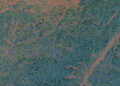
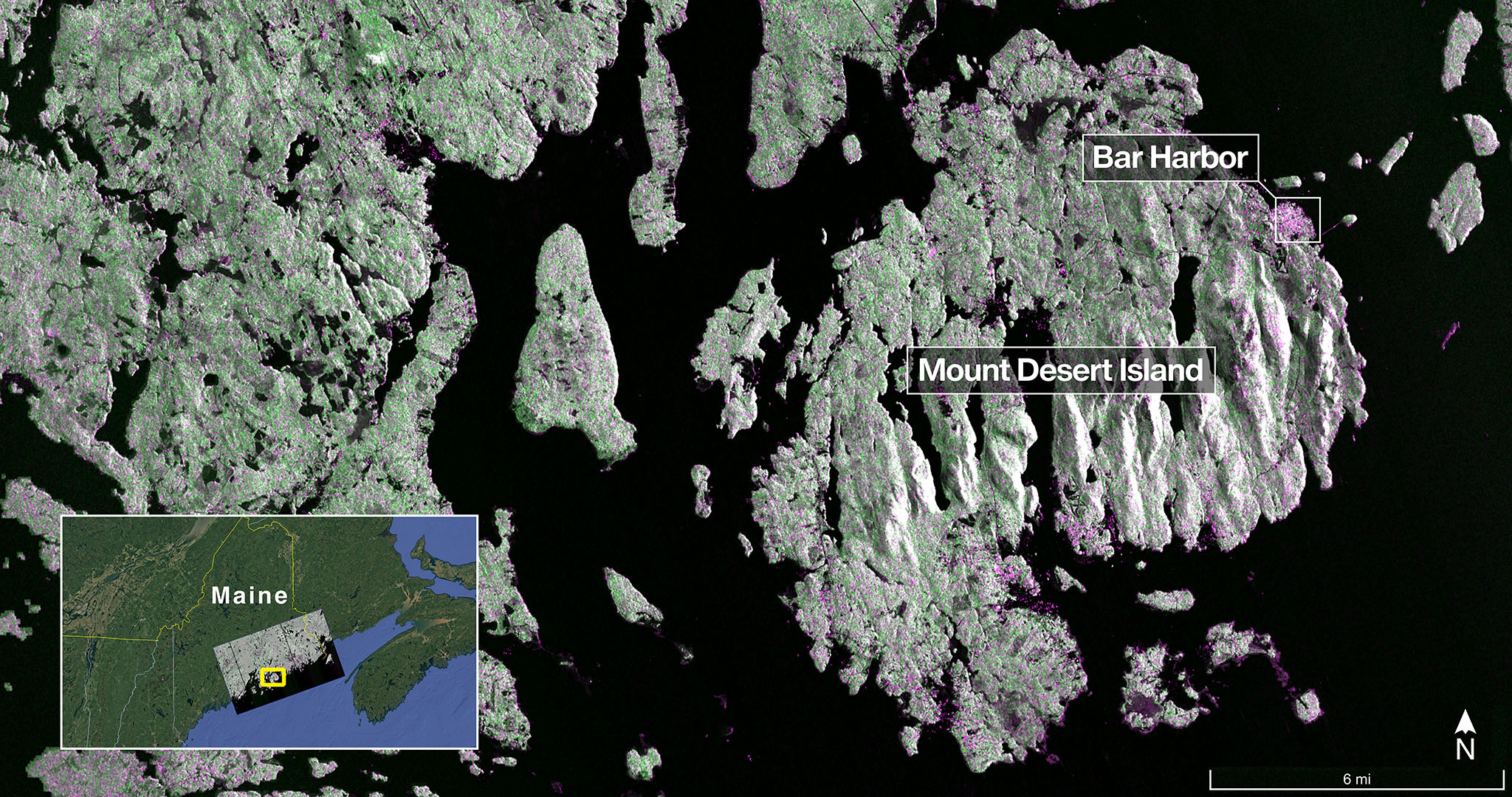
Using its NASA-provided L-band system, NISAR imaged Mount Desert Island, Maine, on Aug. 21, resolving features as small as about 5 meters. Dark tones reveal water, green highlights forested areas, and magenta corresponds to hard or regular surfaces such as bare ground and buildings, capturing narrow waterways and islets surrounding the island. On Aug. 23, an additional L-band observation covered parts of Grand Forks and Walsh counties in North Dakota, depicting wetlands and forests along the Forest River and surrounding agricultural plots. Dark fields appear fallow, while lighter areas indicate pasture or active crops, with circular patterns marking center-pivot irrigation.

Dual-band payload and global coverage

NISAR is the first spacecraft to fly both L-band (25-centimeter wavelength) and S-band (10-centimeter wavelength) radar. L-band signals penetrate vegetation and can measure soil moisture and subtle ground and ice motion down to fractions of an inch, supporting studies of earthquakes, volcanoes, landslides, and glacier dynamics. S-band is more sensitive to smaller vegetation, aiding monitoring of certain crops and grasslands. The mission operates from a 747-kilometer (464-mile) orbit, using a 12-meter drum-shaped reflector antenna, and is designed to observe Earth’s land and ice surfaces twice every 12 days.

What the data will enable

  • Disaster response: Rapid mapping of surface deformation before and after earthquakes, volcanic activity, and landslides.
  • Infrastructure monitoring: Detection of gradual ground subsidence and surface stability around critical assets.
  • Agriculture and water: Tracking crop conditions, irrigation patterns, and soil moisture.
  • Ecosystems: Assessing gains and losses in forests and wetlands, and characterizing biomass and land cover.
  • Cryosphere: Measuring ice-sheet flow and seasonal freeze/thaw transitions.

Mission status and partnership

The spacecraft launched on July 30 and reached its operational orbit in mid-September. The science phase is expected to begin in November following ongoing instrument checkout and calibration. The NISAR mission reflects a long-running U.S.-India partnership: ISRO’s Space Applications Centre supplied the S-band SAR; the U R Rao Satellite Centre built the spacecraft bus; Vikram Sarabhai Space Centre provided the launch vehicle with launch services from Satish Dhawan Space Centre; and the ISRO Telemetry, Tracking and Command Network supports operations through its global ground stations. On the U.S. side, NASA’s Jet Propulsion Laboratory (managed by Caltech) leads the contribution, providing the L-band SAR, the antenna reflector and boom, the high-rate science data downlink system, a solid-state recorder, and the payload data subsystem. NASA’s Goddard Space Flight Center manages the Near Space Network, which receives NISAR’s L-band data.

These initial observations demonstrate how NISAR’s combined radar frequencies will generate consistent, high-resolution measurements to inform research and decision-making across hazards, resources, and climate-related applications.

Source: NASA news release
Previous Post

NASA Taps Steven Sinacore to Head Fission Surface Power, Eyes 100 kW Lunar System by 2030

Next Post

Falcon 9 Deploys IMAP, Geocorona Observatory, and NOAA SWFO-L1 for Solar Wind Science

Related Posts

Space Technology

DLR’s MAPHEUS-16 Sets Microgravity Payload Record with Twin Red Kite Motors

November 12, 2025
Space Technology

ESA flags X5.1 flare and fast CMEs driving severe G4 storm with satellite and GNSS risk

November 12, 2025
Space Technology

Sentinel-1D Lifts Off on Ariane 62; DLR to Calibrate SAR for Copernicus Continuity

November 5, 2025
Space Technology

ESA’s AI quake-mapping models move toward operational use under CNES-led Charter

October 29, 2025
Space Technology

ESA’s Henon CubeSat clears CDR to demo deep-space comms, ion propulsion, and solar-storm early warning

October 29, 2025
Space Technology

ISS study maps fin-film condensation to advance spacecraft cooling systems

October 23, 2025
Next Post

Falcon 9 Deploys IMAP, Geocorona Observatory, and NOAA SWFO-L1 for Solar Wind Science

Leave a Reply Cancel reply

Your email address will not be published. Required fields are marked *

  • Trending
  • Comments
  • Latest

NASA and SpaceX Conduct Crew-11 Dry Run Ahead of Launch

July 29, 2025

SpaceX Dragon Missions: Crew Prepares for Departure and Arrival at ISS

July 30, 2025

NASA Advances Supersonic Parachute Technology for Mars Missions

July 30, 2025

Upcoming Suborbital Rocket Launches from NASA Wallops: July 28-August 8, 2025

July 28, 2025

Dragonfly Mission Hits Major Test Milestones, Targets 2028 Falcon Heavy Launch

1

ESA Initiates Construction of LISA Mission to Detect Gravitational Waves

0

UK-France MicroCarb Satellite Launches to Enhance Global CO₂ Monitoring

0

NASA’s SpaceX Crew-11 Arrives at Kennedy Space Center for Upcoming Launch

0

ESCAPADE Reset to Nov. 13 After G4 Storm; Blue Origin VADR Launch Preserves Mars Trajectory

November 13, 2025

Brazil, INPE and ESA plan uptake of Biomass P-band radar data for Amazon carbon monitoring

November 13, 2025

LOFAR and XMM-Newton confirm coronal mass ejection from a red dwarf, threatening exoplanet atmospheres

November 12, 2025

DLR’s MAPHEUS-16 Sets Microgravity Payload Record with Twin Red Kite Motors

November 12, 2025

Popular Stories

  • NASA and SpaceX Conduct Crew-11 Dry Run Ahead of Launch

    0 shares
    Share 0 Tweet 0
  • SpaceX Dragon Missions: Crew Prepares for Departure and Arrival at ISS

    0 shares
    Share 0 Tweet 0
  • NASA Advances Supersonic Parachute Technology for Mars Missions

    0 shares
    Share 0 Tweet 0
  • Upcoming Suborbital Rocket Launches from NASA Wallops: July 28-August 8, 2025

    0 shares
    Share 0 Tweet 0
  • SpaceX Crew-11 Prepares for Launch: Final Steps Before Hatch Closure

    0 shares
    Share 0 Tweet 0
  • About
  • Advertise
  • Privacy & Policy
  • Contact
The Space Feed

© 2025 Stride Interactive Group

No Result
View All Result
  • Home
  • News
    • Launches
    • Space Technology
    • Human Spaceflight
    • Space Exploration
    • Astronomy
  • Launch Schedule
    • Upcoming Launches
    • Completed Launches

© 2025 Stride Interactive Group