The Space Feed | Latest Space News
  • Home
  • News
    • Launches
    • Space Technology
    • Human Spaceflight
    • Space Exploration
    • Astronomy
  • Launch Schedule
    • Upcoming Launches
    • Completed Launches
  • Knowledge Base
    • All Missions
    • All Rockets
No Result
View All Result
  • Home
  • News
    • Launches
    • Space Technology
    • Human Spaceflight
    • Space Exploration
    • Astronomy
  • Launch Schedule
    • Upcoming Launches
    • Completed Launches
  • Knowledge Base
    • All Missions
    • All Rockets
No Result
View All Result
The Space Feed | Latest Space News

Perseverance Core Reveals Possible Martian Biosignature in Jezero’s ‘Bright Angel’ Formation

September 10, 2025
in Space Exploration

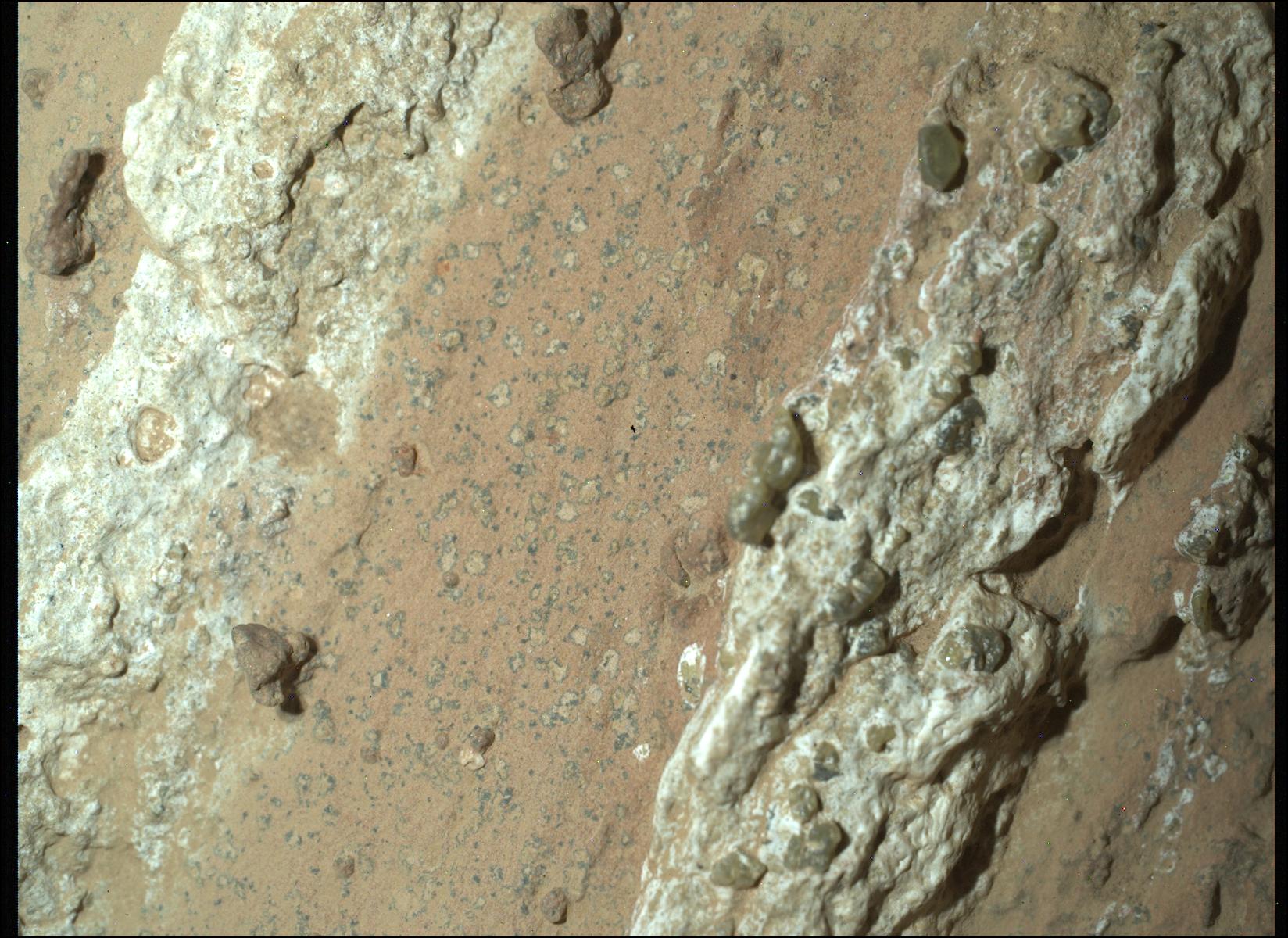
NASA’s Perseverance rover has identified a potential biosignature within Jezero Crater’s ‘Bright Angel’ formation, based on analyses of the rock core nicknamed ‘Sapphire Canyon’ extracted from an outcrop called ‘Cheyava Falls’ in 2024. The peer-reviewed finding, published in Nature, outlines geochemical and mineralogical patterns that on Earth can be linked to past microbial activity, while emphasizing that non-biological processes remain possible explanations.

What the rover measured

Perseverance examined the ‘Bright Angel’ outcrops along the northern and southern margins of Neretva Vallis, an ancient, roughly 400-meter-wide river channel that once fed Jezero Crater. The site’s sedimentary rocks are composed of clay and silt and show enrichments associated with habitability.

  • Fine-grained (clay- and silt-rich) sedimentary rocks that are favorable for preserving micro-scale textures and organics.
  • Elevated organic carbon, sulfur, oxidized iron, and phosphorus within the unit.
  • Millimeter-scale ‘leopard spot’ reaction fronts containing vivianite (hydrated iron phosphate) and greigite (iron sulfide), mapped at high resolution.
  • Local geologic context that does not indicate sustained high temperatures or strongly acidic alteration, conditions that could create similar minerals abiotically.

These observations were captured primarily by the rover’s PIXL (X-ray lithochemistry) and SHERLOC (Raman and luminescence) instruments, which can resolve mineral chemistry and detect organics at fine scales.

Why it matters

On Earth, the co-occurrence of vivianite and greigite in sedimentary settings can reflect electron-transfer reactions that certain microbial metabolisms exploit. The Jezero signals therefore represent a plausible indirect fingerprint of past biological processes. However, abiotic pathways can also produce these minerals. The study’s interpretation weighs those alternatives against the measured geologic context, concluding that the signals are consistent with, but do not prove, past microbial activity.

Geologic and mission context

The potential biosignature appears in some of the youngest sedimentary rocks examined by Perseverance. This extends the time window during which surface water and habitable conditions may have persisted in Jezero. The rover has collected 27 rock cores since landing in February 2021, adding to a stratigraphically diverse archive for future analysis. Beyond its geology payload, Perseverance also operates a weather station and carries materials-exposure samples to inform future human missions.

Data integrity and assessment frameworks

The result advances along established life-detection frameworks, including NASA’s Confidence of Life Detection (CoLD) scale, which emphasizes multiple, independent lines of evidence, rigorous hypothesis testing, and reproducibility.

What to watch next

  1. Additional measurements across ‘Bright Angel’ exposures to test spatial consistency of the signals.
  2. Comparisons with other Jezero cores to assess whether similar mineral-organic patterns recur in different settings.
  3. Further application of the CoLD framework to evaluate the coherence and robustness of the evidence.
  4. Higher-fidelity laboratory analyses if and when samples become available for study on Earth.

These steps will help distinguish between biological and abiotic origins for the observed mineral and organic signatures at Jezero.

Source: NASA press release

Previous Post

ISS Experiment ZBOT-NC to Advance Zero-Boil-Off Cryogenic Propellant Storage on NG-23

Next Post

ISS Advances Space Health Research as Progress 93 and Cygnus Line Up Back-to-Back Deliveries

Related Posts

Space Exploration

ESA’s RAMSES Aims to Shadow Apophis During 2029 Earth Flyby

October 13, 2025
Space Exploration

ESA Maps 1,039 Martian Dust Devils, Uncovering Faster Winds for Mission Planning

October 8, 2025
Space Exploration

ESA’s Hera completes year one: Mars flyby achieved, autonomous navigation proven, Didymos arrival in 2026

October 7, 2025
Space Exploration

Fresh Enceladus Plume Chemistry Uncovered, Energizing ESA Orbiter-Lander Plans

October 1, 2025
Space Exploration

Carruthers Geocorona Observatory Deploys, Begins L1 Cruise to Probe Earth’s Exosphere

September 25, 2025
Space Exploration

NASA’s IMAP Checks In, Begins Cruise to L1 for Space Weather Science

September 25, 2025
Next Post

ISS Advances Space Health Research as Progress 93 and Cygnus Line Up Back-to-Back Deliveries

Leave a Reply Cancel reply

Your email address will not be published. Required fields are marked *

  • Trending
  • Comments
  • Latest

NASA and SpaceX Conduct Crew-11 Dry Run Ahead of Launch

July 29, 2025

SpaceX Dragon Missions: Crew Prepares for Departure and Arrival at ISS

July 30, 2025

NASA Advances Supersonic Parachute Technology for Mars Missions

July 30, 2025

Upcoming Suborbital Rocket Launches from NASA Wallops: July 28-August 8, 2025

July 28, 2025

Dragonfly Mission Hits Major Test Milestones, Targets 2028 Falcon Heavy Launch

1

ESA Initiates Construction of LISA Mission to Detect Gravitational Waves

0

UK-France MicroCarb Satellite Launches to Enhance Global CO₂ Monitoring

0

NASA’s SpaceX Crew-11 Arrives at Kennedy Space Center for Upcoming Launch

0

ESCAPADE Reset to Nov. 13 After G4 Storm; Blue Origin VADR Launch Preserves Mars Trajectory

November 13, 2025

Brazil, INPE and ESA plan uptake of Biomass P-band radar data for Amazon carbon monitoring

November 13, 2025

LOFAR and XMM-Newton confirm coronal mass ejection from a red dwarf, threatening exoplanet atmospheres

November 12, 2025

DLR’s MAPHEUS-16 Sets Microgravity Payload Record with Twin Red Kite Motors

November 12, 2025

Popular Stories

  • NASA and SpaceX Conduct Crew-11 Dry Run Ahead of Launch

    0 shares
    Share 0 Tweet 0
  • SpaceX Dragon Missions: Crew Prepares for Departure and Arrival at ISS

    0 shares
    Share 0 Tweet 0
  • NASA Advances Supersonic Parachute Technology for Mars Missions

    0 shares
    Share 0 Tweet 0
  • Upcoming Suborbital Rocket Launches from NASA Wallops: July 28-August 8, 2025

    0 shares
    Share 0 Tweet 0
  • SpaceX Crew-11 Prepares for Launch: Final Steps Before Hatch Closure

    0 shares
    Share 0 Tweet 0
  • About
  • Advertise
  • Privacy & Policy
  • Contact
The Space Feed

© 2025 Stride Interactive Group

No Result
View All Result
  • Home
  • News
    • Launches
    • Space Technology
    • Human Spaceflight
    • Space Exploration
    • Astronomy
  • Launch Schedule
    • Upcoming Launches
    • Completed Launches

© 2025 Stride Interactive Group