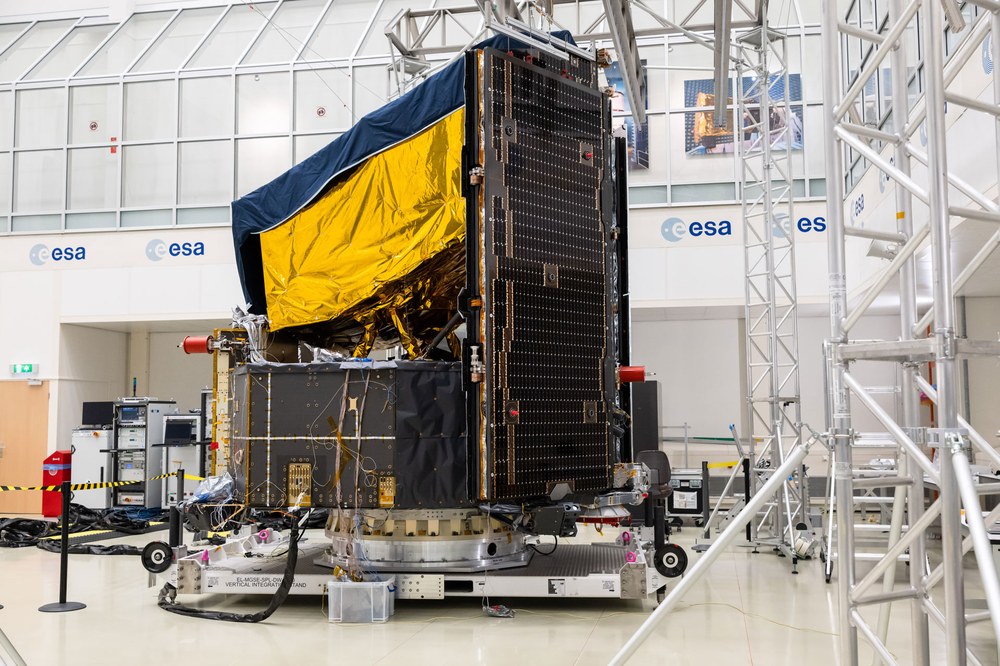
ESA’s PLATO exoplanet observatory has completed spacecraft assembly at the agency’s ESTEC centre in the Netherlands, marking a major milestone ahead of a planned Ariane 6 launch at the end of 2026. Engineers have installed and successfully test‑deployed the combined sunshield and solar array system, verified power generation under simulated sunlight, and prepared the satellite for its final environmental test campaign. Once in operation at the Sun–Earth L2 point, PLATO will target Earth-sized planets around Sun-like stars, with routine science expected to begin in 2027.
What’s new
The spacecraft now integrates its payload module—featuring 26 optical cameras on a common bench—with the service module, sunshield and solar arrays. Recent cleanroom tests confirmed the separate deployment of the left and right solar wings and validated electrical performance.
Final test campaign
In the coming months, PLATO will undergo vibration and acoustic tests to simulate launch loads. It will then enter ESA’s Large Space Simulator for thermal-vacuum trials, demonstrating performance in the space environment. Following qualification, the spacecraft will ship to Europe’s spaceport in Kourou, French Guiana, for launch preparation.
- Vibration and acoustic testing to qualify for rocket ascent
- Thermal-vacuum testing in the Large Space Simulator
- Shipment to Kourou for Ariane 6 launch at end-2026
- Cruise and commissioning at L2; science ramp-up in 2027
How PLATO will find new worlds
PLATO (PLAnetary Transits and Oscillations of stars) is designed to detect exoplanets via the transit method, measuring minute, periodic dips in starlight as planets pass in front of their host stars. Its array of 26 identical telescopes will monitor about 250,000 stars, enabling high-precision light curves over long timescales.
The instrument suite includes 24 “normal” cameras operating at 25-second cadence for science acquisition and two “fast” cameras with 2.5-second cadence that also support fine pointing. The fast cameras employ red/blue filters to compare transit depths at different wavelengths, a capability that can hint at the presence of planetary atmospheres. PLATO will not image exoplanets directly; instead, it will provide candidate detections for detailed ground-based follow-up.
Industrial and scientific roles
Germany coordinates key aspects of PLATO’s payload and science. The German Aerospace Center (DLR) leads the international payload consortium and contributes to instrument electronics and onboard processing. The Max Planck Institute for Solar System Research oversees the mission’s scientific data centre. The industrial core team is led by OHB, with Thales Alenia Space and Beyond Gravity as major partners. Payload development and testing are distributed across consortium member states.
Mission context
From its stable L2 orbit 1.5 million kilometres from Earth, PLATO will conduct uninterrupted, long-duration observations with minimal thermal variation and continuous communications. Building on missions such as CoRoT and Kepler, PLATO is expected to uncover thousands of rocky, icy and gaseous worlds, including targets in the habitable zones of nearby Sun-like stars. These discoveries will refine models of planetary system formation and evolution and provide prime candidates for atmospheric characterization by ground and space observatories.
Source: DLR – ESA’s PLATO space telescope completed and ready for final tests