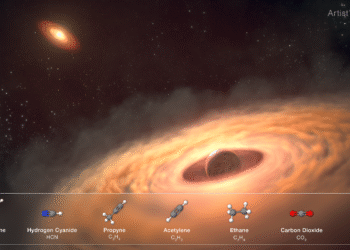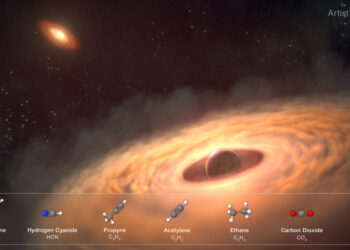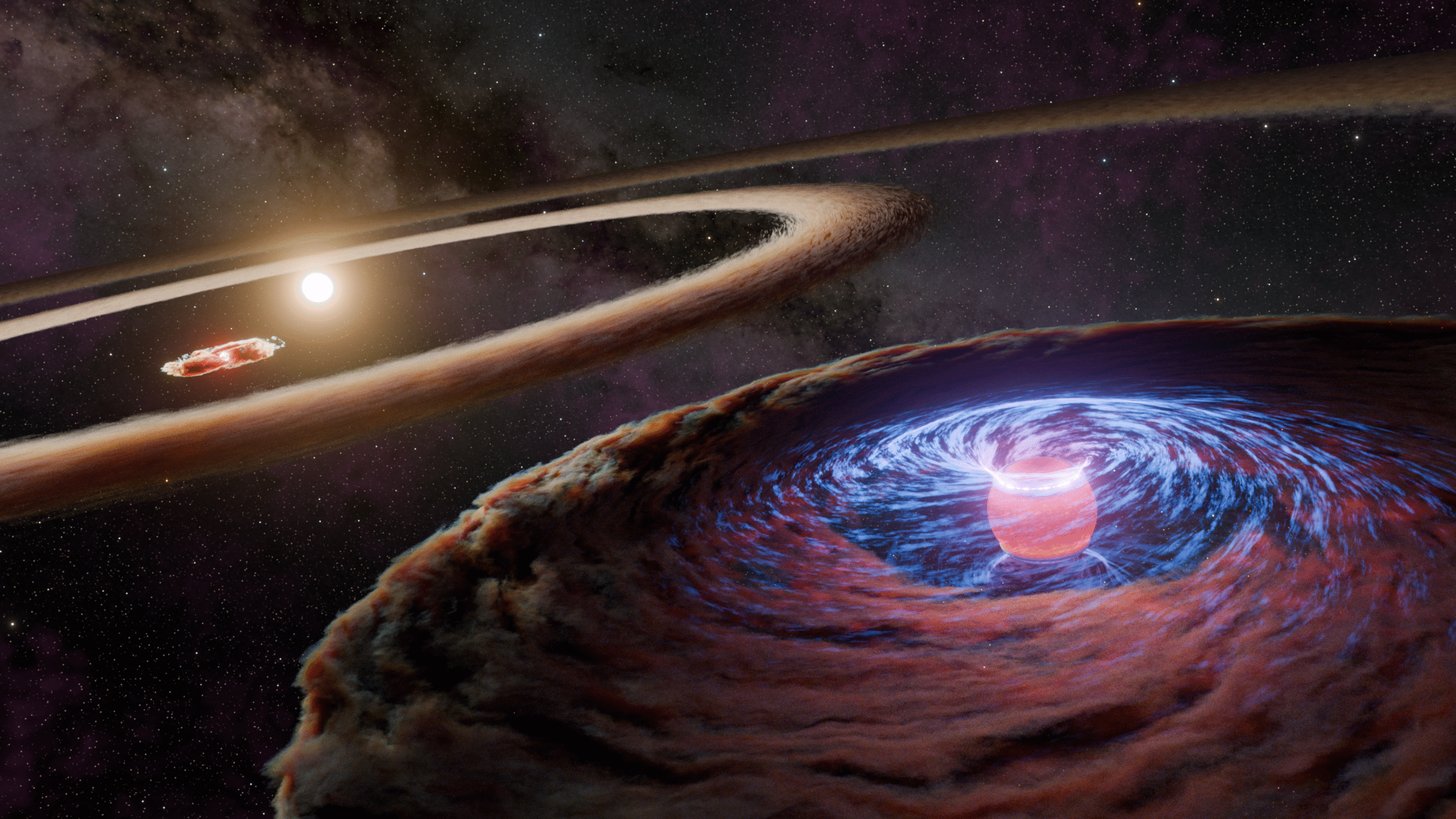
Astronomers have directly imaged a young gas giant, WISPIT 2b, embedded inside a dust ring gap around its star, delivering the first clear observation of a protoplanet sitting within a cleared region of a protoplanetary disk. The detection provides direct evidence that forming planets can sculpt the gaps and rings widely seen in disks around young stars.
Discovery at a glance
- Object: Protoplanet WISPIT 2b orbiting the young star WISPIT 2
- Distance: ~437 light-years
- Estimated mass: ~5 times Jupiter
- Age: ~5 million years
- Milestone: First direct detection of a planet located within a ring-shaped gap of a protoplanetary disk
The result, reported in research published in August 2025 in Astrophysical Journal Letters, advances long-standing theories that massive young planets clear dust and gas along their orbits, producing the ring-and-gap architectures frequently observed in disks. A second candidate object was also identified closer to the star in another gap, warranting follow-up.
How the team saw it
The ringed disk around WISPIT 2 was initially identified with VLT/SPHERE in Chile. Subsequent high-contrast imaging at the Magellan Clay Telescope using the University of Arizona’s MagAO-X extreme adaptive optics system captured a point source co-located with one of the dark gaps. Critically, MagAO-X detected the object in H-alpha light—a hallmark of active accretion as hydrogen gas falls onto a forming planet—indicating WISPIT 2b is still gathering material.
To characterize the system further, the team also observed in infrared wavelengths with the LMIRcam detector as part of the Large Binocular Telescope Interferometer. The multi-instrument approach strengthened the case that the signal is a bona fide protoplanet and not a disk feature or noise artifact.
Why it matters
- Direct link between gaps and planets: The detection anchors the hypothesis that giant planets carve the annular structures seen in many disks.
- Formation where found: Evidence indicates WISPIT 2b likely formed in situ, helping constrain how and where giant planets assemble.
- Accretion in real time: H-alpha emission provides a direct tracer of ongoing gas accretion, offering a window into mass-growth rates and timescales.
- Model calibration: Measured brightness and location within the gap will help refine disk-planet interaction models and predictions of gap widths, pressure bumps, and migration behavior.
What’s next
- Confirm the second candidate: Targeted follow-up in H-alpha and infrared bands can validate the inner-gap object and test whether multiple protoplanets are shaping the disk.
- Track orbital motion: Multi-epoch imaging will constrain WISPIT 2b’s orbit and its dynamical influence on the surrounding disk.
- Measure accretion variability: Repeated H-alpha monitoring can reveal changes in accretion rate and help pin down the planet’s growth trajectory.
- Broaden the sample: Applying the same techniques to other ringed disks can determine how common gap-carving planets are during the first few million years of system evolution.
The WISPIT 2b discovery underscores the rapid progress in extreme adaptive optics and high-contrast imaging, which are transforming direct exoplanet detection from the realm of mature, wide-separation giants to actively forming worlds. These capabilities, combined with complementary infrared observations, are enabling a more complete picture of how massive planets emerge and reshape their birth environments.
For additional context and imagery, see the NASA Discovery Alert: WISPIT 2b imaged within a disk gap.